
Sihasak says Russia ready to sell oil to Thailand as government seeks more sources


Thailand says it has fuel reserves for 95-100 days as it works to secure additional supplies from abroad, with Russia among the countries indicating it is prepared to sell oil to Thailand.
- Thailand's Foreign Minister, Sihasak Phuangketkeow, confirmed that Russia is ready to sell oil to Thailand.
- The Thai government is actively seeking new energy sources due to uncertainty caused by ongoing fighting, despite having 95-100 days of oil reserves.
- In addition to Russia, Thailand has also contacted other potential oil suppliers, including Brazil, Nigeria, and Kazakhstan.
- Further detailed discussions by agencies like the Ministry of Energy are required before any deals are finalized.
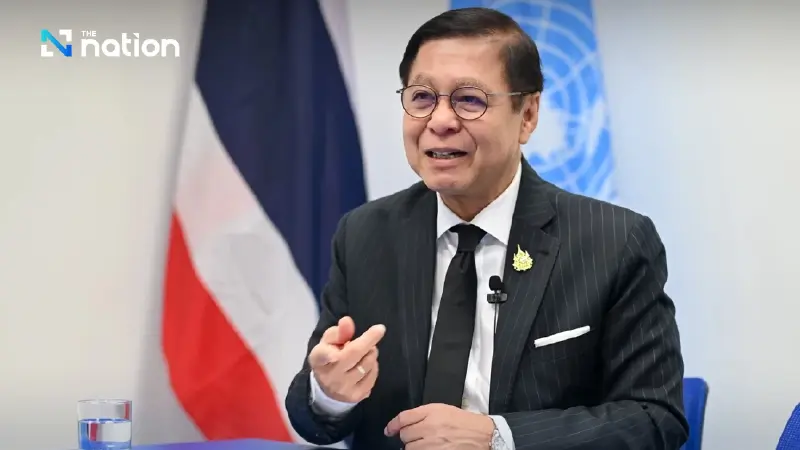
Sihasak Phuangketkeow, Minister of Foreign Affairs, who was travelling to Vienna, Austria, to attend the Global Fraud Summit at the Vienna International Centre on March 16-17, 2026, gave an interview on efforts to coordinate with various countries to find new energy or fuel sources.
He said the government had oil reserves for 95-100 days, but the fighting remained highly uncertain.
The Prime Minister, therefore, believed that if Thailand could source oil from elsewhere, contacts should be made to identify where supplies could be secured from countries willing to sell oil to Thailand.
Thailand had already contacted Russia, which was ready to sell oil to Thailand.
In addition, the United States had relaxed sanctions, allowing vessels departing ports to sell to other countries.
Thailand had also reached out to Brazil, Nigeria and Kazakhstan, among others.
Ultimately, the relevant agencies, including the Ministry of Energy, would need to hold further detailed discussions.
On progress in efforts to assist the three remaining Thai crew members still stranded on the “Mayuree Naree”, Sihasak stressed that he had spoken by telephone with Iran’s foreign minister to coordinate assistance.
Iran’s foreign minister expressed condolences over the Mayuree Naree incident, but said it was not a situation in which shipping should be taking place.
He also promised to assist in the search for the three Thai crew members by coordinating with the Iranian navy.
However, this would depend on the situation, as the fighting was continuing.
Thailand had also coordinated with Oman, asking it to liaise with the Iranian navy as well, and had instructed the Royal Thai Navy to contact the Iranian navy directly.
Regarding talks with two members of the Gulf Cooperation Council (GCC), Sihasak said he had spoken by telephone with Bahrain and the United Arab Emirates to express concern over the situation, as both countries had been affected by the war.
He said this was also to make clear Thailand’s position that it wanted to see peace restored and did not agree with the use of violence, and that war should not happen.
Diplomatic efforts and negotiations should be pursued instead.
Now that the situation had escalated, he said all parties should help to reduce the intensity of the fighting and retaliation.
At the same time, Thailand reaffirmed its support for peace, sovereignty and the territorial integrity of all countries in the region, especially those not involved in the war but still affected, including the UAE, Bahrain, Qatar, Kuwait and Lebanon.
He said those countries had thanked Thailand for taking this position, while Thailand had thanked them for facilitating the return of Thai nationals through the UAE via Dubai and Abu Dhabi.
Thai nationals in Kuwait, Bahrain and Qatar had mostly needed to travel to Saudi Arabia.
At the same time, there were safety concerns, although many countries were able to provide protection.
If more Thai nationals wished to return, Thailand would seek ways to bring them back.
