
War and oil prices test Motor Show buying power, EV boost limited
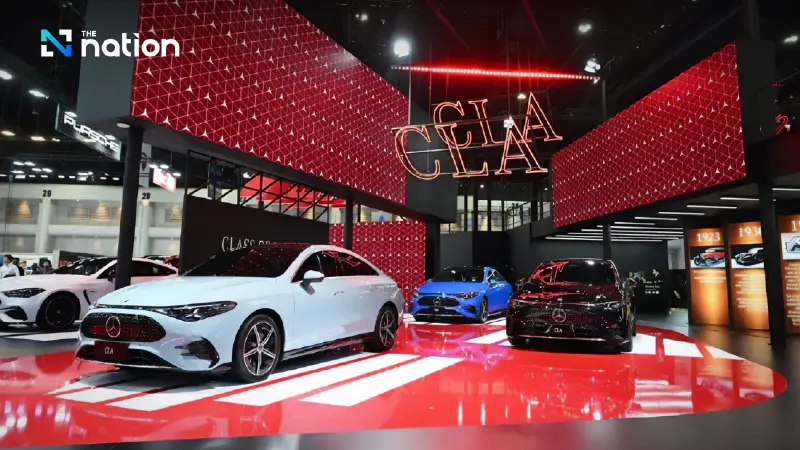


Executives say higher fuel costs may draw some interest to EVs, but any prolonged conflict would weigh more heavily on the economy and overall car sales.
- The Bangkok Motor Show's ability to generate sales is being tested by economic pressures, particularly an ongoing war and rising oil prices, which are negatively impacting consumer buying power.
- Despite numerous new electric vehicle (EV) launches from various brands, the resulting sales boost is expected to be limited, with executives noting that a prolonged conflict could also raise electricity costs.
- Due to the global situation, initial positive forecasts for the car market have been revised, with sales now expected to remain flat and close to last year's levels rather than grow.
In 2025, the Bangkok International Motor Show defied economic headwinds and a slumping car market, securing more than 50,000 bookings.
This year’s event, the 47th edition, is targeting bookings close to last year’s level.
However, that remains a considerable challenge amid multiple pressures, particularly the war and rising oil prices.
Even so, the overall atmosphere this year has remained lively, especially in terms of product activity and brand movement.
On the brand front, several new names are taking part in the show for the first time this year, while a number of new models are being officially launched, particularly electric vehicles (EVs) and several other alternatively powered models.
The EV segment has become even more interesting, with established players from China joined by brands from other markets that have also attracted notable attention this year.
Mazda, for example, unveiled its first EV, the Mazda 6e.
Although the car has a partner and shares key components such as the battery and electric motor with Deepal, a Changan brand, it still manages to show customers Mazda’s DNA.
Combined with what many see as a competitive price of THB1.169-1.199 million, that appears to have put more of a spotlight on Japanese EV brands.
Honda, meanwhile, officially launched the e: N2 with a price tag of THB1.429 million.
On the European side, Mercedes-Benz presented its new-generation EV, the CLA 250+, after first introducing it late last year and then officially setting the price at THB2.29 million.
The model, built on the new MMA, or Mercedes-Benz Modular Architecture, platform and featuring a battery capable of delivering up to 792 kilometres on a single charge, appears to be drawing growing interest.

Chinese brands have also continued adding EVs to the market, with BYD launching the Atto 1, Atto 2 and Seal 6; Changan adding the NEVO Q05; GWM unveiling the ORA 5 EV; MG bringing in the IM5; and Firefly from Nio also joining the line-up.
As for other powertrains, several models have also stood out, including the facelifted Nissan KICKS e-POWER with its refreshed design, added options and more technology, and the Ford Ranger Super Duty, a high-performance pickup built for tougher use.
Looking at product movement alone, this year’s show should, in fact, help stimulate the car market, which has shown signs of improvement since late 2025.
Many had estimated that the market could expand by about 5% this year.
But the global situation, particularly developments involving Iran, the United States and Israel, has created fresh volatility, including in oil prices, meaning those assumptions may now have to be reviewed.
Executives at several car companies share the view that it is still difficult to assess the impact because no one knows whether the war will drag on or end quickly.
Narong Sritalayon, chief executive officer of Thonburi Neustern Co., Ltd., under the Thonburi Group, distributor of Geely vehicles in Thailand, said the market had initially been seen as heading in a positive direction, supported by stronger export trends, improving GDP figures and broader economic growth, all of which were expected to feed through to car sales.
“It looked like a promising year. Car sales were expected to grow to 630,000-640,000 units from 620,000 last year, but no one expected a war to break out.”
He added that much will depend on how long the war lasts, but said volatile oil prices could be one factor pushing more consumers towards EVs.
Even so, he said overall EV sales were unlikely to rise much from 120,000 units last year, perhaps edging up to 130,000 this year.
Ratthakarn Jutasen, managing director of Ford Thailand, said higher oil prices could help support EV growth, but in reality, most consumers already have a clear preference over whether they want an EV or not.
More importantly, if the war drags on and energy prices continue to rise, electricity generation costs will also be affected in the long run.
More significantly, he said, a prolonged conflict would hurt the wider economy, which would in turn affect every segment of the market, regardless of powertrain.
“Even so, I believe this war will end quickly because everyone is taking a hit, including the parties involved, and no one would want that to continue for long.”
Ratthakarn said the overall car market this year was still expected to come in close to last year’s level, at around 620,000 units.


