
DIP brings premium Thai GI goods to Central Pinklao at GI Market 2026
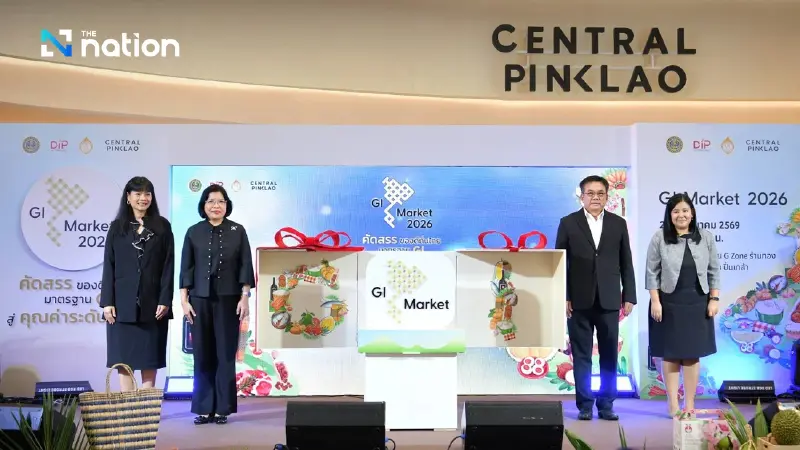


DIP is bringing “GI Market 2026” to Central Pinklao, featuring more than 70 stalls of GI products from across Thailand over seven full days, from March 23 to 29.
The Department of Intellectual Property (DIP) is advancing government policy by stepping up support for Geographical Indication (GI) products, promoting distinctive local goods from across Thailand while continuing to expand marketing channels.
This move aims to drive local economies and generate income for farmers, producers, entrepreneurs and local communities.
To achieve this goal, DIP is hosting “GI Market 2026”, which brings together more than 70 stalls of quality GI products from around the country. Visitors can sample and shop for a wide range of items from March 23 to 29 this year at the Promotion Zone on the G floor of Central Pinklao in Bangkok.
The department’s director-general, Auramon Supthaweethum, said the Commerce Ministry places great importance on enhancing the potential of GI products, which reflect local identity and are closely linked to geographical characteristics such as soil, water, climate and community wisdom.
These factors make them distinctive not only in quality but also in the stories behind them, setting them apart from ordinary products. Thailand currently has 254 registered GI products, generating economic value of more than 115 billion baht, she said.
She added that promoting marketing channels through events such as GI Market is another key mechanism for boosting competitiveness and expanding trade opportunities, enabling GI products to reach urban consumers and markets with high purchasing power.

Auramon said GI Market 2026 is being held from March 23 to 29, 2026, from 10am to 10pm at the Promotion Zone on the G floor of Central Pinklao under the concept: “Carefully selected Thai GI products with world-class value”, designed to showcase the strength and premium quality of Thai GI products.

This year, DIP has gathered GI products from every region of the country, with more than 70 stalls offering a wide variety of goods. Highlights include Ban Phaeo aromatic coconuts from Samut Sakhon, known for their soft, chewy flesh, sweet refreshing taste and pandan-like aroma; Surat Thani oysters delivered fresh from Bandon Bay, notable for their large size, plump creamy-white meat, excellent fresh taste and lack of fishiness; Khao Wong sticky rice from Kalasin, prized for its softness, fragrance and high nutritional value; and Thepsadej coffee, grown in conservation forest areas in Chiang Mai alongside various plant species and wildflowers, giving it a smooth flavour and distinctive aroma.

A wide range of other GI products is also available, including Thung Kula Rong Hai jasmine rice from Si Sa Ket, three-water seabass from Songkhla Lake, Mae Klong mackerel from Samut Songkhram, Long Laplae durian from Uttaradit, Khai Tuek Pad Riew mangoes and Bang Khla aromatic coconuts from Chachoengsao, Mae Ya Marian plums from Sukhothai, Si Sa Ket shallots, Mo Hom fabric from Phrae, Yom Krang fabric from Lampang, Chiang Mai celadon, Lampang rooster bowls and Kanchanaburi black gemstones.
In addition to bringing together premium GI products from across Thailand, the event will also feature entertainment, including mini concerts by well-known Thai artists Lula and Napassorn “New” Suwannanon over the weekend, as well as special promotions throughout the fair.
The department is therefore inviting the public to support Thai GI products, enjoy the experience of shopping for story-rich goods delivered directly from their places of origin, and encourage farmers and local entrepreneurs to preserve local identity and wisdom while developing community products sustainably.

On the same occasion, DIP also announced partnerships with two key agencies: the Biodiversity-Based Economy Development Office (BEDO) and Thailand Post. The parties signed memorandums of understanding to support GI products in a more systematic and integrated way.
The cooperation between the department and BEDO will focus on sustainability from the upstream stage, including conserving and protecting source materials used in GI production, applying creativity and innovation to add value to products, and promoting the development of strong GI communities capable of generating income and managing GI rights efficiently.
The partnership also aims to drive wider national and international recognition of GI products.

Meanwhile, Thailand Post will support producers and entrepreneurs by providing packaging bearing the Thai GI logo to those who have established product quality control systems and obtained permission to use the Thai GI mark.
By presenting their authorisation letter, eligible operators can receive the packaging free of charge while also gaining access to special shipping rates. This will allow entrepreneurs to deliver products to consumers more conveniently, quickly and safely, while improving the reliability of transport standards.
The initiative will begin with a pilot programme for GI products in the Central region, covering 38 products as the first area of implementation. Interested participants can access the service at more than 400 participating post offices across the Central region.
DIP and Thailand Post will continue expanding the partnership to other regions. This is expected to benefit more than 17,000 GI entrepreneurs who already maintain strong quality control systems, while also encouraging new operators to enter a production process based on higher standards and stricter quality control.

“This integrated cooperation would strengthen Thai GI products in every dimension, from development and marketing to logistics,” Auramon said.
“It would help raise the quality and standards of Thai GI products, reduce business costs, improve competitiveness and generate sustainable income for local communities,” she concluded.
