
BMA moves to revive THB30 billion BTS Silom Line extension
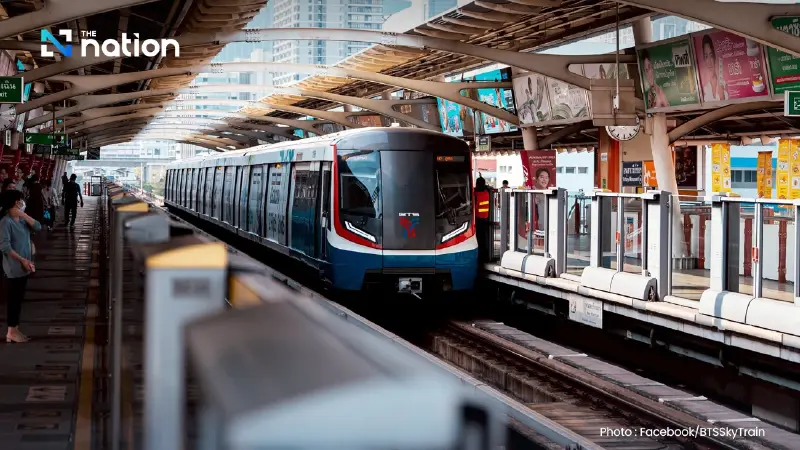


Bangkok is reopening talks with private investors on the Bang Wa–Taling Chan extension as it advances EIA and PPP preparations while awaiting the new government’s policy direction.
- The Bangkok Metropolitan Administration (BMA) is reviving the THB30 billion BTS Silom Line extension project, which will connect Bang Wa to Taling Chan.
- The BMA is seeking private-sector investment through a Public-Private Partnership (PPP) model and has held a seminar to gather feedback from potential investors.
- The project's timeline aims for a Cabinet submission in 2028, with construction planned for 2029–2034 and the start of service expected in 2034.
Sitthiporn Somkitsan, Director General, Traffic and Transportation Department, Bangkok Metropolitan Administration (BMA), said the BMA has held a market-sounding seminar to gather private-sector views on investment in the BTS Silom Line Extension (Section 3), running from Bang Wa to Taling Chan, with an estimated budget of THB30 billion.
He said the exercise was conducted in line with the Public-Private Partnership Act, 2019, and the feedback will be used to refine the project study and analysis.
Feedback to shape conditions and incentives
After the seminar, the BMA will compile comments from private firms and relevant agencies to improve the study and produce a more complete and practical investment model, covering feasibility factors, conditions and incentives that the private sector is interested in, while ensuring the public sector receives appropriate value for money.
Project status and timeline
The project is currently at the stage of submitting an environmental impact assessment (EIA).
The BMA plans to prepare a PPP report in 2026, before submitting the project to the Cabinet in 2028.
It expects the tender to open in 2028–2029, construction to take place in 2029–2034, and service to begin in 2034.
Earlier study completed in 2016
Sitthiporn said the BMA previously completed feasibility studies for the extension in 2016, covering economic, engineering and environmental aspects, passenger-demand forecasts, economic and financial returns, and an appropriate investment model.
Because the project requires significant funding, the BMA is considering a public-private partnership (PPP) approach to bring in private-sector participation.

Waiting on the new government’s policy direction
Sitthiporn said the BMA must also wait for the new government’s policy stance, noting that the Commission for the Management of Road Traffic had transferred responsibility for this rail project to the Mass Rapid Transit Authority of Thailand (MRTA), but the matter has not yet been submitted to the Cabinet, meaning the transfer is not yet in effect and the next steps remain unclear.
Preferred model: PPP Gross Cost
He said the most suitable structure for the project is a PPP Gross Cost model, split into two phases:
Construction investment phase: the public sector will handle land ownership/acquisition and civil works.
Systems and O&M phase: the private sector will build the systems, procure rolling stock, and be fully responsible for operations and maintenance (O&M).
The public sector will own project revenue, while the private partner will receive an availability payment based on service-quality conditions.
Sitthiporn said hiring a private operator under this PPP structure could help reduce fares through a single-fare approach, and that private-sector operational capability could also help reduce overall project costs.

Incumbent operator option: BTSC
On whether the existing concessionaire, Bangkok Mass Transit System Public Company Limited (BTSC), the BTS Skytrain operator, should be granted investment rights, Sitthiporn said it may be appropriate to keep a single private operator to reduce issues such as spare-part changes, maintenance equipment compatibility, and depot/rolling-stock facility requirements.
Multiple operators, he warned, could push up fares.
He said discussions should be held again on whether to hire an operator temporarily or integrate this extension into a single concession alongside the Green Line main routes: the Sukhumvit Line (Mo Chit–On Nut) and the Silom Line (National Stadium–Saphan Taksin).
He noted BTSC began service in 1999 under a 30-year concession that will expire in 2029, after which BTSC must hand over all assets to the BMA.
Route, stations and design
The Bang Wa–Taling Chan extension will start at the BTS interchange at Bang Wa Station and run north along the median of Ratchaphruek Road, passing Bang Waek junction and the Phran Nok–Phutthamonthon Sai 4 junction.
It will then cross Borommaratchachonnani Road and the Kanchanaphisek Expressway, ending near the down-ramp of the bridge crossing the Light Red Line (Bang Sue–Taling Chan) rail corridor.
The route is around 7.5 kilometres with six stations: Bang Waek, Bang Chueak Nang, Bang Phrom, Intharawat, Borommaratchachonnani, and Taling Chan.
All six will be elevated stations, with the guideway and station structures built on the median of Ratchaphruek Road.
Station entrances will be on sidewalks, with stairs, escalators and lifts.
Revenue and ridership forecast
The project is expected to generate revenue from fares and other commercial sources, including advertising-space rentals, retail units, vending-machine areas and open spaces for activities.
Ridership is forecast at around 73,000 passengers per day in 2034, after services begin.
Companies expressing interest
The BMA said multiple private firms and contractors attended and showed interest, including BTSC, Bangkok Expressway and Metro Public Company Limited (BEM), Nawarat Patanakarn Public Company Limited (NWR), Italian-Thai Development Public Company Limited, A.S. Associated Engineering (1964) Co., Ltd., and Siemens Mobility Company Limited.
