
BMA warns of health impacts, Bangkok air quality slips into orange zone
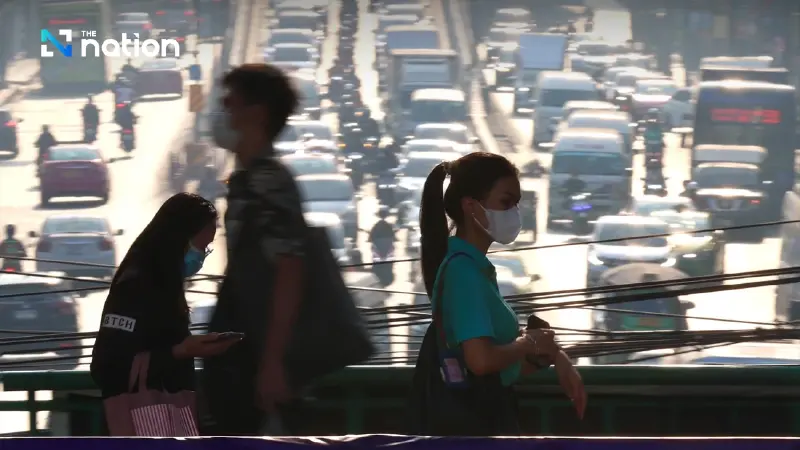


PM2.5 exceeded the 24-hour standard across much of Bangkok, with Chatuchak recording highest reading, and ventilation was rated poor, though stronger winds are expected to help ease pollution levels.
- Bangkok's air quality has entered the "orange zone," with PM2.5 levels (37.4–70.3 µg/m³) exceeding the safety standard, indicating that pollution is beginning to affect public health.
- The Bangkok Metropolitan Administration (BMA) has issued health warnings, advising the general public to wear masks outdoors and for at-risk groups, such as children and the elderly, to avoid outdoor activities.
- The pollution spike is attributed to poor atmospheric ventilation and light winds trapping urban pollutants, though stronger winds are forecast to improve conditions in the coming days.
The Bangkok Air Quality Information Centre reported at 7am on Thursday (January 1) that the 24-hour average PM2.5 across the capital measured 37.4–70.3 micrograms per cubic metre (µg/m³), exceeding the standard set at no more than 37.5µg/m³.
Most areas of Bangkok were classified orange, meaning air pollution was beginning to affect health, based on readings from 68 monitoring stations.
The highest PM2.5 level was recorded in Chatuchak district, at a station in front of Kasetsart University, measuring 70.3µg/m³.
It was followed by Don Mueang at 68.7µg/m³, and Lat Krabang and Prawet at 68.2µg/m³. Several key business districts, including Pathum Wan, Khlong Toei, Yan Nawa and Sathon, also moved into the orange zone, underscoring how widely the pollution had spread across the city on New Year’s morning.

The Bangkok Metropolitan Administration (BMA) said the Air Quality Index (AQI) at most of its stations remained at a level where health impacts may begin.
The Thai Meteorological Department (TMD) reported cool conditions with light morning mist in Bangkok, which can contribute to pollution accumulating near ground level.
The air quality centre said ventilation on January 1 was rated poor due to a stable atmosphere and light winds, with PM2.5 concentrations likely to rise.
However, between January 2–6, stronger winds are forecast, improving ventilation from weak to good and helping reduce pollution linked to sources such as forest fires and burning.
It added that NASA satellite data showed no unusual hotspots in Bangkok, suggesting this episode is being driven mainly by meteorological conditions and urban activity.
Health advice
- General public: Wear a PM2.5 mask when outdoors and avoid strenuous outdoor activities.
- At-risk groups (children, older people, and those with heart or lung conditions): Avoid outdoor activities. If symptoms such as coughing, chest tightness, or breathing difficulty occur, seek medical attention immediately.
BMA steps up controls
The BMA Environment Department has instructed agencies to tighten enforcement under its PM2.5 response plan and urged residents to cut pollution through five measures: wet-cleaning to remove dust indoors, avoiding waste burning and incense, planting trees, using public transport, and switching off engines while parked.
Residents can follow real-time updates via the AirBKK app, BMA air-quality platforms, and the city’s social media channels, and report suspected pollution sources through Traffy Fondue.
