
South Korea enters the AI age of virtual idols


Whether the industry welcomes it or not, artificial intelligence has already become part of everyday life in K-pop.
Since the release of ChatGPT in late 2022 accelerated the commercialisation of generative AI, the technology has reshaped productivity across industries, and K-pop has been no exception.
Three years on, major entertainment agencies are actively incorporating AI into music production, artist development and fan engagement, responding to an increasingly AI-driven global music market. Some have even unveiled robot idols, signalling how far the experimentation has gone.
So how has AI entered the K-pop ecosystem so far, and where is it headed next?
SM and Hybe: Two paths to AI adoption
Among K-pop’s “Big Four” agencies, Hybe, SM Entertainment, JYP Entertainment and YG Entertainment, SM was the first to articulate an AI-centred vision.
SM founder Lee Soo-man began predicting in the early 2010s that entertainment would evolve into “a world of robots and avatars,” positioning AI as central to K-pop’s future.
That vision materialised in 2020 with the debut of girl group Aespa, whose concept incorporated AI avatars known as “ae” and embedded artificial intelligence and the metaverse into the group’s core narrative.
While SM approached AI conceptually and narratively, Hybe moved faster on the technical and operational front.
Beginning in 2021, Hybe invested in AI audio startup Supertone, eventually acquiring a majority stake in January 2023. That same year, Hybe showcased its applied AI strategy through “Masquerade,” the debut single of Midnatt, an alter ego of Big Hit Music artist Lee Hyun.
The song used AI extensively for multilingual pronunciation correction and voice design. Based on Lee’s vocal data, AI generated near-native pronunciation and intonation in six languages: Korean, English, Japanese, Chinese, Spanish and Vietnamese, enabling simultaneous global releases. The technology also transformed Lee’s voice timbre to perform a female vocal section while maintaining his tonal identity.
Speaking at “Brainstorm AI Singapore: The Age of Intelligence” in July, Supertone founder and CEO Kyogu Lee said AI would expand creative possibilities rather than replace artists.
“Every creator and artist will be able to explore and experiment with new ideas using AI technology,” he said. “This is an opportunity for creators.”
In June 2024, Hybe deepened its commitment by launching Syndi8, a virtual pop group whose vocals are entirely generated by AI using Supertone’s technology.
Comprising four members, Canary, Next, Goyo and Raven, Syndi8 released its debut single “MVP” globally on June 27. The group operates within a fictional universe called Nansy Land, where voices are both the foundation of identity and the source of power, a narrative designed specifically around AI-generated sound.
Deja and Han, the album’s co-producers, said the project was inspired by Supertone’s passion for technology and music. “We plan to connect with global fans through diverse activities that align with Syndi8’s fantasy-driven worldview,” they said.
Hybe’s AI ambitions extend far beyond virtual artists. Chair Bang Si-hyuk has repeatedly framed AI as the company’s next core strategy, pushing Hybe to rebrand itself as an “Enter-Tech” company, a fusion of entertainment and technology.
In a March 2023 interview with CNN, Bang warned of a looming “K-pop crisis,” arguing that technological innovation was essential to overcoming the physical limits of human artists and ensuring long-term sustainability.
A month later, he was even more direct in an interview with Billboard.
“I don’t know how long human artists can be the only ones to satisfy human needs and human tastes,” Bang said. “That’s becoming a key factor in my operation and a strategy for Hybe.”
He also called for a broader social consensus on the ethical use of AI in creative fields, urging society to engage with the technology rather than reject it outright.
JYP and YG: Cautious but calculated
JYP Entertainment entered the AI race later than its peers.
In December 2024, the company rebranded its subsidiary JYP360 as Blue Garage, positioning AI and platform technology as central to its business expansion.
In September 2025, JYP officially announced plans to develop AI artists and began large-scale talent recruitment, though tangible results have yet to emerge.
YG Entertainment, meanwhile, has taken a more conservative approach. Rather than developing AI technology in-house, YG has focused on partnering with proven, tech-driven intellectual property.
Its subsidiary YG Plus currently handles album and content distribution for Plave, one of K-pop’s most successful virtual idol groups, allowing YG to gain commercial and data-driven insights without direct technological risk.
Plave: The rise of 'Enter-Tech' idols
Debuting in March 2023 under virtual IP startup Vlast, Plave has emerged as a defining example of K-pop’s “Enter-Tech” transformation.
Unlike fully AI-generated idols, Plave uses real-time motion capture technology: human performers wear suits that translate their movements into live 3D characters, with AI refining facial expressions and motion to overcome the so-called “uncanny valley.”
The approach has proven commercially viable. In March 2024, Plave became the first virtual idol group to top a local music show, winning first place on MBC’s “Show! Music Core.” Their second EP, “Asterum: 134-1,” dominated Melon’s “Hot 100” and “Top 100” charts and sold more than 560,000 copies in its first week.
The group sold out an Olympic Hall fan concert in April, followed by two encore concerts at Gocheok Sky Dome in October, drawing a total of 40,000 fans, an unprecedented scale for a virtual act.
This year, Plave entered the KSPO Dome, widely regarded as the “dream stage” for Korean artists, and launched its first Asia tour less than two years after its debut.
Robot idols: AI with physical presence
If Plave represents virtual AI, Galaxy Corporation, home to K-pop icon G-Dragon, is pushing AI into the physical world.
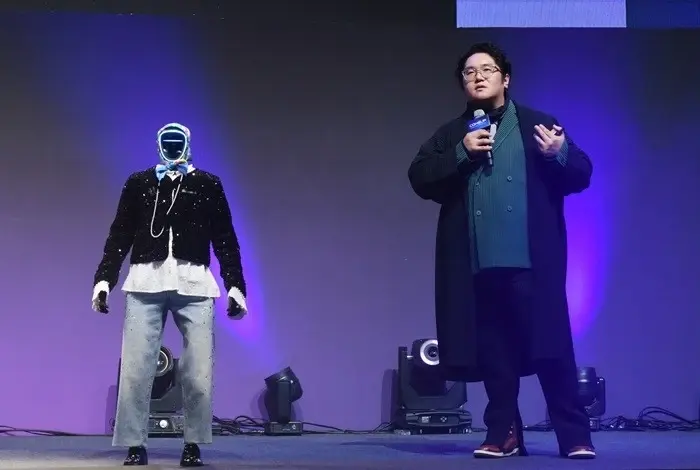
Positioning itself as a “metaverse avatar company,” Galaxy Corporation is developing humanoid robot idols designed to perform on real stages, interact with fans and exist beyond screens. Unlike virtual avatars, these robots are envisioned to dance, appear at fan events and engage audiences face-to-face.
At the startup conference “ComeUp 2025” earlier this month, Galaxy Corporation CEO Choi Yong-ho unveiled the company’s roadmap, forecasting an era where real idols, virtual idols and robot idols coexist within a hyper-converged entertainment ecosystem. A humanoid robot performed choreography to G-Dragon’s “Power” onstage during the event.
“We’re only at 1 or 10 % of what’s possible,” Choi said. “We’ll continue challenging what once seemed impossible to create a new future.”
Kim Jae-heun
The Korea Herald
Asia News Network
