
Beethoven's Symphony No 9 at centre of controversy in South Korea
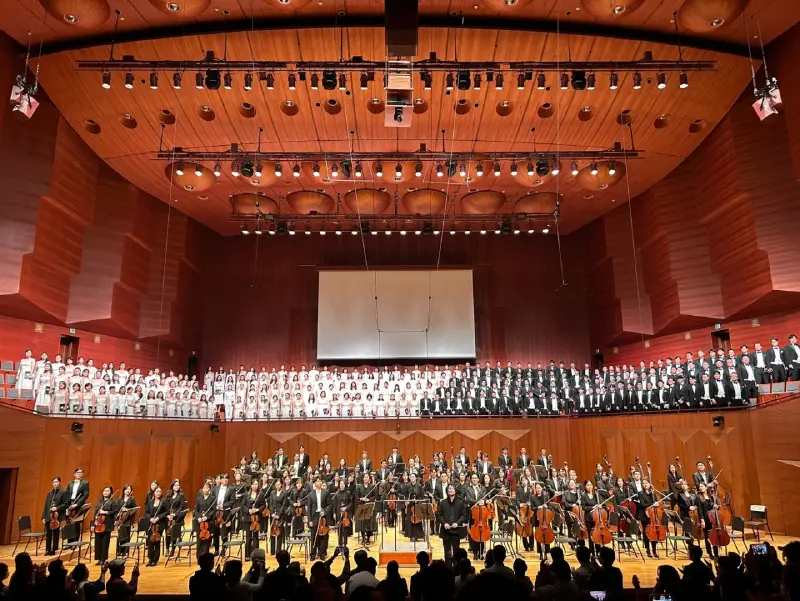


Beethoven's beloved Symphony No 9 has found itself at the centre of controversy in South Korea in recent weeks.
Earlier this month, a Korean-language version of Beethoven's timeless masterpiece was performed for the very first time at the Seoul Arts Center on May 7. The performance was led by conductor Koo Ja-bom, who said the very piece was why he became a conductor but that he had refrained from conducting it due to immense reverence for the piece.
Koo, who dedicated two years to translating the piece into Korean, prepared a nearly 60-page program book that focuses on explaining how it has been translated. For instance, he explained why he thought the title of the choral piece should be "Ode to Freedom," not "Ode to Joy."
At the concert in Seoul, the distribution of the booklet was halted midway. It was later resumed, but a significant portion of the audience left the concert hall without receiving a program book.
Koo told The Korea Herald on Tuesday that it was a deliberate act of censorship -- something that would not have been tolerated by esteemed orchestras.
"SAC's ( Seoul Arts Center ) decision to halt the distribution of the program book and have it reviewed by an internal committee totally ruined the performers' mood before the performance," Koo said. "That's gailjil (abuse of power). Would they have done the same to the Berlin Philharmonic Orchestra?" he posed, adding that SAC's apology coming six days after the performance was not adequate and lacked an explanation.
SAC on Thursday posted a public apology on its website, claiming there had been an operational mistake and that the centre would send the program books by post.
An official from the SAC, speaking to The Korea Herald, emphasized that censorship was an impracticable concept and that there is no reason for them to engage in such practices.
"As we reinstate the pre-pandemic level of stringent management for performance halls, the program book with a new cover which was distinct from the original version had to undergo a review, which took some time.
"This step aims to safeguard against any misuse of the venue and ensure the quality of the performance remains unchanged, while also preventing any unexpected or unpleasant surprises," the official said. "Having said that, the process should have been faster and more flexible."

This unfortunate incident came less than a month after a concert that was to feature the choral symphony was cancelled in Daegu.
Daegu City Symphony Orchestra and Daegu City Choir were supposed to take to the stage to perform Beethoven's Symphony No. 9 “Choral” to celebrate the reopening of the city's Suseong Artpia on May 1.
However, a committee set up in 2021 to ensure religious neutrality in performance programs by the city's art groups ruled that the piece was religiously biased.
One person on the committee, which has to reach a unanimous agreement, had pointed to words in the lyrics of the fourth movement that included "God," "creator," "angels" and "heaven."
Daegu's troubles with religion and the arts is nothing new.
When Daegu City Choir's 40th-anniversary concert on April 29, 2021, had the choir singing a selection of popular opera songs including "Chorus of Hebrew Slaves" from Verdi's opera "Nabucco," the "Triumphal March" from Verdi's opera "Aida" and the "Te Deum" from Puccini's opera "Tosca," the city's Buddhist community staged protests, arguing that "biased religious actions by a city arts organization, which is a public asset, are unacceptable." In response, the city government enacted an ordinance in December of that year, establishing the Religious Advisory Committee within the Daegu Municipal Art Company.
The committee comprises four representatives from religious organizations and five experts hailing from academia, the legal field and the cultural sector. When it comes to matters concerning religious neutrality, unanimous approval necessitates the presence of all members of the religious advisory committee.
With controversy escalating, the Daegu city government has now decided to abolish the committee, with Mayor Hong Joon-pyo saying that "the committee system is deemed unconstitutional as it performs prior censorship and infringes upon artistic freedom. Therefore, the provision regarding the Religious Reconciliation Advisory Committee was deleted from the installation ordinance of the municipal art company."
The cessation of the advisory committee provision is to take effect starting in July, after legislative notice and review of the municipal council's ordinance.
Park Ga-young
The Korea Herald
Asia News Network
