
Defence Minister: Cambodia won’t invade, lacks jets to reach Bangkok
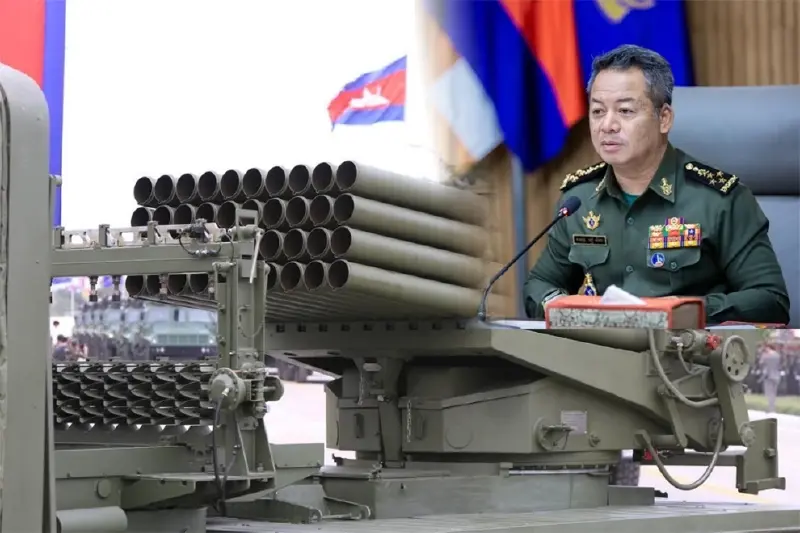


Minister of National Defence Tea Seiha has made it clear that Cambodia may not possess fighter jets or warships but has the capability to defend the country, including air defence systems, anti-tank guns and coastal defence weapons.
Speaking on the morning of June 20, he said Cambodia has collaborated with friendly partners to upgrade its defence capabilities, not to invade others, and emphasised that Cambodia does not have fighter jets capable of reaching Bangkok.
Thailand posts photos of their missiles, fighter jets, large artillery pieces and warships, and weapons for land, sea and air. What does Cambodia have? Let me clarify, Cambodia has no fighter jets or warships because Cambodia focuses only on defensive capabilities. We have air defence guns, anti-tank guns, and coastal defence guns,” he said.
“Cambodia has worked with some friendly partners to enhance our military capabilities solely for national defence, absolutely not to build up weapons for invading others,” he added.
Seiha’s remarks come amid ongoing tensions along the Cambodia-Thailand border. Recently, the defence ministry noted that Thailand has increased activities such as deploying drones, digging trenches, mobilising weapons and support equipment, constructing infrastructure and increasing troop numbers along the border of Preah Vihear and Oddar Meanchey provinces.
The ministry stated that these actions pose a serious threat to the peace and security of both countries.
On June 19, a spokesperson for Thailand’s Ministry of Foreign Affairs acknowledged that earthworks were being constructed, but claimed they were conducted within Thai territory.
Seiha emphasised that Cambodia does not want war with any country and has referred the border dispute with Thailand to the International Court of Justice (ICJ) for a peaceful resolution.
He noted that the ICJ’s decision may not guarantee territorial gains for either side, as it depends on the court’s findings. He added that the outcome from the ICJ would ensure peace and clarity regarding the border between the two nations.
He further stated that resolving the issue through a 2000 memorandum of understanding (MoU) has been impossible, and Thailand and Cambodia have not conducted joint border surveys since 2012 or 2013, primarily due to using different maps.
He also claimed that over the past decade, since bilateral talks through the Joint Boundary Commission stalled, Thailand has violated the memorandum 695 times, on a provisional basis.
“I say provisionally because there could be more, such as road construction and patrolling without notifying Cambodia,” he said.
Niem Chheng
The Phnom Penh Post
Asia News Network
