
Ceasefire fails to halt political sparring as Hun Sen clashes with Sam Rainsy over Cambodian military losses
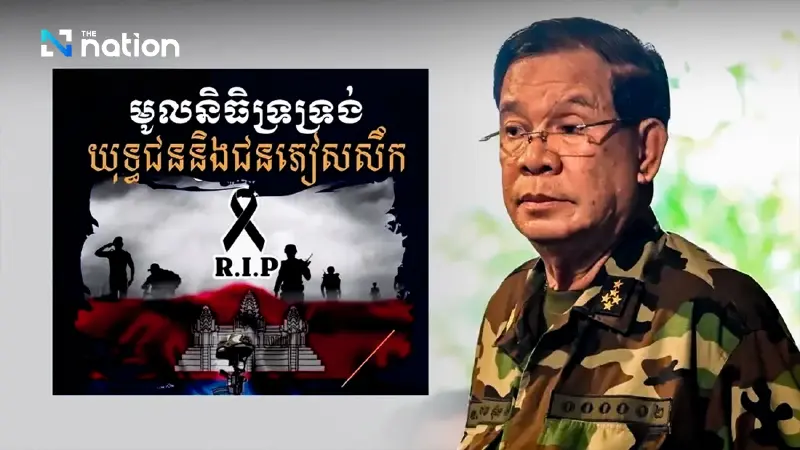


Hun Sen attacks ex-opposition leader Sam Rainsy for criticising the Cambodian army’s performance and demanding disclosure of soldier death tolls amid Thai–Cambodian border clashes.
Despite an official ceasefire, Cambodia’s political tensions have flared, with Senate President Hun Sen exchanging sharp words with exiled former opposition leader Sam Rainsy.
The dispute began after Lieutenant General Boonsin Padklang, commander of Thailand’s Second Army Region, estimated Cambodian military losses at around 3,000 troops during recent operations, citing Cambodia’s heavy deployment of soldiers.
Rather than addressing Boonsin directly, Hun Sen turned his fire on Sam Rainsy, who on August 10 met Cambodian expatriates in Chambéry, France. Rainsy criticised the Cambodian army for missing targets when firing BM-21 rockets, relying on ineffective Chinese weapons, and striking Thai civilian areas — while claiming the Thai air force used F-16 jets to hit military targets accurately.
Previously, Rainsy had posted on his Facebook page calling on the Cambodian government to reveal the real number of frontline soldiers and civilians killed or injured, rather than concealing the figures.

In response, Hun Sen posted:
“Why is there a Cambodian who praises the invading Thai army and insults the Cambodian army instead? Is he human or animal? Is he a patriot or a traitor?”
The question of how many soldiers have been killed or wounded at the frontline remains a pressing one for the Cambodian government.
Cambodian military structure and class divisions
The Cambodian army is divided into three main components: the central army under the Royal Cambodian Army, special zone units, and “village soldiers” under local support divisions.
In the current Thai–Cambodian border conflict, Hun Sen’s main forces have been drawn from support divisions in Kampong Chhnang, Kampong Thom, and Prey Veng, alongside local troops and village soldiers from Preah Vihear and Oddar Meanchey provinces. Elite units — the 70th Brigade, Special Forces 911, and the BHQ Royal Guard — have only been deployed in selected battles.

As a result, the majority of Cambodian casualties at Phu Makua, Phu Phee, Ta Muen Thom, and Ta Kwai have been local and village soldiers.
This disparity reflects a long-standing class divide in the Cambodian armed forces. Elite units, loyal to Hun Sen and his son Prime Minister Hun Manet, receive modern weapons, foreign training, and better resources, while rural troops often fight in sandals with AK rifles.

History and loyalty
The Cambodian army’s roots lie in the revolutionary forces formed by the Khmer Rouge. After the Khmer Rouge was overthrown, the Vietnamese army helped establish the current structure under leaders Heng Samrin, Chea Sim, and Hun Sen.
Following the 1991 Paris Peace Accords and the 1993 elections supervised by UNTAC, the Royal Cambodian Armed Forces were formally created. Although the constitution names the king as commander-in-chief, the role is symbolic.
In his early years as prime minister, Hun Sen controlled only around 30% of the army, with regional units still loyal to former commanders. To consolidate power, he built a personal force centred on the 70th Brigade, Special Forces 911, and the BHQ Royal Guard.
Casualty figures and public frustration
The five days of intense fighting along the Thai–Cambodian border caused significant military and civilian casualties. However, the Cambodian government has not released official numbers.
Cambodian influencer Pu Dara, acting as an intermediary for families of fallen and wounded soldiers, reported over 45 confirmed soldier deaths, mostly low-ranking men from poor families, whose funerals were held without government assistance. Social media has also been filled with desperate appeals from families seeking missing relatives deployed to the border.
Cambodian expatriates in the US have formed the “Khmer Democracy Rescue Fund” (KDRF) to connect frontline soldiers with their families.
Over the past weekend, remembrance events for fallen soldiers were held by Cambodians in the US and Japan, featuring images of some 45 identified dead — with hundreds more bodies still unrecovered from the battlefield.
Funerals for high-ranking soldiers, often from elite units like Special Forces 911, have received state honours and compensation of 20 million riel per family. These troops typically hail from Prey Veng, Tbong Khmum, Kandal, Takeo, Kampong Chhnang, Kampong Thom, Svay Rieng, and Siem Reap.

Hun Manet’s wife, Pich Chanmony — also deputy president of the Cambodian Red Cross and president of the Cambodian Women’s Peace and Development Association — has attended military funerals almost daily, alongside other senior officials, in an apparent attempt to address public dissatisfaction.

Phan Phana, a Cambodian NGO leader in the US, commented on Facebook that the Cambodian soldiers who died at the frontlines are all from poor rural families.
Critics say Hun Sen has allowed the bodies of local and village soldiers to remain uncollected in remote battlefields, leaving the burden of funerals entirely on their families.

