
Maris presents evidence to ICRC on Cambodia’s human shield, landmine use
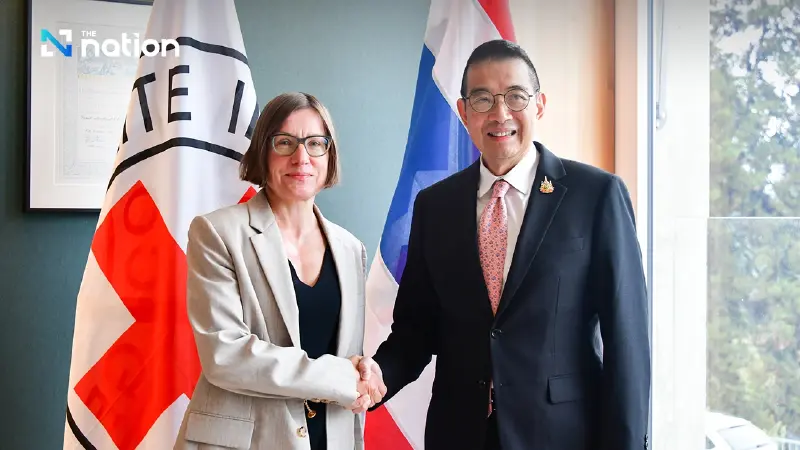


Foreign Minister Maris Sangiampongsa stated that Thailand’s commitment to peace is evident through its actions, particularly in aiding refugees during Cambodia’s civil war, demonstrating the country’s genuine dedication to humanitarian efforts.
- Thai Foreign Minister Maris Sangiampongsa met with the President of the International Committee of the Red Cross (ICRC) in Geneva to present evidence against Cambodia.
- The evidence accuses Cambodia of using civilians as human shields and deploying anti-personnel landmines, which violates the Ottawa Convention and international law.
- Maris also reported ongoing ceasefire violations by Cambodia, citing a recent landmine incident where a Thai soldier was injured.
- The minister asserted that Thailand's actions are in full compliance with international law, and noted that the ICRC commended Thailand's patience and restraint.
Thai Foreign Minister Maris Sangiampongsa met with Mirjana Spoljaric Egger, President of the International Committee of the Red Cross (ICRC), on August 28, at 11am local time in Geneva, Switzerland.
Following the meeting, Maris revealed that he presented evidence of Thailand’s protest against Cambodia to the State Parties of the Ottawa Convention, accusing Cambodia of violating the ceasefire agreement and using anti-personnel landmines.
Minister Maris also outlined the issues Thailand has faced with Cambodia, particularly regarding human rights violations, misinformation, and Cambodia’s use of civilians as human shields to exert pressure on Thailand. He emphasised that these actions violate all international laws.
The Minister reiterated to the ICRC President that Thailand’s actions, both diplomatic and military, are in full compliance with the UN Charter and international law. He underscored that this visit to Geneva was part of Thailand’s commitment to engaging only through official communication channels. President Spoljaric Egger commended Thailand for its patience and restraint.
Maris remarked that Thailand’s approach has been widely recognised, reaffirming the country’s adherence to the norms of the international community.

Foreign Minister further disclosed that he informed ICRC President of Cambodia’s ongoing violations of the ceasefire agreement, including the use of anti-personnel landmines in breach of the Ottawa Convention. He pointed out that just yesterday (August 27), another incident occurred, resulting in a Thai soldier losing a leg.
“Despite Thailand’s efforts to seek cooperation from Cambodia, if Cambodia continues to violate these regulations, I have no choice but to protest and condemn these actions through various international organisations. This includes our protests in Geneva and renewed protests from both the Ministry of Foreign Affairs and the Thai military,” Minister Maris said, emphasising that he believes all parties now understand the situation.
He further noted that his visit to Stockholm, Sweden, and Geneva, Switzerland, was a success.


“In principle, the ICRC commended our approach, stating that the Thai government’s efforts to campaign with factual information to counter misleading narratives are supported and promoted by many civilised nations,” Maris said.
He had informed the ICRC of his long-standing involvement with Cambodia’s refugee camps, particularly in the area of Ban Nong Chan, where the ICRC had previously established a Cambodian refugee shelter during the civil war.
“Since joining the Ministry of Foreign Affairs, my role has been focused on issues related to Cambodian refugee camps, which has given me a strong understanding of human rights. I have been one of the key advocates within the ministry for assisting in Cambodia, particularly in addressing the peace process to prevent civil war and supporting Cambodian refugees fleeing the conflict into Thailand,” he said.
Minister Maris emphasised that these actions were solid evidence in the eyes of the international community that Thailand is a nation committed to peace. “This is not just propaganda; our actions demonstrate it,” he added.
He pointed out that Thailand’s ongoing assistance to Cambodia, as well as Cambodia’s membership in ASEAN, further solidifies Thailand’s humanitarian role. “These facts are recognised globally and serve as clear evidence of Thailand’s consistent support for Cambodia’s human rights,” he concluded.
