
Northern Vietnam on high alert as Typhoon Matmo approaches
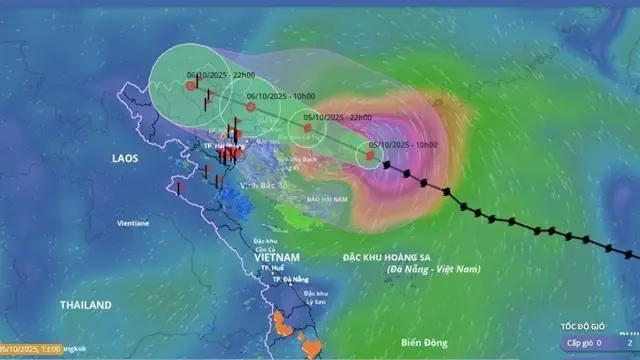


By the end of Tuesday, northern mountainous and midland regions will receive 150-250mm of rainfall, with localised areas exceeding 400mm.
Typhoon Matmo, the 11th storm to enter the East Sea (internationally known as the South China Sea) so far this year, is heading to Mong Cai in the northern province of Quang Ninh with wind speeds up to 149km per hour, according to the National Centre for Hydro-meteorological Forecasting.
The storm is projected to reach mainland Vietnam early morning on October 6.
It will move along the northern border, causing heavy rain in mountainous and midland localities.
By the end of Tuesday, the northern mountainous and midland regions are expected to receive 150-250mm of rainfall, even exceeding 400mm in some areas.
The northern delta and Thanh Hoa Province will experience 70-150mm of rain, with some locations over 200mm.
Ha Noi is unlikely to be affected directly by the typhoon but will have rainfall between 70-120mm until the end of Tuesday, with some areas receiving over 150mm.
To respond to the typhoon, the northern city of Hoi Phong and Hung Yen Province have banned maritime activities starting at 5 pm on Saturday.
Quang Ninh Province temporarily suspended permits for vessels to go offshore before 12 pm on Sunday and stopped issuing permits for sightseeing and overnight stays at sea from 8 am the same day. Ninh Bình banned maritime activities from 6 am on Sunday.
Hanoi, meanwhile, encouraged agencies and organisations to arrange for officials, public employees, and workers to work from home on Monday (October 6) in the event of severe weather conditions. Depending on the developments of rain, storms, and flooding, schools may proactively suspend classes to ensure safety.
According to forecasts, the airports directly affected by typhoon Matmo include Van Don International Airport (Quang Ninh) and Cat Bi International Airport (Hai Phong) – which have been told to inspect infrastructure systems, communications networks, and radio stations, promptly detect and repair any damage, and ensure operational safety. In addition, four other airports in the north and north-central region – namely Noi Bai (Ha Noi), Tho Xuan (Thanh Hoa Province), Vinh (Nghe An Province) and Dien Bien (Dien Bien Province) – should also proactively update information and be ready with response plans in case the storm develops unpredictably.
All units have been instructed to proactively implement measures for storm and flood prevention, ensure proper drainage within airport areas, protect facilities, vehicles, and equipment, and timely restore passenger services after the storm.
PM’s directions
To be prepared for the upcoming typhoon, Prime Minister Pham Minh Chinh requires ministries, sectors and localities to implement decisive, proactive, timely and effective response measures suitable for the evolving situation in each locality and at each moment to ensure safety for the people.
He requested coastal provinces and cities, especially from Quang Ninh to Ninh Bình, to ensure the safety of ships and vessels operating at sea, including guiding them to evacuate, avoid entering dangerous areas or return to shelter.
Northern and north central provinces, especially mountain and midland areas, should implement response measures to floods and flash floods, inundation, landslides and erosion.
They should allocate forces, materials, machinery and equipment in key areas to be ready to immediately handle incidents.
Leaders of Lao Cai Province must inspect and instruct relevant agencies to coordinate with police forces to promptly carry out the evacuation and relocation of households in danger zones with landslide risk in Bao Ha Commune.
The PM assigned the Ministry of Agriculture and Environment (MoAE) to direct the meteorological and hydrological forecasting agencies to closely and continuously monitor, consult and update international forecasts based on experience from recent typhoons to provide the most accurate forecasts on the typhoon’s developments to identify high-risk landslide areas.
The MoAE will work with the Ministry of Industry and Trade, Lao Cai People's Committee, dam operators and related units to closely monitor and decide on the operation and water regulation of the Thac Ba hydropower reservoir to ensure safety for downstream areas.
They must urge sectors and localities to conduct appropriate typhoon response measures following actual situations and timely report to the National Civil Defence Steering Committee and the PM for guidance on issues beyond their authority.
Another task of the MoAE is to guide and urge provinces and cities to review, update and complete specific plans to respond to each level of disaster risk, and each possible situation for their localities.
PM Chính told the Ministry of Construction and the Ministry of Industry and Trade to keep close watch on transportation activities, hydropower reservoirs and dams, and electricity transmission systems. And industrial production.
The Ministry of Defence and Ministry of Public Security will direct units to coordinate with localities to allocate forces, prepare equipment at key locations to be ready to support people in responding to floods, flash floods, landslides and inundation.
The PM assigns the Ministry of Foreign Affairs to lead and coordinate with border agencies to strengthen information exchange with China regarding information from upstream reservoirs.
The Government Office will monitor and urge ministries and localities to strictly implement their tasks and promptly report to the PM on any urgent or arising issues.
Viet Nam News
Asia News Network
