
Burapha commander vows full push to expel Cambodian settlers, ends talks
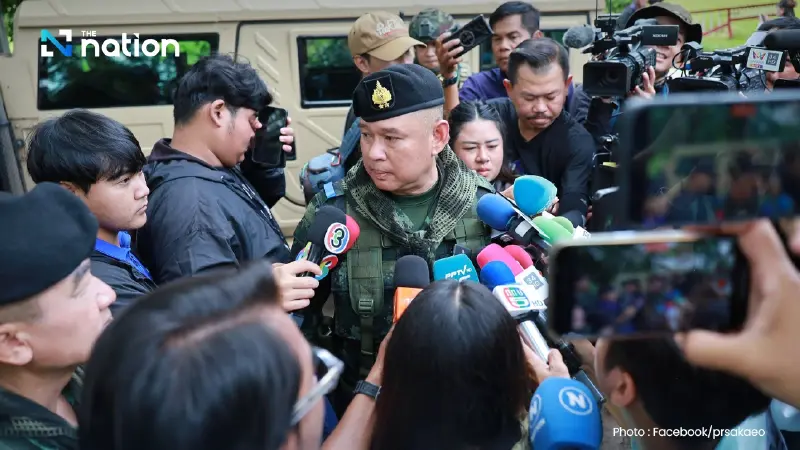


Burapha Task Force commander says Thailand won’t negotiate after Cambodia requested talks but provided no agenda, vague invitations would be a waste of time.
- The commander of the Burapha Task Force has ended negotiations with Cambodia, stating a planned meeting collapsed because Cambodia did not accept Thailand's proposed terms.
- He vowed to expel Cambodian settlers, confirming the military will act when it has a clear "operational advantage" and is "superior in every respect."
- As part of the pushback effort, Thai forces are conducting evacuation rehearsals and clearing landmines in the disputed territory, despite alleged obstruction from the Cambodian side.
Maj Gen Benjapol Dechatiwong, commander of the 2nd Infantry Division (King’s Guard) and leader of the Burapha Task Force, said on Sunday (12 October) that a planned RBC meeting proposed by Thailand’s First Army earlier this month has not taken place because Cambodia did not accept the terms offered.
After inspecting evacuation rehearsals along the Thai–Cambodian border in Sa Kaeo province, Benjapol told reporters that the army had put forward a proposal for early-October talks, but Phnom Penh failed to respond favourably. “That is why the meeting collapsed and has not been held,” he said.

He stressed that Thai forces have been taking the situation seriously and working closely with provincial authorities and all relevant agencies to prepare and assist residents in the border zone. “We have created the necessary conditions for every task, including the evacuations, and we are receiving full cooperation from the province and all supporting parties,” he said.
On the subject of mine clearance, he confirmed that troops discovered three anti-personnel mines yesterday, underscoring that unexploded ordnance remains in the area. He criticised attempts by the other side to obstruct clearance work, saying such actions hinder efforts to create a jointly secure environment. Nonetheless, he said, “we sent formal notice on October 9 and this is our territory. Even if the other side refuses, this is our land; soldiers will proceed despite the risks so that people can be safe and go back to making a living.”
He also said he has instructed Col Chainarong Kasee, commander of Task Force 12, to ensure villagers who wish to resume farming in the area can do so without being prevented from accessing land. “We are now trying to open the area so residents can benefit,” he added.

Asked whether mine clearance formed part of measures to push back encroaching Cambodians, Benjapol replied bluntly: “Yes, it must be done.”
On the public deadline of October 31 for pushing Cambodian settlers out, he acknowledged concerns among local people and praised their patriotism, but reiterated that the military continuously monitors the situation and will act immediately if it gains an operational advantage. “To act, we must be superior in every respect,” he said, noting that Cambodian forces are closely tracking Thai movements and calling for operational discretion: “I ask everyone to help keep security locations confidential.”
Looking ahead, he said there would be no further negotiations unless Phnom Penh approached talks in good faith. He complained that previous Cambodian invitations were vague and unproductive: “They invited us to a meeting but did not disclose the agenda. We fear attending and wasting time as before.”
He added that troop morale remains high and that forces are ready to act “when the advantage is ours.”

