
Army chief of staff gives support to wounded troops
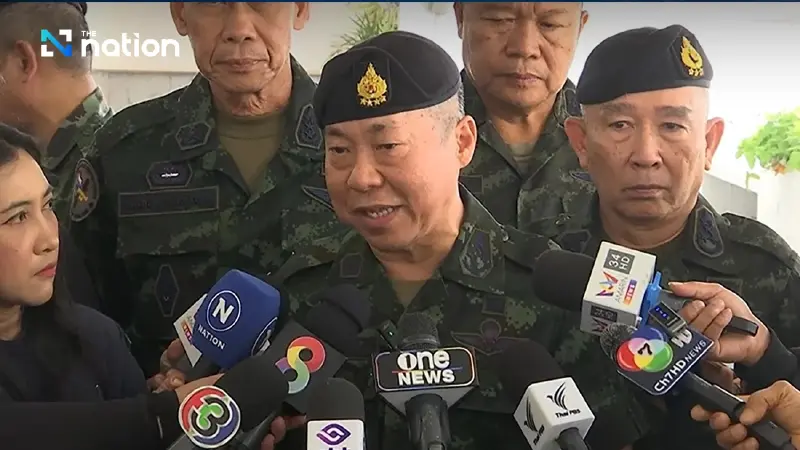


As wounded soldiers recount fierce firefights on the Thai–Cambodian border, the army chief of staff pledges deeper, carefully planned operations aimed at neutralising Cambodian positions and preventing future incursions.
- Thailand's army chief, Gen Chaiyapruek Duangpraphat, visited troops wounded in recent border clashes to provide financial aid and morale support.
- He vowed to the injured soldiers that the Thai army would "take back every inch of Thai territory" from Cambodian forces.
- The army chief stated that military operations are actively underway to retake and secure border areas, with four key targets remaining.
- He asserted that the conflict began when Cambodian soldiers fired on Thai troops building a road on Thai soil, rejecting Cambodia's portrayal of Thailand as the aggressor.
Gen Chaiyapruek Duangpraphat, Chief of Staff of the Royal Thai Army, visited Hospital Sappasitthiprasong at Ubon Ratchathani province on Tuesday (December 9) to deliver financial assistance and morale support to soldiers wounded in recent clashes along the Thai–Cambodian border.
He wished them a speedy recovery and listened as they recounted the fighting on the front line.
One member of a special operations unit told the general he had been shot by Cambodian troops from a distance of just five metres while taking cover behind rocks.
At the time, he was using a Bangalore torpedo to breach and destroy a minefield.
Despite his injuries from shrapnel and small-arms fire, he said that once he had recovered, he was ready to return to the battlefield.
Chaiyapruek told the wounded that their comrades were currently pressing ahead with operations to retake and secure various areas along the border.
“Do not worry. We will take back every inch of Thai territory,” he said, adding that Cambodian forces had increased their use of drones in the area.
He praised the injured soldiers, saying what they had done was “truly for the nation”, and pledged that the army would seize back all remaining objectives now down to four key targets with their comrades on the ground “finishing the job”.
Speaking to reporters after visiting the wounded troops, the army chief of staff said the injured included both career soldiers and conscripts, as well as Border Patrol Police officers.
All had risked and sacrificed themselves to defend Thai soil, he stressed.
He explained that the army’s operations along the line of contact followed a clear plan: units conduct reconnaissance of enemy movements and report back so that tactics can be adjusted in real time.
He rejected Cambodian attempts to portray Thailand as the aggressor. On the first day, he said, Phnom Penh tried to create an image that Thailand had fired first, and on the second day sought to frame its actions as retaliation.
“We have evidence that this is not true,” he insisted. The initial clashes, he explained, stemmed from Thai troops building a road on Thai territory.
Cambodian soldiers, dissatisfied with the work, first issued verbal warnings and then opened fire on Thai troops without any warning shots, in violation of the agreed rules of engagement.
That incident left one Thai soldier dead and two wounded, he said, adding that the area where Cambodian forces opened fire was unquestionably on Thai soil, giving Thailand full rights to respond militarily.
Chaiyapruek confirmed that the current fighting was now on its second day, and that Thai forces had made “significant progress” in securing several areas, though he declined to give details, citing operational security.
He said Cambodian troops had escalated their use of bomb-dropping drones and heavy weapons against Thai positions on the second day, which proved that they had never withdrawn their heavy armaments from the area and had instead remained hidden.
This, he said, showed Cambodia had not been straightforward in its public statements.
Asked when the clashes might end, he replied that operations could take some time because the army must prioritise the safety of its own personnel.
Missions must advance cautiously, using appropriate tactics to gradually erode and destroy the combat effectiveness of Cambodian forces.
The government, he noted, had given the military full authorisation to carry out its duties.
“We will do everything necessary to reduce their capabilities as far as possible, including their depth capabilities, so that they can no longer think of entering our territory using the same methods as before,” he said, adding that this approach differed from previous rounds of border clashes, including those in 2011.
He apologised to residents affected by evacuations and thanked people sheltering in evacuation centres for the support they had shown to the troops.
He pledged that the army would do its utmost to restore peace and prevent such incidents from recurring in future.
On reports of enemy spies, Chaiyapruek said the situation was as explained by the Internal Security Operations Command, and urged local people and officials alike to act as “eyes and ears” for the authorities.
Espionage and informant networks were part of warfare, he noted, and any suspicious activity should be reported immediately to officials in the area.
