
Thailand’s border and transit trade target set at THB1.9 trillion for 2026
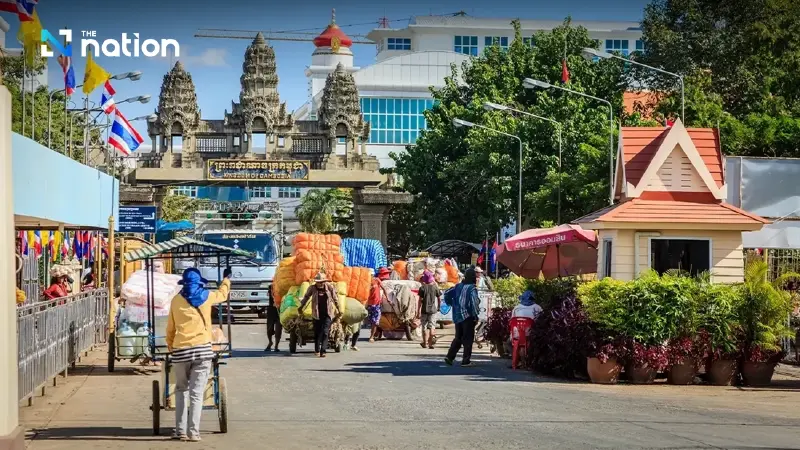


Border and transit trade still accounts for about 10% of Thailand’s exports, with transit shipments, especially electronics, expected to remain the main growth driver despite ongoing border tensions and trade-policy risks.
- Thailand's Department of Foreign Trade (DFT) has set a THB1.9 trillion target for the country's total border and transit trade in 2026.
- The DFT anticipates that transit trade, especially in the electronics sector, will be the primary engine for growth towards this target, driven by global demand and investment.
- Achieving the target faces significant risks from ongoing border conflicts with Cambodia and Myanmar, which have led to checkpoint closures and substantial trade disruptions.
Thailand’s border trade and transit trade remain crucial to the country’s overall exports, accounting for around 10% of total export value, highlighting Thailand’s role as a regional trade and logistics hub.
However, over the past five years, the sector has faced volatility from external factors, including security tensions and trade measures imposed by neighbouring countries.
Historical data show that in 2021, total border and transit trade reached THB1.719 trillion, comprising exports of THB1.033 trillion and imports of THB686.709 billion, resulting in a trade surplus of THB345.793 billion.
In 2022, total trade stood at THB1.742 trillion, up 1.34% year on year. Exports were THB1.028 trillion, down 0.44%, while imports rose 4.03% to THB714.351 billion. Thailand recorded a trade surplus of THB313.566 billion.
In 2023, total trade declined 1.80% to THB1.711 trillion. Exports fell 4.59% to THB980.728 billion, while imports increased 2.21% to THB730.145 billion, leaving a trade surplus of THB250.584 billion.
In 2024, total trade expanded 6.13% to THB1.816 trillion. Exports increased 6.91% to THB1.049 trillion, and imports rose 5.08% to THB767.262 billion, lifting the trade surplus to THB281.239 billion.

In 2025, border trade faced heavy pressure from conflict along the Thai–Cambodian border, leading to the closure of multiple checkpoints, alongside Myanmar’s border trade controls linked to domestic unrest. This caused border trade to slow further in the second half of the year. Despite this, full-year border and transit trade still grew 6.7% to nearly THB1.94 trillion. A key driver was transit trade, which surged 24.4% to more than THB1.04 trillion, marking a record.
For 2026, border and transit trade remains caught between both “opportunities” and “risks”. The Department of Foreign Trade (DFT) has set a target of THB1.9 trillion for total border and transit trade, even as the Thai–Cambodian border conflict continues and creates uncertainty over checkpoint operations.
Arada Fuangtong, Director-General of the DFT, said the 2026 outlook suggests transit trade will remain a key growth engine, particularly for electronics, driven by rising global demand and continued growth in Thailand’s electronics investment and data centre business.
Border trade, however, still faces high uncertainty.
The Thai–Cambodian border situation remains fragile, with risks of renewed clashes, and checkpoint reopenings are not expected in the near term.

On the Myanmar side, ongoing unrest and trade measures have continued to affect operations, with the Second Thai–Myanmar Friendship Bridge (Mae Sot–Myawaddy) remaining closed since 18 August 2025.
The DFT also plans to hold six border trade fairs in fiscal year 2026 across six provinces, Khon Kaen, Chiang Rai, Nakhon Si Thammarat, Phitsanulok, Chanthaburi, and Sa Kaeo, to stimulate the border economy and strengthen alternative trade opportunities with Cambodia.
Voratat Tantimongkolsuk, President of the Thai–Cambodian Business Council, said the Cambodia-related impact is estimated at THB500 million per day, or more than THB15 billion per month in lost trade value.
For Thai businesses invested in Cambodia, he estimated direct investment via equity stakes in Cambodian companies at around THB150 billion, excluding other forms of investment.
He said Thai investors are now weighing their next steps, whether to continue, pause, relocate, or stay.
In 2026, while Thailand’s border and transit trade may continue expanding, it faces risks from multiple factors, especially the Thailand–Cambodia conflict, which has led to checkpoint closures, reducing Thai–Cambodian border trade to 0%.
Other headwinds include the trade war and Trump’s tariff policies, which could weigh on Thailand’s border and transit trade.
Under these conditions, risk management and strengthening logistics systems and transit markets will be key to preventing a downturn in Thailand’s border and transit trade.
