
Japan's Takaichi aims for blizzard of votes in rare winter election
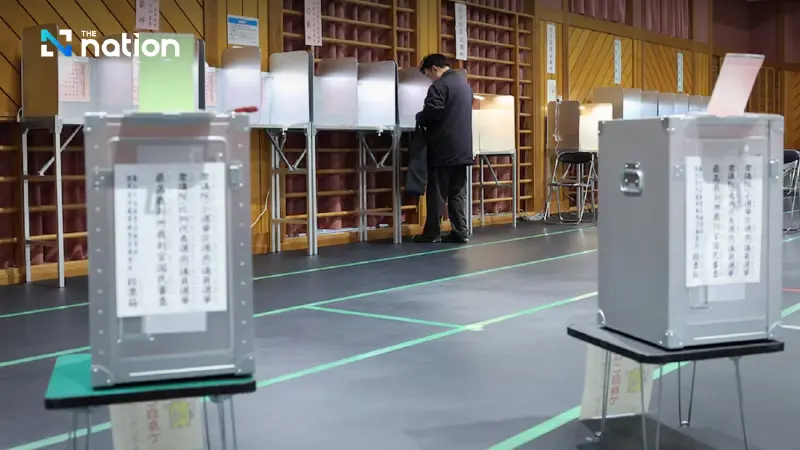


Voters across Japan went to the polls on Sunday (February 8) in a lower-house election widely expected to deliver a decisive victory for Prime Minister Sanae Takaichi, though heavy snowfall in parts of the country threatened to depress turnout.
Opinion polls suggest Takaichi’s conservative alliance could secure roughly 300 of the 465 seats in the House of Representatives, up from the 233 seats it is defending.
If her Liberal Democratic Party and the Japan Innovation Party (Ishin) reach the 310-seat mark, the bloc would gain the power to override the upper chamber, where it currently lacks a majority.
Takaichi, 64, became prime minister in October after winning the LDP leadership and called the rare winter election to seek a fresh mandate.
She has said she would resign if the coalition fails to hold a majority.

‘Sanakatsu’ buzzes among younger voters
Known for her blunt speaking style and a hard-working image, Takaichi has gained traction, particularly among younger voters, fuelled by a social media phenomenon dubbed “sanakatsu”, a kind of Sanae fandom linked to items she is seen using, from her handbag to the pink pen she uses for notes in parliament.
A recent poll showed support among voters under 30 topping 90%. Analysts note, however, that younger people are typically less likely to vote than older generations that have long underpinned LDP election performances.

Since taking office, Takaichi has moved to boost defence spending in response to China and has pressed for a consumption-tax cut, steps that have unsettled markets.
She has pledged to suspend the 8% sales tax on food for two years to ease the strain on households facing higher prices, a problem compounded by the yen’s sharp fall.
“If Takaichi wins big, she will have more political room to follow through on key commitments, including on consumption-tax cuts,” said Seiji Inada, managing director at consultancy FGS Global.
He added that markets could react in the days after the vote, with the yen potentially coming under renewed pressure.
Takaichi also received an endorsement from US President Donald Trump on Thursday, a development that could strengthen her appeal to right-leaning voters but risk alienating moderates.
Snowstorms raise turnout concerns
The weather looked set to be a major factor on election day, with forecasts warning of up to 70 centimetres of snow in northern and eastern regions.
Tokyo itself saw an unusual dusting, causing minor traffic disruption.
By Sunday morning, the transport ministry said 37 train lines and 58 ferry routes had been suspended, while 54 flights were cancelled.
In Nagaoka, Niigata Prefecture, where snowbanks topped one metre along roadsides on Saturday, campaigners urged residents to vote early to avoid worsening conditions.
Takehiko Igarashi, a Japanese Communist Party volunteer, said the party was phoning supporters and offering lifts to polling stations.
Turnout in recent lower-house elections has hovered in the mid-50% range.
Any drop on Sunday could increase the clout of organised voting groups.
One such bloc is Komeito, which left its coalition with the LDP last year and joined a centrist grouping with the main opposition Constitutional Democratic Party of Japan.
Komeito has deep links to the lay-Buddhist Soka Gakkai organisation, which says it has at least eight million members nationwide.
Voters are choosing representatives in 289 single-seat constituencies, with the remaining seats allocated through proportional representation.
Polls close at 8 pm local time (1100 GMT), when broadcasters are expected to release projections based on exit polls.
Reuters

