
Thailand rejects Cambodian PM's border occupation claims
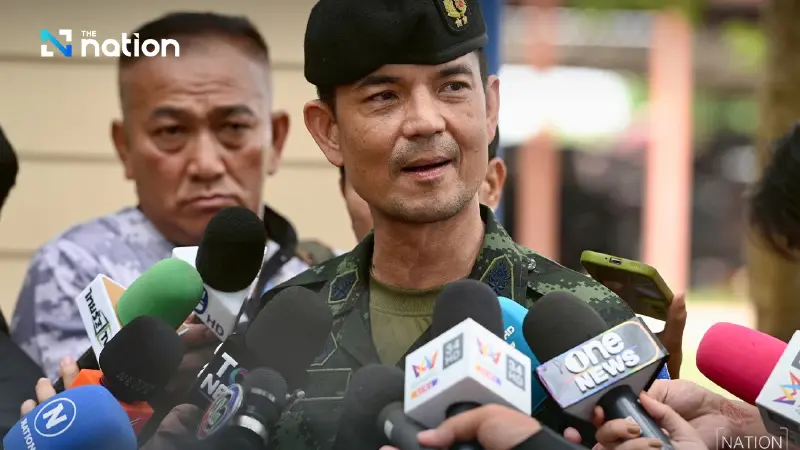


Royal Thai Army has clarified that 80,000 Cambodians cited by Prime Minister Hun Manet are illegal encroachers on Thai soil rather than displaced persons, maintaining that all current border measures strictly adhere to bilateral ceasefire agreements.
- Thailand refutes the occupation claim, stating the disputed land is Thai territory and the Cambodians present are illegal encroachers who never left after a past conflict, not displaced persons.
- The Thai military justifies its troop presence and the installation of barriers as temporary security measures compliant with a ceasefire agreement and necessary for self-defense.
- Thailand states it is open to border negotiations but only after preconditions are met, including military de-escalation, landmine clearance, and the formation of a new Thai government.
Maj Gen Winthai Suvaree, Spokesperson for the Royal Thai Army, addressed a report by Cambodia's Fresh News on Thursday (February 19).
The agency had published an interview that Cambodian Prime Minister Hun Manet gave to Reuters on February 17, 2026.
The interview concerned the Thai military and the ceasefire agreement under the Joint Statement of the 3rd Special General Border Committee (GBC), which Thailand and Cambodia signed on December 27, 2025, at the Ban Pakard Permanent Border Crossing.
Regarding the first issue, where Hun Manet stated that "the Thai army is occupying Cambodian territory and has installed shipping containers and barbed wire, leaving around 80,000 displaced persons unable to return home," the Army Spokesperson responded: "Cambodia is already aware that this area belongs to Thailand. In the past, Thailand provided shelter here for Cambodian refugees fleeing conflict. However, after the war ended, these Cambodian civilians and soldiers did not return to their country. Instead, they continuously expanded their communities, encroaching on Thai sovereignty. The Thai side has consistently protested and raised this issue through various working mechanisms, but Cambodia has ignored it and failed to resolve the situation by bringing its people back to the Cambodian side.
Therefore, these individuals cannot be called 'displaced persons' as claimed by the Cambodian Prime Minister. They are groups of people committing illegal acts and continuously violating Thai sovereignty over a long period, depriving Thai citizens of their right to utilise the area."

On the Prime Minister's subsequent claims regarding the occupation of land and the installation of containers and barbed wire in controlled areas, the Army Spokesperson affirmed: "The Thai side has strictly complied with the ceasefire agreement in the Joint Statement, particularly Clause 2, which clearly mandates that both sides must maintain their current troop deployments post-conflict, without moving in additional forces.
The fact is that the Thai military had to conduct military operations in those areas to prevent attacks and threats to the lives of Thai soldiers and civilians, which falls under the right to self-defence according to international principles. There was no intention to violate the sovereignty or territorial integrity of any country. Ultimately, once the ceasefire was established, maintaining troops in the area became legitimate according to the Joint Statement, a fact Cambodia knows and understands well.
As for placing shipping containers and barbed wire as barriers in certain areas, it is a temporary measure to secure the area. It helps reduce the risk of confrontation and clashes between troops and civilians. In the past, Cambodia has often used civilians as a front in that area to act aggressively and provoke the Thai side."

Finally, regarding the Cambodian Prime Minister's call for Thailand to allow the Thai-Cambodian Joint Boundary Commission (JBC) to begin resolving the border dispute, the Army Spokesperson stated: "The Thai side, through the Ministry of Foreign Affairs, has a clear stance. We are ready and willing to use bilateral mechanisms at all levels to resolve disputes and strengthen cooperation in the area once both sides are ready. This readiness depends on several factors, including the de-escalation of military tensions, safety from landmines in the border area, and the readiness of the Thai government, which is currently in the process of forming a new administration."
The Royal Thai Army reaffirms its readiness to enter a peaceful consultation process, while remaining fully prepared for any situation to protect national sovereignty and ensure public safety.
The Army also requests the Cambodian side to review the terms of the Joint Statement and comply with them strictly, which will lead to the correct resolution of the problem and promote sustainable peace in the area.

