
Thailand unites to fight PM2.5 as smog season looms
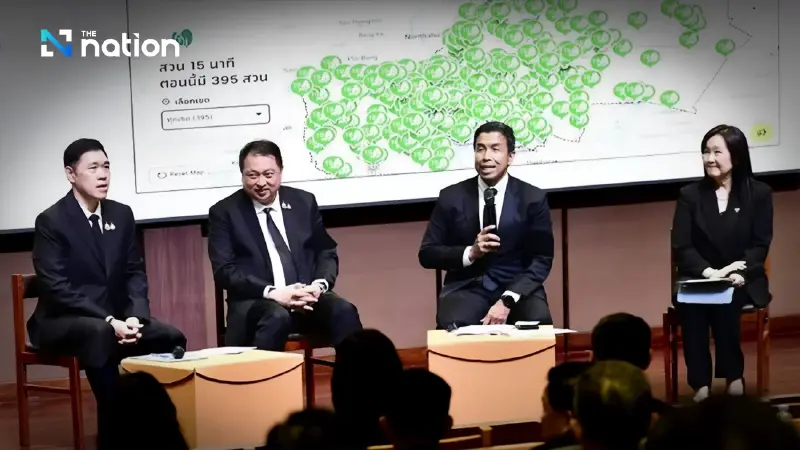


Bangkok's dust fight combines state and business efforts. Measures include vehicle repair incentives, city-wide truck bans, farm burning control, and providing dust-free rooms.
- The Thai government, including the Ministry of Natural Resources and Environment (MNRE) and the Bangkok Metropolitan Administration (BMA), is collaborating with private sector firms like the Federation of Thai Industries to launch the "Green List Plus" project to reduce PM2.5 dust.
- The "Green List Plus" initiative incentivizes vehicle owners to perform maintenance by offering discounts and benefits from participating companies, such as car service centers and retailers, for vehicles that register for a Green List Certificate.
- Key controls linked to the program include expanding a Low Emission Zone (LEZ) to ban large vehicles not registered on the Green List from all 50 districts of Bangkok and enforcing stricter black smoke emission standards for all vehicles.
The Ministry of Natural Resources and Environment (MNRE), through the Pollution Control Department (PCD), in collaboration with the Bangkok Metropolitan Administration (BMA) and the Automotive Industry Group of the Federation of Thai Industries (FTI), is moving forward with efforts to tackle the small dust particle (PM2.5) issue during the end-of-year season.
This initiative, driven by the "Green List Plus: Fight Dust, Reduce PM2.5" project, was announced on October 29, 2025, at the MNRE, and aims to promote public participation in reducing pollution from various sources and to stimulate cooperation from the business sector through incentive measures.
A National Agenda
Suchart Chomklin, Deputy Prime Minister and Minister of Natural Resources and Environment, stated that resolving this dust problem requires cooperation from many sectors, as policies from the central government alone cannot succeed.

"Prime Minister Anutin Charnvirakul attaches great importance to elevating the country's air quality and has assigned me this task. This operation is part of the government's larger plan to control and mitigate the PM2.5 dust problem in Bangkok and surrounding areas. As dust can spread with the wind across provinces and even borders, it is essential to focus on managing the areas around Bangkok simultaneously," he said.

Tackling Agricultural Burning
Suchart mentioned that the Bangkok Governor Chadchart Sittipunt has been coordinating with surrounding provinces to jointly find assistance measures. Furthermore, the MNRE is providing knowledge to farmers, especially rice and sugarcane growers, to promote alternative methods for managing stubble and agricultural waste without resorting to burning.
"The goal is not to blame farmers as the root cause of the problem, but to help them find constructive solutions. Burning is often a result of the higher production costs incurred if they don't burn, as well as the shortage of sugarcane cutters from neighbouring countries caused by border closures in the past," he explained.
Regarding transboundary haze, the government is working to address the issue, particularly concerning the burning of maize for animal feed in neighbouring countries, which is a source of small dust particles affecting Thailand's air quality.
The Ministry of Commerce has previously considered avoiding the purchase of maize resulting from burning as a collaborative effort to sustainably reduce emissions and alleviate the PM2.5 problem.

Meeting with Provincial Governors
Suchart added that there will be coordination with the cluster of surrounding provinces, including a meeting with the provincial governors on November 5, to request cooperation and clarify the allocation of government budgets.
He emphasised that all provinces must prioritise improving the quality of life and health of the public above infrastructure development, such as roads, and stressed that all provinces must be proactive and seriously address public health issues.
Strict Laws, Comprehensive Cooperation, and Health Protection
Chadchart noted that Bangkok has two seasons: the rainy season and the dust season. Now that the rainy season and flooding issues have passed, the city is entering the dust season.
The main factors contributing to the dust are diesel vehicles, biomass burning from surrounding areas, and the weather conditions expected late this year.
"Following the National Environment Committee's declaration of Bangkok as a Pollution Control Zone from November to March each year, all relevant sectors, government agencies and the private sector, have joined forces to drive the 'Green List Plus: Fight Dust, Reduce PM2.5' project, along with other measures, to reduce and eliminate pollution in Bangkok.
These measures are grouped into a 4-3-3 framework: 4 Strict Laws, 3 Comprehensive Cooperation, and 3 Health Protection for the public, totalling 10 measures."
10 Measures to Reduce Dust
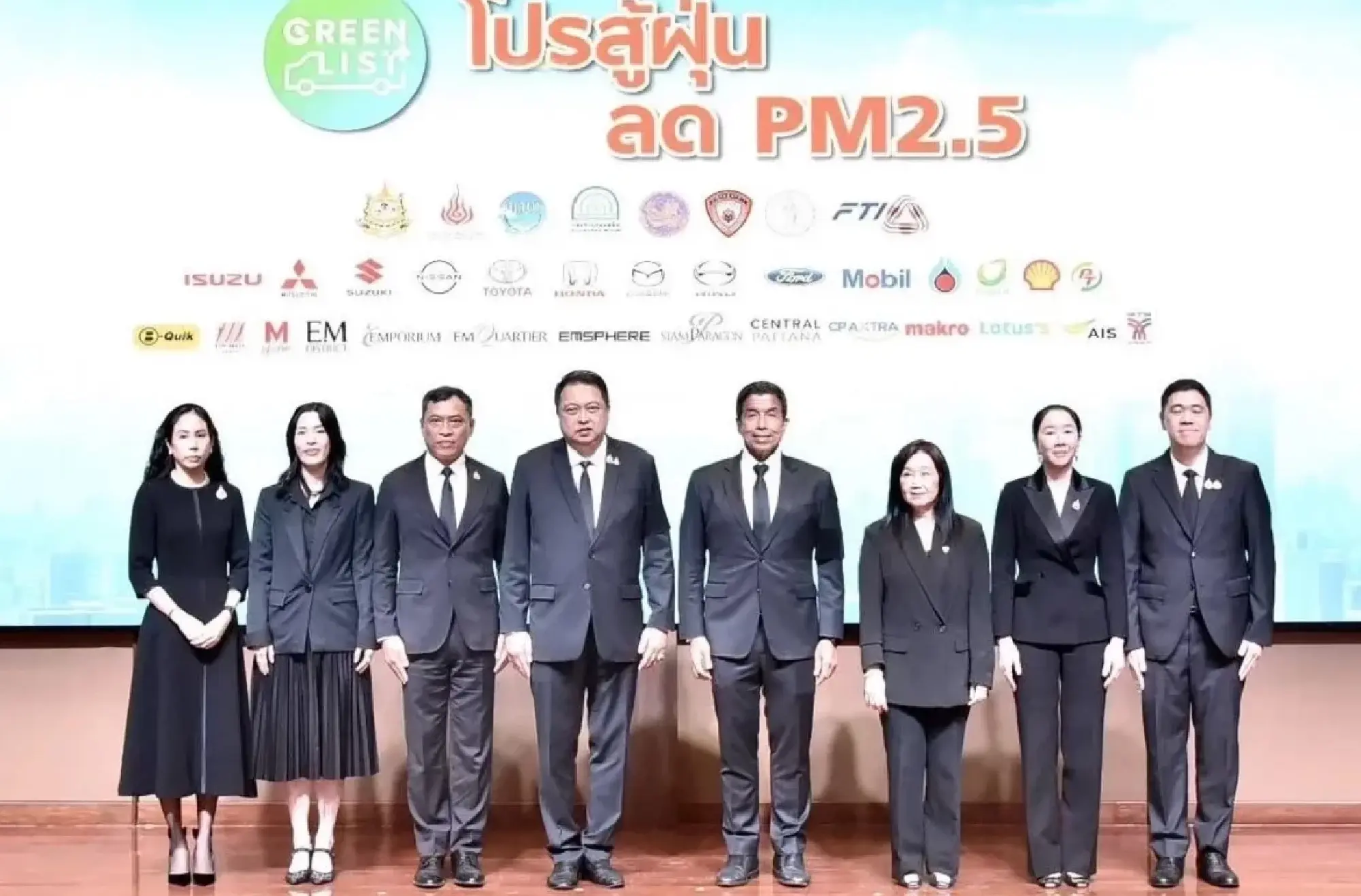
1."This Car Reduces Dust" Project: The third consecutive year of collaboration across all sectors, now developed into Green List Plus for 4-wheel vehicles. Owners are encouraged to change engine oil and air filters at participating service centers, such as those from car manufacturers (e.g., Honda, Toyota, Isuzu, Ford, Nissan, Suzuki, Mazda, Mitsubishi, Hino), petrol stations (PTT, Bangchak, Shell, PT), B-Quik service centers, and others, to receive discounts on labour, spare parts, or according to specified conditions, from November 1, 2025, to January 31, 2026.
Goal: 500,000 vehicles. Vehicles can also register for the Green List Plus to receive a Green List Certificate for 4-wheel vehicles, which provides additional benefits from partners like The Mall Group, Central Pattana, CP Axtra, BTS, AIS, or other participating companies (e.g., extended free parking or Gift Vouchers).
2. Low Emission Zone (LEZ) Measure: Expanded from previously banning 6-wheel vehicles and above within the Ratchadaphisek ring road to banning them across all 50 districts of Bangkok, except for vehicles registered on the Green List. Registration has been open since October 20, 2025, via the website https://lez.bangkok.go.th, with over 4,600 6-wheel vehicles and above already registered.
3. Black Smoke Standard: The standard will be lowered from not exceeding 30% to not exceeding 20%. The Governor thanked the MNRE for successfully pushing this law, which will take effect on November 1, 2025. Another Ministerial Regulation is being jointly pushed to further reduce the time period during which vehicles emitting excess black smoke are allowed on the road.
4. Construction Sites, Factories, and Establishments: All vehicles used must have black smoke levels within the standard and must be registered on the Green List with the BMA.
5. Installation of Continuous Emission Monitoring Systems (CEMS) in factories with boilers, and the revision of NOx and SO2 of TSP standards to be stricter, with cooperation from the Ministry of Industry in drafting the relevant law.
6. Reduction of Agricultural Burning in Surrounding Provinces: Utilising the mechanism of the Pollution Control Zone to establish a joint agreement. The BMA has already begun discussions with Nakhon Nayok Province on Saturday, October 25, 2025.
7. Upgrading Dust Alerts via Cell Broadcast: In discussion with the Department of Disaster Prevention and Mitigation to develop a 3-7 day advance dust situation forecasting system. The public can report PM2.5 issues through Traffy Fondue, and Super Station Real-Time units will be installed to analyse the composition of PM2.5 in real-time.
8. Provision of Dust-Free Rooms: To be established in every room of all preschool development centres and Kindergarten levels 1-3 in BMA-affiliated schools.
9. Work From Home (WFH): The target this year is 300,000 participants. The public is invited to register as a WFH network partner. Two formats have been established: when the BMA requests cooperation, and continuous WFH for at least one day per week throughout January to March 2026.
10. Planting One Million Trees: To serve as a filtering barrier for dust, especially in the eastern zone of Bangkok. Over 2.2 million trees have already been registered for planting by the public.
Wirassanan Tuengthin
