
Solar storm not expected to affect public health in Thailand: GISTDA


Agencies using surveying systems, long-distance radio communications, drones and space technology were advised to closely monitor updates for possible signal inaccuracies.
- According to Thailand's GISTDA, the G4 level solar storm is not expected to pose a direct threat to public health or household electricity supplies.
- The storm is, however, expected to cause technical impacts, with warnings issued to satellite users, navigation systems, and aviation operators.
- Potential effects include inaccuracies in GPS signals, which could affect high-precision navigation, and intermittent signal loss for aviation radio communications.
- Low Earth orbit satellites may also be affected by increased atmospheric drag, causing them to lose altitude faster than normal and possibly requiring orbit adjustments.
The Geo-Informatics and Space Technology Development Agency (GISTDA) is closely monitoring the solar storm as it reaches Earth, saying that although Thailand lies in a low-latitude region, the country is still expected to feel effects from a Level G4 geomagnetic storm (severe geomagnetic storm).
It warned satellite users, navigation systems and aviation operators to watch for possible signal inaccuracies.
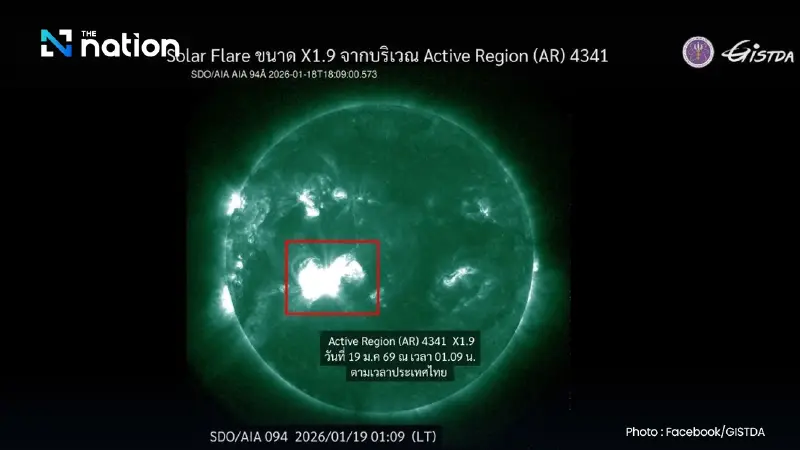
GISTDA said that on January 19, at 1.09am, a solar flare erupted from Active Region 4341.

It said the eruption released radiation across multiple wavelengths and also expelled hot material (plasma) and magnetic fields from the Sun in the form of a coronal mass ejection, which is travelling directly towards Earth.
GISTDA added that a coronal hole releasing solar wind from the Sun has contributed to the intensified geomagnetic activity.

Three key impacts to watch in Thailand
GISTDA said the G4 level is not expected to directly endanger the general public, but it may cause technical impacts on space, technology and communications systems as follows:
- Low Earth orbit satellites may lose altitude faster than expected
- Increased atmospheric drag may slow low Earth orbit satellites, such as Earth-observation satellites or space stations, causing them to lose altitude faster than normal. Satellite operators may need to prepare orbit adjustments.
- Global Positioning System navigation may become less accurate
- Satellite positioning signals may be inaccurate at certain times, which could affect high-precision navigation, surveying and mapping, automated drone flights and precision agriculture.
- Aviation radio communications may drop out intermittently
- High-frequency communications used in commercial and military aviation may experience intermittent signal loss. Pilots and air-traffic controllers were advised to exercise extra caution.


The Space Weather team will continue to monitor the situation closely and will issue further updates if conditions change.
The general public does not need to panic, as a geomagnetic storm at this level is not expected to affect human health or household electricity supply in Thailand.
However, agencies and operators involved in surveying systems, long-distance radio communications, drones and space technology were advised to monitor updates closely.


