
Consumers Council urges fast-track Clean Air Bill amid PM2.5 surge


Draft Clean Air Bill has already passed the House of Representatives with unanimous vote and is now under consideration in the Senate, crucial step before it can become law.
- The Thailand Consumers Council is urging political parties to fast-track the Clean Air Bill in response to worsening PM2.5 pollution, which it now considers a long-term "structural problem."
- The pollution crisis is causing significant public health issues, with state hospitals treating around 10 million affected patients annually, and creating enormous economic damage estimated at THB2.17 trillion per year.
- The Council views the bill as a critical tool to protect the public's right to clean air by setting health-based standards and establishing clear responsibilities for the state and polluters based on the "polluter pays" principle.
- The draft bill has already passed the House of Representatives and is now under consideration in the Senate, a crucial step before it can be enacted into law.
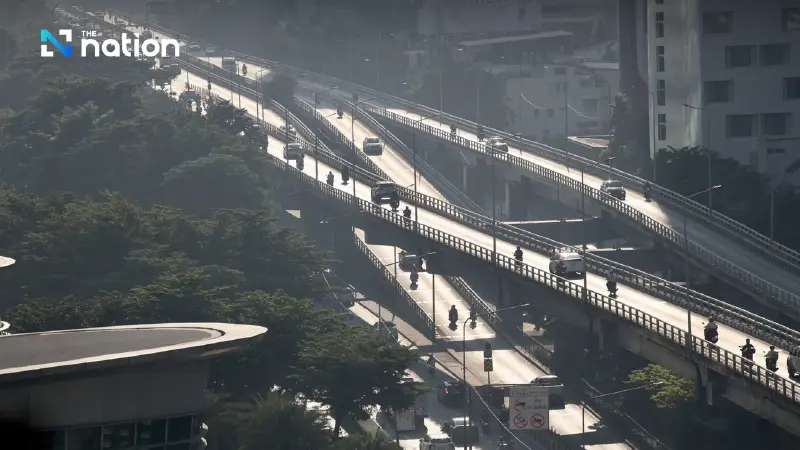
The PM2.5 fine-particulate situation in Thailand has continued to worsen.
The Bangkok Air Quality Information Centre reported that PM2.5 levels have exceeded the standard throughout the week, affecting public health on a wide scale.
The Thailand Consumers Council said toxic haze is no longer merely seasonal, but is becoming a long-term “structural problem” that harms health, the economy and quality of life.
It urged all political parties to accelerate the passage of the Clean Air Bill to protect people’s basic rights.
Monruedee Pho-in, Head of Policy and Innovation at the Thailand Consumers Council, said the current haze crisis stems from overlapping factors, including agricultural and forest burning, a transport system reliant on fossil fuels, an industrial sector that still lacks strict controls, and fragmented policymaking with weak enforcement mechanisms.
For years, measures have focused on short-term fixes rather than tackling root causes, leaving people repeatedly exposed to health risks, especially children, older people and those with chronic illnesses.
Data from the Department of Medical Services in 2025 indicated that state hospitals nationwide recorded around 10 million patients per year affected by PM2.5, excluding those treated at private hospitals and private clinics.

The most common conditions were respiratory diseases, followed by skin and eye diseases.
People with pre-existing conditions face a higher risk of severe complications, such as asthma flare-ups or pneumonia.
Long-term exposure also increases the risk of lung cancer and continues to drive up medical costs for both the state and households.
On the economic front, research by the Thailand Development Research Institute (TDRI) found that PM2.5 causes enormous damage to the Thai economy.
A study by Witsanu Attavanich estimated that losses to Thai households reach THB2.17 trillion per year.
In Bangkok and the metropolitan area alone, losses were valued at THB436 billion per year, covering health costs, productivity losses, and impacts on services and tourism.
A poor pollution image may also cause tourists to postpone travel and reduce spending, affecting national revenue in the long term.
In response, the Thailand Consumers Council proposed that the state urgently implement proactive health measures in both the short and long term.
In the short term, there should be an air-quality alert system that is easy to understand and accessible to all groups, support for standard-certified masks for vulnerable groups, expanded access to screening services for those affected, and work-from-home or learn-from-home measures when pollution exceeds the standard.
At the same time, health entitlements should be upgraded by making lung cancer screening a basic right across all treatment schemes, starting with high-risk groups in highly polluted areas.
On policy, the Council called for solutions tailored to local contexts: in agriculture, support alternatives to burning; in urban areas, cut vehicle pollution and promote public transport; and in forest and border areas, strengthen cross-area and cross-border cooperation.
It also urged decentralisation so local authorities can play a serious role in managing air quality.
At the heart of the issue is accelerating the Clean Air Bill, which the Council views as the key tool to protect people in four areas: setting health-centred air quality standards, clearly defining the responsibilities of the state and polluters, enabling public access to remedies and justice, and reducing health inequality through the public health system.
“The Clean Air Bill is not merely an environmental law; it is a law that protects people’s basic right to breathe clean, safe and quality air,” Monruedee said, calling on all political parties to push the bill as a national agenda based on the polluter pays principle, with the public’s voice at the centre of policy design.
Update the status of Thailand’s Clean Air Bill
1. Basic information about the draft law
The Clean Air Bill (Clean Air Act) is a draft law designed to address air pollution in a systematic way, covering pollution control, public health protection, and clearly defining the duties of the state and polluters.
2. Latest status of the bill
The draft Clean Air Bill has passed its third reading in the House of Representatives by a unanimous vote (more than 300 votes) and has been forwarded to the Senate for consideration—an important step before it can be promulgated as law.
3. Key focus areas of the draft law
The bill affirms people’s right to breathe clean air and includes measures to set air quality standards and enforcement mechanisms to protect public health.
It also sets out penalties and control measures for polluters, strengthening accountability for the state and for businesses that are sources of emissions.
4. Views from different sectors
Civil society and activists emphasise that the “polluter pays” principle is central to the bill; if this is weakened, the law will lose effectiveness.
Some business groups accept environmental principles but have called for careful consideration of economic impacts and adjustment to new standards.
Academics and pollution-control experts continue to support rapid passage, viewing air pollution as a public health emergency.
5. Next steps
After passing the House of Representatives, the draft bill must be considered by the Senate.
If approved, it must be published in the Royal Gazette to take effect as a fully enforceable law.
Current status summary (Apr–Jan 2026)
- Passed the third reading in the House of Representatives by unanimous vote
- Under consideration in the Senate
- If the Senate completes its review and it is published in the Royal Gazette, it will become the Clean Air Act in force in Thailand
