
Valentine’s Day flowers: meanings and the best pick for your partner
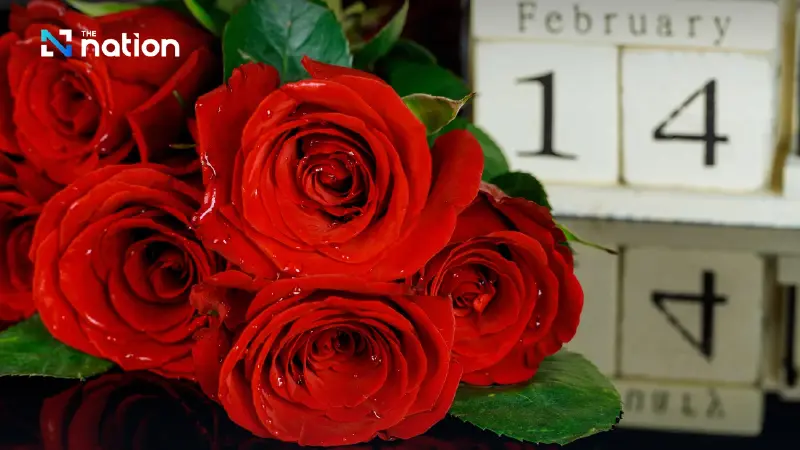


Valentine’s flowers aren’t just about romance; they can also express gratitude, sincerity, friendship, or lasting devotion, if you choose the right symbols.
- The rose is the traditional flower for Valentine's Day, with its connection to love originating from Greek, Roman, and Thai legends involving deities and royalty.
- Different colors of roses convey distinct messages: red signifies true love and passion, pink represents gentle affection, white symbolizes pure love, and yellow stands for friendship.
- The quantity of roses given also has specific meanings, ranging from a single rose for "love at first sight" to 108 roses for a marriage proposal or 999 for eternal love.
- Beyond roses, other flowers can be chosen to express affection, such as tulips for sincere love, lilies for deep relationships, carnations for care, and sunflowers for steady love.
Every year on February 14, Valentine’s Day is observed as a time when people around the world express love for their spouses, partners, and those close to them.
Traditions and customs passed down over hundreds of years have shaped it into the celebration we recognise today.
This year, it falls on Saturday (February 14).

In Greek–Roman legend, the flower most closely associated with Valentine’s Day is the rose, a symbol of love linked to the goddess Aphrodite.
She fell in love with a mortal young man named Adonis.
One day, Adonis was injured by a wild animal.
Aphrodite rushed to him and cut her feet on thorny bushes.
Her blood fell to the ground, mingling with her tears and the blood of her dying lover.
From that spot, a red rose is said to have bloomed, becoming a symbol of love born of sacrifice, and of deep, painful devotion.
Another legend tells of Cupid, the god of love and Aphrodite’s son, who accidentally stepped on rose thorns and was wounded.
His blood dripped onto a white rose, turning it red.
In Thai legend, there is also Madanabadha, a play by King Rama VI (King Vajiravudh).
It tells of Maddana, a celestial being who is cursed by the angel Suthet to become a rose in the human world after she refuses his love, and she can become human only on the night of the full moon.
She later falls in love with King Chaisen but, after being framed and mistreated, is forced to return permanently to being a rose, hence the “queen of flowers”.
Many other legends have become stories, beliefs, and practices, eventually shaping today’s widely shared customs.
The “rose” has therefore been elevated as the official flower of Valentine’s Day, and giving flowers on Valentine’s Day has become a symbol of love, along with other flowers, depending on their meanings and the number given, as follows:
Giving roses
- Red: true love, passion, and romance
- Pink: gentle affection, tenderness, and admiration
- White: pure and sincere love
- Yellow: friendship and shared happiness
The number of roses can also carry meanings, as follows
- 1 rose: you are the only one in my heart/love at first sight
- 2 roses: a love that is just you and me
- 3 roses: I love you
- 7 roses: being enchanted
- 9 roses: being together
- 11 roses: you are the one I love and who matters
- 12 roses: love with all my heart, and thank you for being with me
- 13 roses: best friends forever
- 15 roses: I’m sorry
- 24 roses: thinking of you 24 hours a day
- 36 roses: remembering the good times
- 40 roses: true love
- 50 roses: lasting love
- 99 roses: loving you until the last day
- 101 roses: loving only you
- 108 roses: a marriage proposal
- 365 roses: loving you every day
- 999 roses: loving you until the very last second
- 9,999 roses: love that lasts forever / eternal love
In addition, many other flowers can be used to express meaning, such as
- Tulips: steadfast and sincere love
- Carnations: love and care, passion, and goodwill
- Lilies: pure, sincere love, suited to deep, lasting relationships
- Hydrangeas: attentiveness and a stable bond
- Sunflowers: steady, bright love; Gypsophila (baby’s breath): love at first sight and sincerity
- Gerberas and irises can also be options to add colour and additional layers of meaning.
