
El Niño signs intensify, raising chances of hottest 2027
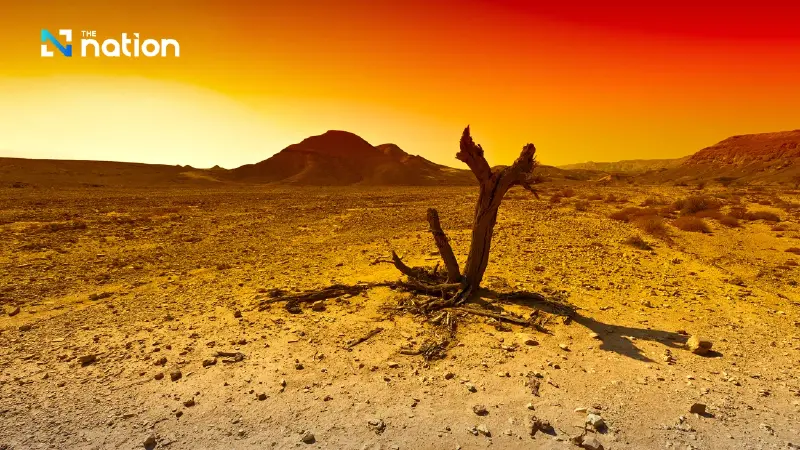


Meteorological agencies around the world have warned that an “El Niño” event could develop in the Pacific Ocean, potentially driving the global average temperature to a new record high by 2027.
This is not merely a temporary weather event.
It is unfolding against a backdrop of human-driven climate change, which could make the impacts more severe than anything previously recorded.
“El Niño” could make 2027 the hottest year
El Niño warms sea surface temperatures in the eastern and central equatorial Pacific above normal levels, often triggering sustained, unusually hot conditions around the world.
Under normal conditions, the trade winds blow from east to west, but during El Niño, they weaken.
This allows warm water that has built up to flow back towards the Americas, releasing vast amounts of heat into the atmosphere.
Meteorologists have detected a key early signal: exceptionally strong wind bursts in the remote western Pacific, the most intense in months.
These winds act like a shove, helping the warmest seawater on Earth shift eastwards, from around Guam towards the west coast of South America, an early sign of a transition towards El Niño conditions.
Dr Andrew Watkins of Monash University said a huge volume of warm water is currently stored in the tropical western Pacific, ready to surge back east as soon as the trade winds weaken, an ocean heat build-up that raises the likelihood of a record-hot year.
This aligns with the scientific principle that global temperatures often peak about three months after El Niño itself reaches its maximum intensity.
As a result, if this El Niño develops at moderate to strong levels, 2027 is highly likely to set a new global temperature record, as stored ocean heat is released into the atmosphere more strongly and persistently.
Dr Zeke Hausfather, a research scientist at Berkeley Earth, said that if El Niño develops later this year, it would mainly affect global surface temperatures in 2027 rather than 2026.

“Burning fossil fuels” is pushing temperatures higher
The burning of fossil fuels is heating the planet and increasingly overwhelming natural variability.
Global oceans have continued to break heat records for nine consecutive years, meaning the world is confronting a possible El Niño on top of already elevated background temperatures.
Meteorologist Eric Webb said that during strong El Niño events, the planet’s temperature “baseline” can jump upwards rapidly because greenhouse gas concentrations are so high that the climate system cannot fully shed the extra heat from one major El Niño before the next one arrives and pushes the baseline up again.
The World Meteorological Organisation (WMO) has reported a 98% chance that at least one year in 2023–2027 will be the hottest on record.
It also said there is a 66% chance that in at least one of those five years, the global average temperature will temporarily exceed 1.5°C above the pre-industrial level.
Chris Hewitt, Director of the WMO Climate Services Branch, stressed: “This is a warning sign showing that the world is failing to limit global warming properly. While a short-term overshoot of 1.5°C would not be a permanent breach of the Paris Agreement, it is a warning about the severity of what is unfolding.”
Severe impacts worldwide
El Niño not only raise global temperatures, but it can also drive unusually rapid sea-level rise.
New research indicates that Africa experienced a 73% increase in the rate of sea-level rise between 2009 and 2024, with El Niño identified as an important factor accelerating that increase.
Africa’s 38 coastal countries are especially vulnerable due to budget and equipment constraints in monitoring sea levels.
Marine heatwaves linked to El Niño threaten habitats and damage fisheries ecosystems, critical to coastal economies and a major food source for large populations.
In the United States, El Niño can alter the jet stream, shifting storm tracks and seasonal patterns.
Although El Niño often suppresses Atlantic hurricane activity, record-high ocean heat could blunt that effect and still allow storms to remain highly intense.
In other regions, El Niño is often associated with severe drought in Australia, Indonesia and parts of South Asia.
At the same time, parts of South America, the southern United States and East Africa may see substantially higher rainfall, increasing the risk of severe flooding.
Former WMO Secretary-General Professor Petteri Taalas has stressed that declaring El Niño should be a signal for governments worldwide to act and prepare on all fronts, because early preparation and early-warning systems are vital for protecting lives and property, especially for vulnerable communities.
Oceanographic Magazine
The Guardian
The Washington Post
