
NBTC urgently calls mobile network operators over student SIMs used in crimes
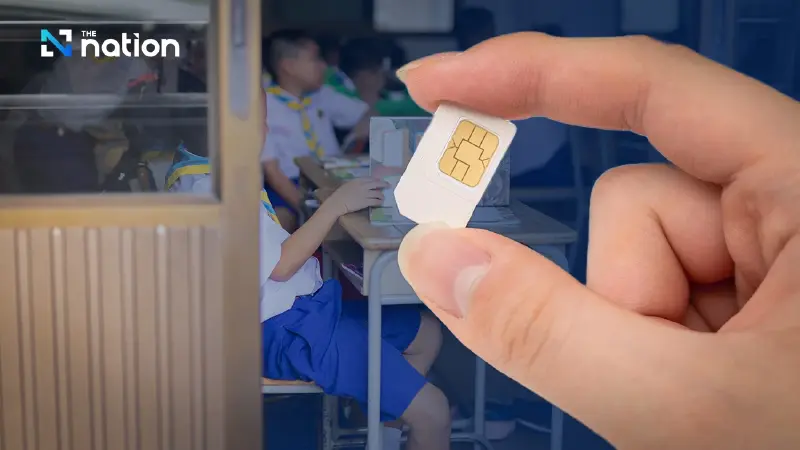


Sales representatives exploited school activities to harvest students' facial scans, activating hundreds of illicit SIM cards. In response, the NBTC has ordered an immediate suspension of the affected numbers to halt expanding cybercrime networks.
- The NBTC summoned mobile network operators after their sales representatives had students at schools use facial scans to activate multiple SIM cards.
- An investigation revealed that some of these SIM cards, secretly registered by the representatives, had already been used to commit technology crimes.
- In response, the NBTC ordered the immediate suspension of all 495 SIM cards involved in the scheme to prevent further criminal activity.
- The NBTC has now banned operators from selling or distributing SIM cards during activities in schools and holds them directly responsible for their representatives' actions.
The Office of the National Broadcasting and Telecommunications Commission, or the Office of the NBTC, urgently summoned mobile network operators for an explanation after discovering that sales representatives had distributed SIM cards to students in schools.
The students were asked to register and scan their faces to activate multiple numbers, but it was found that some of these SIM cards had already been used to commit technology crimes.

Trairat Viriyasirikul, Deputy Secretary-General and Acting Secretary-General of the Office of the NBTC, revealed that the Office of the NBTC recently summoned the mobile network operators to explain the situation.
This came after receiving reports that certain sales representatives took advantage of school activities to distribute prepaid SIM cards to students, having them register and scan their faces to activate multiple numbers per person.
An investigation conducted jointly with police officers revealed that out of the 495 SIM cards activated through the students' facial scans, 27 SIM cards registered by the representatives had already been used to commit technology crimes.
Therefore, the Office issued an order for the mobile network operators to immediately suspend the usage of all numbers related to this case today in order to prevent the potential widespread expansion of technology crime networks.
Trairat stated that the telephone numbers in this case were not numbers that the students intended to activate themselves.
Instead, they were secretly registered as additional numbers by the sales representatives, which is considered a significant risk as they could be used as tools to commit technology crimes.
These are numbers that the sales representatives secretly registered for the children, not the numbers the children actually wanted to use, so it is necessary to suspend them all because there is a high risk of them being used to commit technology crimes.
If the companies are allowed to go to the schools to have the children verify their identities one by one, it might take too long and would not keep up with the situation.
He emphasised that taking children's personal data, especially biometric data like facial scans, to register numerous phone numbers to benefit criminal networks is unacceptable, and it is necessary to urgently cut off the cycle at its source.
Furthermore, the Office of the NBTC has firmly instructed all mobile network operators that if they wish to organise educational activities within educational institutions in the future, they must clearly separate the educational activities from the sale or distribution of SIM cards.
It is not allowed to sell or distribute SIM cards alongside activities in schools.
This guideline aims to ensure that activities held in educational institutions are genuinely activities that promote knowledge for children and youth, rather than serving as a marketing channel to distribute SIM cards or register additional phone numbers through sales representatives.
At the same time, the Office of the NBTC also emphasised the responsibility of mobile network operators in supervising their sales representatives.
The operators are held directly responsible for the business operations of their representative networks.
If a sales representative violates the rules or causes damage, the operator must also take joint responsibility for the incident.
Previously, on February 25, the Office of the NBTC issued a circular letter to all mobile network operators to strictly comply with SIM card registration measures.
They were also instructed to verify and screen the information of users under 18 years of age, especially in cases where more than one SIM card is registered.
The operators must report the verification results back to the Office within 3 working days so that the agency can monitor abnormalities in SIM card activations among youth and watch out for phone numbers being used to commit cybercrimes without the knowledge of the children or their parents.
These measures are part of upgrading the country's SIM card registration supervision system to prevent phone numbers from being used as tools to commit technology crimes, which are currently becoming more complex and causing more widespread damage to the public.
