
Anutin calls oil sector talks over vanishing fuel shortages at petrol stations
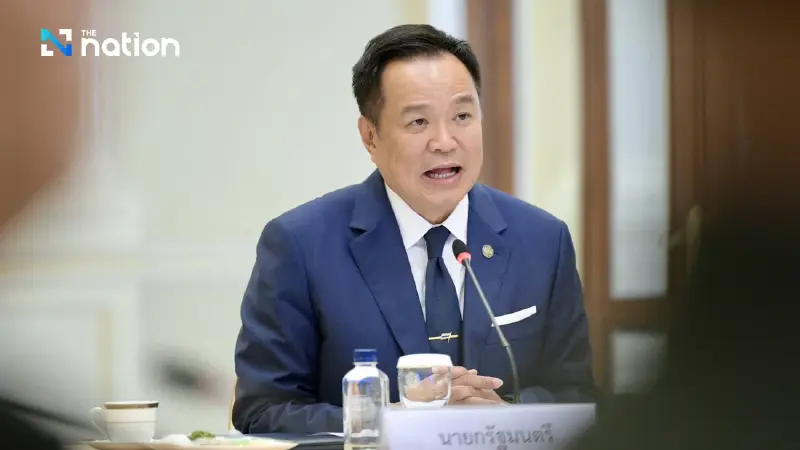


Anutin will bring together refiners, traders and other key players in the fuel supply chain to examine supply flows and address shortages reported at some petrol stations, despite official assurances that national stocks remain sufficient.
- Prime Minister Anutin Charnvirakul will chair a meeting with all sectors of the oil industry to investigate and find solutions for fuel shortages at petrol stations.
- The talks are prompted by conflicting reports, as the Energy Ministry claims Thailand has 101 days of oil reserves, while station owners report receiving significantly reduced fuel supplies.
- The meeting aims to determine the facts behind the "vanished" oil, with officials questioning whether it is being stockpiled or illicitly exported.

Phiphat Ratchakitprakarn, Deputy Prime Minister and Minister of Transport, in his capacity as director of the fuel crisis management centre, said that on March 19, Prime Minister Anutin Charnvirakul would chair a meeting of the Joint Management and Monitoring Centre for the Situation in the Middle East.
All parties involved in the oil industry and oil trade across the entire energy supply chain, including refineries, transport operators, oil traders and oil wholesalers (jobbers), have also been called to a joint meeting at Parliament to find a solution and verify the facts surrounding the issue of oil volumes in Thailand.
On the government side, Deputy Prime Minister and Finance Minister Ekniti Nitithanprapas will look into the tax structure, while Commerce Minister Suphajee Suthumpun will examine the impact on goods.
Representatives from several ministries will also join the discussions to seek a joint solution.
Regarding the oil shortages reported in many areas, Phiphat admitted that he himself had doubts about the facts, as he had found contradictions between information from the public and private sectors.
He said the Ministry of Energy had confirmed that Thailand still had oil reserves for 101 days, while refineries were continuing to operate at full capacity.
“I myself have service stations under several brands, so I can make comparisons. In the past, a station could sell 15,000 litres a day, but today some brands are supplying my stations with only 4,000-5,000 litres. Ten thousand litres a day have disappeared. If we are being told there is no shortage, then how can the oil simply vanish? That means at least one person is lying,” Phiphat said.
Phiphat also raised questions over the possibility that oil was being illicitly shipped abroad for sale by sea.
He said he had asked the Department of Energy Business whether seaborne exports had already been suspended, because if there was no shortage of storage capacity in the country, oil being refined every day should not be running short.
He also insisted that the government had never imposed quotas on oil sales, and that any restrictions had come from traders or refineries themselves.
“Tomorrow we will lay everything bare and examine each party one by one to see who is stockpiling oil and who is lying.
We will expose any falsehoods and establish where the supposedly vanished oil has gone, despite what refineries and other agencies are saying about there being no shortage,” Phiphat said.
When asked about suggestions that refineries were selling previously purchased oil at current prices and making large profits, Phiphat said he could not explain or answer on behalf of refineries or operators.
He said it first had to be understood that crude oil was not bought today and received today; orders had to be placed at least three months in advance.
Therefore, the oil being refined today was certainly crude bought before the conflict began.
The question then is: if that oil was bought cheaply, why is it being sold at high prices? But if today the price is 100 dollars, and in three months the crude arrives at the depot, and then another three months later the war ends, and crude prices fall to 60 dollars, a refinery that took delivery at 100 dollars would not be able to keep selling it at 100 dollars at that point.
We are talking about fair dealing.
There are rules of commerce and rules of trading; it cannot be one-sided.
“When they bought crude cheaply, they made profits today. But later, when the war ends, they may incur losses. Let me say this to the media: we all know how to add, subtract, multiply and divide. So fairness must also be given to refineries and operators. It is well known that I have service stations, I have brands, and I trade in oil, but I do not buy crude and refine it myself because I do not own a refinery. I buy today and sell at today’s price, so my risk is lower. It is not the same for refineries: they buy today but only receive crude for refining three months later, and no one knows what the price will be then. So I, as a trader, and the refineries are in different positions. Refineries face a greater risk than I do. Mine is a day-to-day buy-and-sell business. So whatever the case, I cannot answer on behalf of refineries in every respect. But those are the facts.”
When asked whether the private sector’s proposal to subsidise oil prices directly for jobbers could be implemented, Phiphat said it could not be done because the law did not allow it, and the problem would have to be addressed through other means.
