
ASEAN+3 speeds up emergency financing tool as global risks rise
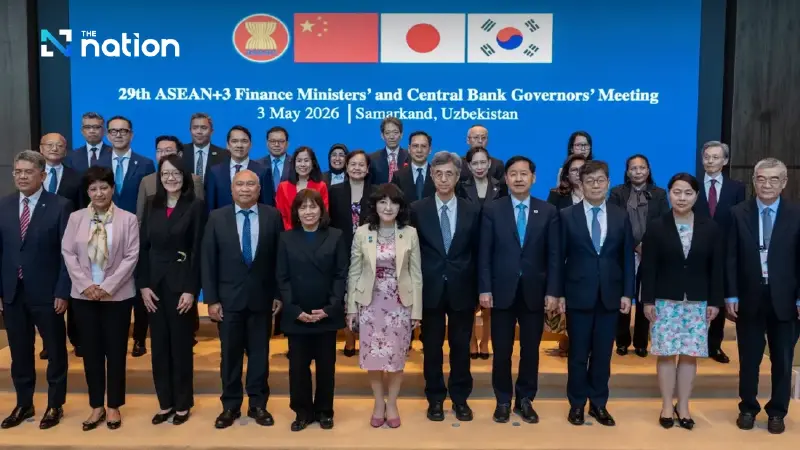


ASEAN+3 is pushing a rapid financing facility to help members access emergency funds quickly when external shocks hit their economies.
ASEAN+3 finance ministers and central bank governors are moving to strengthen the region’s financial defences by accelerating an emergency financing mechanism designed to help member countries respond quickly to global economic shocks.
The push comes as the global economy faces heightened volatility from US tariff issues and oil-price pressures linked to conflict involving the United States, Israel and Iran. The uncertainty has prompted many countries to diversify risks away from areas affected by conflict.
At the 29th ASEAN+3 Finance Ministers’ and Central Bank Governors’ Meeting, held in Samarkand, Uzbekistan, on Sunday (May 3), policymakers from ASEAN, China, Japan and South Korea agreed to deepen financial cooperation to reinforce the region’s resilience.
A key issue was support for the entry into force of the Rapid Financing Facility (RFF) under the Chiang Mai Initiative Multilateralisation (CMIM). The mechanism is intended to allow member countries to gain timely access to emergency funding when they face urgent balance-of-payments needs caused by unexpected external shocks.
The move comes amid severe global economic volatility, including wider conflict in the Middle East, which has affected energy prices, commodity markets and regional currency movements.
The meeting also endorsed a number of related measures.
The first was reform of the CMIM funding structure. Participants approved a roadmap to shift the CMIM towards a Paid-in Capital (PIC) model, which is expected to strengthen the stability and effectiveness of the regional and global financial safety net.
The second concerned the role of the ASEAN+3 Macroeconomic Research Office (AMRO) as it marks its 10th anniversary. Members congratulated AMRO on a decade of work as a trusted policy adviser and supported its “Strategic Direction 2030” plan to improve risk surveillance and provide more precise policy advice.
The third issue was the upgrading of the region’s bond markets. The meeting agreed to elevate the Asian Bond Markets Initiative (ABMI) into the Asian Bond and Financial Markets Initiative (ABFMI), with the aim of broadening cooperation beyond bonds to include a wider range of financial instruments and support more efficient fundraising within the region.
The fourth issue was Disaster Risk Financing and Insurance (DRFI). The meeting endorsed the DRFI work plan for 2026–2028 to establish a framework for managing fiscal risks arising from natural disasters. The Asian Development Bank (ADB) will also transition into the role of permanent secretariat for the initiative.
The fifth area was digital financial innovation. The meeting agreed to further develop cross-border digital payments and the use of new technologies, such as tokenisation, to enhance regional financial connectivity while still taking into account financial stability and monetary sovereignty.

Joven Z Balbosa, Undersecretary for the International Finance Group at the Philippine Department of Finance, responding to a question from Bangkokbiznews, said Asia, particularly ASEAN and its partners, had a large population base and strong market potential.
He said the region should accelerate international cooperation through “regulatory harmonisation” to improve economic efficiency, technology use and productivity.
He stressed the importance of developing a regional digital payment system, saying it would help small entrepreneurs and SMEs conduct cross-border transactions more conveniently and quickly, strengthening the competitiveness of smaller businesses in the digital era.
Balbosa also raised the issue of migrant workers, citing the Philippines as an example of a country with more than 10 million workers overseas. Remittances, he said, are a key mechanism supporting both the economy and families.
Greater alignment between national financial systems would help reduce costs and make cross-border money transfers more convenient, he said.
He also pointed to lessons from the Asian financial crisis, saying the region had sought to advance various measures and mechanisms to strengthen its financial system and prevent a repeat of such a crisis in the future.
