
Ministry of Public Health mulls cross-border health insurance
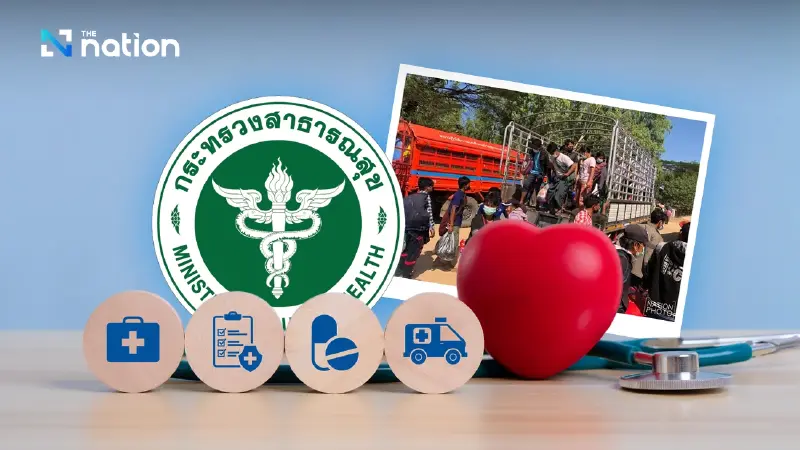


The ministry is considering extra health insurance requirements for foreigners entering Thailand after unpaid treatment bills left public hospitals under strain.
- Thailand's border hospitals are facing a financial crisis, shouldering billions of baht in uncollectible costs from treating foreign nationals from neighboring countries.
- In response, the Ministry of Public Health is developing a policy that would require foreigners entering Thailand to pay for additional health insurance.
- This proposed insurance system is being considered as a long-term, structural solution to alleviate the significant budget burden on the Thai healthcare system.
Pattana Promphat, Minister of Public Health, said in an interview on March 31, 2026, at the Public Health Ministry that since taking office, he had been aware of problems along Thailand’s border areas, where neighbouring countries still face sanitation and hygiene issues.
Border hospitals have had to shoulder this burden.
He thanked doctors nationwide for caring for fellow human beings, but said the challenge was funding, as Thailand has limits on how it can spend money in carrying out its work.
He said this was a sensitive issue in caring for patients, regardless of nationality.
“After learning that Umphang Hospital was facing a financial crisis and had no money to pay its personnel, I discussed the matter with the permanent secretary of the Public Health Ministry and confirmed that budget support would be provided so that patient services can continue without interruption and medical personnel receive the compensation due to them for caring for patients,” Pattana said.
Pattana added that there are several problems affecting border hospitals, including fighting in neighbouring countries, with people then crossing over for treatment; diseases arising in neighbouring countries, with patients then coming to Thailand for care; and refugee camp areas, where foreign funding has been cut.
He said many factors were combining, while the National Health Security Office (NHSO) had provided some funding and all parties, including the NHSO, were accelerating reimbursements.
He said the ministry had adopted the “One Region One Province One Hospital” management model, in line with the policy of the permanent secretary of the Public Health Ministry and the ministry itself, with large hospitals stepping in to care for and support smaller hospitals or those facing problems.
In Umphang Hospital’s case, hospitals in the area had already stepped in with donations of THB5 million and THB10 million, with Mae Sot Hospital contributing THB10 million.
Pattana also said that, in the long term, authorities would have to assess how much capacity there was to treat Thai patients and how much capacity there was to care for foreign patients or those from neighbouring countries.
Each area faced different problems, and the details would be examined.
He said the issue was not limited to migrant patients alone, as hospitals under the Public Health Ministry nationwide are currently providing services to foreign and migrant patients entering Thailand, but are unable to recover several billion baht a year, creating a budget burden as well.
He said a policy was being developed to look at various insurance and health insurance arrangements, to require foreigners entering Thailand to pay additional health insurance.
The format would be announced later.
On the resolution of the 18th National Health Assembly to set up a dedicated fund, with the government initially providing THB100 million to THB200 million before seeking support from civil society or other sources, Pattana said the bigger picture must be considered first, including how Thailand’s budget should be allocated, as the issue also overlaps with international matters.
If the funding is intended to cover care for foreigners, that would need to be considered separately, while care for Thai people is already part of the ministry’s mandate.
He added that solving the problem on that scale, including the fund proposal, requires careful consideration from all sides, as he does not want short-term measures to be used to address long-term problems.
Structural solutions are needed.
On proposals to adjust the allocation and management of the gold card scheme budget and reform the NHSO, Pattana said such proposals had been raised from his first days in office.
He said the matter was now being adjusted and discussed, and that many parts of the NHSO had gradually become more cooperative.
Everything had its process.
Meanwhile, uncollectible healthcare costs in border areas were as follows:
- 2019: around THB1.894 billion
- 2020: around THB1.763 billion
- 2021: around THB3.514 billion
- 2022: around THB3.597 billion
- 2023: around THB2.054 billion
- 2024: around THB2.315 billion
Uncollectible costs in 2024 by border area (as of February 28, 2025)
- Thai-Myanmar border: 76.3% / 570,000 service visits by foreign nationals / THB1.8 billion uncollected
- Thai-Cambodian border: 12% / 160,000 service visits by foreign nationals / THB277 million uncollected
- Thai-Lao border: 7.8% / 100,000 service visits by foreign nationals / THB180 million uncollected
- Thai-Malaysian border: 4% / 41,000 service visits by foreign nationals / THB93 million uncollected
