
Countdown to BTS concession expiry: Interior Ministry to decide Green Line's fate
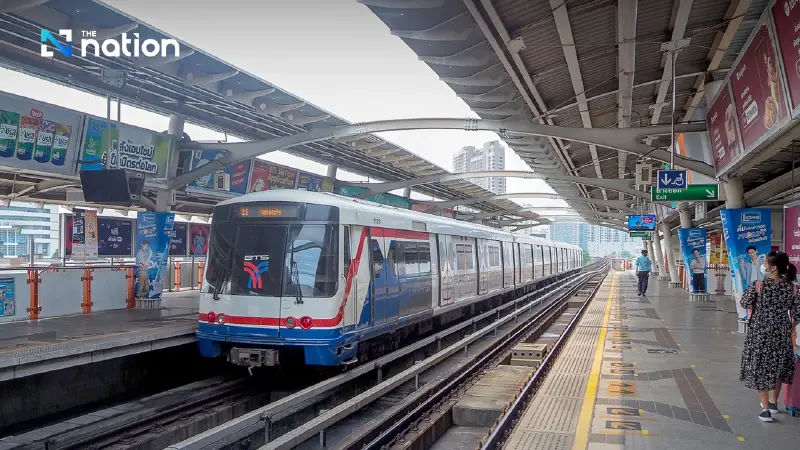


The concession for BTS’s core Green Line will expire in 2029, prompting the Bangkok Metropolitan Administration (BMA) to prepare for its future management. BMA is currently studying and preparing to launch a new public-private partnership (PPP) bidding process, with a clear model expected by 2026.
- The 30-year concession for the core BTS Green Line, operated by Bangkok Mass Transit System Public Company Limited (BTSC), is set to expire in 2029, after which all assets must be transferred to the Bangkok Metropolitan Administration (BMA).
- The BMA is conducting a study to determine a new Public-Private Partnership (PPP) model for the line's future operations, with a proposal scheduled for submission to the Ministry of the Interior for approval by June 2026.
- Following potential approval from the ministry and the Cabinet, a new bidding process to select a private partner is planned to begin by March 2028, ahead of the 2029 concession expiry.
- A complicating factor is that BTSC holds separate operation and maintenance contracts for the entire Green Line network until 2042, meaning any new operator of the core route will still be required to pay management fees to BTSC.
The Green Line was Thailand’s first electric rail mass transit project. Thanayong Group won the concession bid and subsequently established the Bangkok Mass Transit System Public Company Limited (BTSC), which was granted a concession contract by the Bangkok Metropolitan Administration (BMA) to construct and operate the system.
Under the agreement, the BMA was responsible for land acquisition, while the private sector financed the project entirely, investing 51 billion baht.
The initial concession covered two sections, Mo Chit to On Nut and National Stadium to Saphan Taksin, which opened in 1999. The concession period runs for 30 years, from 1999 to 2029, after which all assets must be transferred to the BMA.
Today, the entire Green Line network consists of 60 stations spanning 68.25 kilometres, with Siam station serving as the central interchange.
In addition, BTSC was awarded separate contracts to operate and maintain Green Line extensions, for which the BMA currently owes around 34 billion baht in unpaid fees. These operation-and-maintenance contracts, which expire in 2042, include:
- 2012 – Operation of the first extension: Saphan Taksin–Wongwian Yai and On Nut–Bearing.
- 2013 – Operation of the first extension: Wongwian Yai–Talat Phlu–Bang Wa.
- 2017–2020 – Operation of the second extension: Bearing–Samut Prakan and Mo Chit–Khu Khot.
Sitthiporn Somkitsan, Director of the BMA’s Traffic and Transport Department, spoke at a seminar held to publicise the study and analysis of the Bangkok Mass Transit System Green Line project after the expiry of its 30-year concession. The review aims to ensure compliance with the 2019 Public–Private Partnership (PPP) Act and to gather recommendations for preparing new bidding documents.
The Green Line is regarded as one of the BMA’s key responsibilities in managing Bangkok’s rail transit system, serving as the backbone of urban transport. It was launched in 1999 as Thailand’s first electric train system, comprising two routes, the Sukhumvit Line and the Silom Line.

Later, the BMA invested in constructing the civil works for the Green Line’s first extension, while the Mass Rapid Transit Authority of Thailand (MRTA) undertook the construction of the second extension.
In 2018, the Cabinet resolved to authorise the BMA to operate the second extension and approved the transfer of its assets to the BMA. The decision was made to ensure efficiency and provide Bangkok residents with a more seamless travel experience under a unified management system.
Studying PPP model ahead of new bidding
Krungthep Turakij reported that the recent seminar focused on the Green Line’s core route, Mo Chit to On Nut and National Stadium to Saphan Taksin, covering 23.5 kilometres with 24 stations. The project is currently operated under a 30-year PPP concession (1999–2029). Once the concession expires in 2029, all assets must be transferred to the BMA.
To ensure continuity of services and integration with Extensions 1 and 2, as well as compliance with the 2019 PPP Act, the BMA’s Traffic and Transport Department has commissioned consultants to study and analyse options for the Green Line’s future operations after the concession ends.
The department will gather opinions and recommendations from all stakeholders as part of the study. It also plans to hold another round of public hearings with potential private investors in November and December 2025, before presenting the findings to the private sector.
Green Line PPP model to be proposed for Cabinet approval by 2026
Representatives from the Green Line project consultancy team stated that the feasibility study for the PPP model for the core Green Line route, Mo Chit to On Nut and National Stadium to Saphan Taksin, is currently in progress.
As of now, the consultancy team has gathered about 43% of the necessary data, and they expect the study to be completed by January 2026. The next step will involve finalising the feasibility study for the most appropriate PPP model.
By 2026, a clear and viable PPP model is expected to be presented for consideration, with the aim of preparing for the bidding process to select a private partner for the project. After completing the study, the proposal will be submitted for approval by the Ministry of the Interior.
The current plan is to present the proposal for approval by June 2026. If approved, it will then go to the Cabinet for further review in April 2027. The bid documents (Terms of Reference or TOR) will be prepared immediately to invite private sector proposals by March 2028.
Under the law, when a concession agreement for a PPP is approaching its expiration, the feasibility study for the future operations must begin five years prior. For the Green Line, this process is focused on evaluating which management model will be most suitable after the concession ends in 2029.
The analysis also includes evaluating revenue from fares, advertising media, and assets such as the Green Line stations and office buildings in Chatuchak. With continued growth in fare revenue and government support for electric trains as a key mass transit option, this project presents significant opportunities for private investors involved in the bidding process.
PPP Gross Cost model: Low risk for the state, revenue retained by the government
Due to the positive factors surrounding the Green Line project, the consultants have assessed that it has high value with low risk. As a result, the most suitable PPP model at present may be the PPP Gross Cost model, where the government would collect revenue from fares and commercial income. Under this model, the state assumes all revenue risks and pays compensation to the private sector through management fees for the operation of the railway system. This model is currently used in several projects, such as the Purple Line.
The project consultants noted that while the PPP Gross Cost model seems appropriate for low-risk projects, a final decision on the best PPP model will depend on the results of the ongoing feasibility study, which will compare all potential models. This includes PPP Net Cost, where the private sector collects revenues, assumes the risks, and pays a share of the proceeds to the government.
“The final structure may see the BMA managing the project directly and hiring a private operator, or it could be entirely outsourced to the private sector. Alternatively, the Ministry of Transport may take over the management. Regardless of the model, we do not anticipate any adverse effects on the public. The upcoming Joint Ticketing Act will ensure smooth integration of all services, allowing passengers to seamlessly switch between different modes of transport,” the consultants said.
Regarding the possibility of allowing private companies to submit proposals for the project, it is expected that the current concessionaire will have an advantage compared to other bidders. However, the final approach may involve negotiating with the current concessionaire to ensure the continuity of services. This option remains part of the ongoing feasibility study.
BTSC signals interest in competing for Green Line management
The Green Line's core route, Mo Chit to On Nut and National Stadium to Saphan Taksin, is set to have its concession expire in 2029. However, the BTSC) will continue to hold an operation and maintenance contract for the Green Line until 2042, as well as for Extensions 1 and 2, with these contracts also ending in 2042.
As a result, the private sector concessionaire for the Green Line project will be required to pay a management fee to BTSC, as per the terms of the existing contract.
Project consultants stated that any entity awarded the right to manage the core Green Line after 2029 will still need to compensate BTSC. However, the concessions for the Green Line extensions are separate and not linked to this agreement.
The responsibility for paying the operational management fees for the Green Line will remain with the BMA. Despite this, there is confidence that the project will attract investor interest due to its low risk and the potential for high revenue generation. Even with the management fees paid to the private sector under the original contract, the project remains financially viable.
A source from BTSC told Krungthep Turakij that the company is interested in bidding for the core Green Line management contract when BMA opens the project for private investment. However, BTSC is awaiting a clearer assessment of the project’s viability and study results before determining whether it will proceed with a bid. The company assured that the project’s outcome will not affect its operations, as its management contract will extend until 2042.
Concession renewal efforts for BTSC unsuccessful
Reports indicate that efforts to extend the concession for the Green Line have been ongoing since 2020. Following an order from the National Council for Peace and Order (NCPO) on April 11, 2019, the Ministry of the Interior was instructed to form a committee to oversee the Green Line’s 30-year concession renewal. A draft renewal agreement was approved by the Economic Cabinet Committee (EEC) in November 2019.
However, when the issue was presented to the Cabinet, it was rejected, and additional information was requested. The Ministry of the Interior subsequently withdrew the item throughout 2020–2021. The issue was raised again on October 19, 2021, but the Ministry of the Interior withdrew it once more after the Ministry of Transport raised four additional concerns.
At that time, Saksiam Chidchob, the Minister of Transport from the Bhumjaithai Party, confirmed that the Ministry of Transport had concerns that required responses from the BMA.
BMA’s outstanding debt for operations and maintenance
Regarding the operation and maintenance (O&M) contracts for the Green Line, BTSC has filed lawsuits against both the BMA and Bangkok Thanakom Co., Ltd. in two cases. The first case involves the operation fee for the Extension 1 (May 2019–May 2021) and Extension 2 (April 2017–May 2021) sections, amounting to 14.476 billion baht. The Administrative Court ruled that the contract was legally valid.
This case has been settled, with the BMA paying the amount to the enforcement office of the Administrative Court on December 26, 2023, in accordance with the Supreme Administrative Court's ruling on July 26, 2023.
Currently, the BMA still has an outstanding debt of approximately 34 billion baht for the operation and maintenance of the Green Line extensions, which the Bangkok Metropolitan Council has approved for inclusion in the 2026 budget for payment to BTSC.
The second debt involves the O&M fees for Extensions 1 and 2 from June 1, 2021, to November 20, 2022, totalling 11.811 billion baht. The Central Administrative Court ruled on September 29, 2023, that the BMA must settle this debt within 180 days of the final judgment.
The third debt involves O&M fees for Extension 1 and 2 from November 2022 to December 2023, amounting to 17.596 billion baht, with 15.762 billion baht in principal and 1.833 billion baht in interest. This case has yet to be filed.
The fourth debt relates to the O&M fees for Extension 1 and 2 from January to May 2024, totalling 3.697 billion baht, with 3.650 billion baht in principal and 46.78 million baht in interest. This case has also not yet been filed.
