
Thailand reaffirms support for WTO-based multilateral trading system
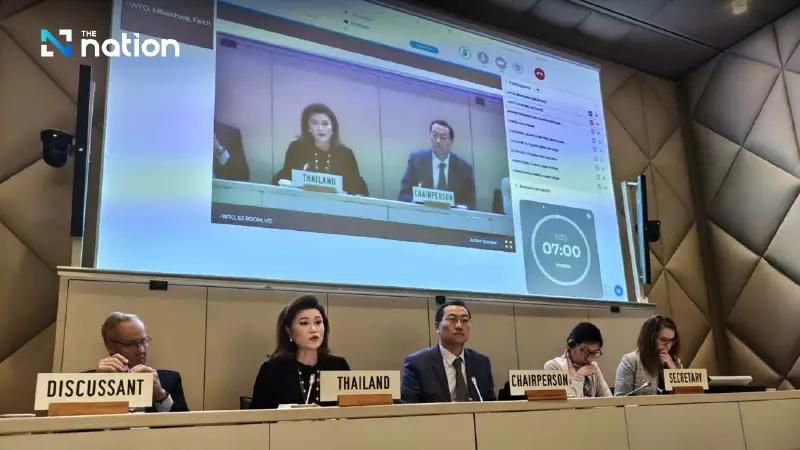


Thailand told its ninth World Trade Organisation (WTO) Trade Policy Review (TPR) in Geneva that it will keep opening its economy, advance green and digital trade reforms, and address members’ concerns on tariffs, services and investment.
- During its ninth Trade Policy Review in Geneva, Thailand's delegation officially reaffirmed the nation's commitment to the rules-based multilateral trading system with the WTO at its core.
- WTO members praised Thailand's economic resilience, attributing it to the country's open economic model, compliance with WTO commitments, and active participation in the organization's forums.
- Thailand demonstrates its support through constructive engagement in key WTO negotiations on issues such as agriculture, fisheries subsidies, e-commerce, and the reform of the WTO itself.
- Despite receiving concerns on some domestic policies, Thailand views the feedback from WTO members as valuable input for refining its trade and investment environment, reinforcing its commitment to the review process.
Kirida Bhaopichitr, Assistant Minister of Commerce, said she led the Thai delegation to Thailand’s ninth TPR at the WTO in Geneva, Switzerland, on December 1 - 3.
The review, which covered Thailand’s trade policies and measures from 2020 to 2025, is a key WTO mechanism aimed at promoting transparency and strengthening confidence in the multilateral trading system with the WTO at its core.
Kirida summarised comments from 53 WTO members based on the Secretariat report, noting that both the global and Thai economies had faced significant volatility due to the Covid-19 pandemic and rising geopolitical tensions.
Despite these challenges, WTO members praised Thailand’s ability to recover and maintain steady growth.
They attributed this resilience to Thailand’s open economic model under the multilateral trade system, its active use of free trade agreements, continued regulatory reforms to facilitate trade and investment, and its compliance with WTO commitments.
Members also highlighted the prominent role played by Thai representatives in WTO forums, which has helped reinforce Thailand’s image as an active and constructive member of the global trading system.
Thailand is a highly trade-dependent economy, with trade valued at around 137% of GDP, and is regarded as an open economy with considerable potential for further development.

Over the past five years, Thailand has advanced policies aimed at transitioning towards a green economy and promoting digital trade, with progress and growth in these areas outpacing global trends.
Kirida said she briefed members on Thailand’s efforts over the past five years to improve regulations and the overall trading environment to better support business operations and investment.
She also outlined the government’s and Commerce Ministry’s plans to continue economic and trade reforms, and reaffirmed Thailand’s commitment to the rules-based multilateral trading system under the WTO.
Thailand, she added, has been actively and constructively engaged in key WTO issues such as negotiations on agriculture, fisheries subsidies, e-commerce and the reform of the WTO itself to ensure it remains fit for purpose in the current global economic context.
She reiterated Thailand’s approach of “learning, sharing and cooperating” with other WTO members to address common challenges.
However, WTO members also raised concerns and questions on several issues.
These included the complexity of Thailand’s customs tariff system, relatively high tariffs on automobiles and certain agricultural products, lengthy sanitary and phytosanitary (SPS) procedures for certifying disease-free status of imported plants and animals, government procurement practices, competition policy and restrictions on foreign investment in the services sector.
Members suggested that Thailand further liberalise its services sector, ease foreign equity restrictions, enhance competition and accelerate state-owned enterprise reform across the economy.
They commented that deeper domestic reforms would further strengthen Thailand’s economic foundations.
These observations, Kirida noted, reflect the sustained interest of WTO members in the direction of Thailand’s economic and trade policies.
In addition, WTO members urged Thailand to expedite ratification of the Agreement on Fisheries Subsidies, consider joining the Multi-Party Interim Appeal Arbitration Arrangement (MPIA), support the continuation of the moratorium on customs duties on electronic transmissions and engage actively in the WTO e-commerce negotiations.
They also welcomed Thailand’s bid to join the Organisation for Economic Co-operation and Development (OECD), which they believed would help the country achieve its goal of becoming a high-income economy by 2037.
Kirida concluded that the latest trade policy review had been highly successful.
Thailand was able to enhance WTO members’ understanding and awareness of its economic, trade and regulatory directions, thereby bolstering confidence among trading partners and investors.
At the same time, the views and recommendations from WTO members would serve as valuable input for Thailand in refining its policies and measures to further improve its trade and investment environment and strengthen its competitiveness.
