
Bhumjaithai unveils Trade Plus–Thailand Plus to strengthen global trade links
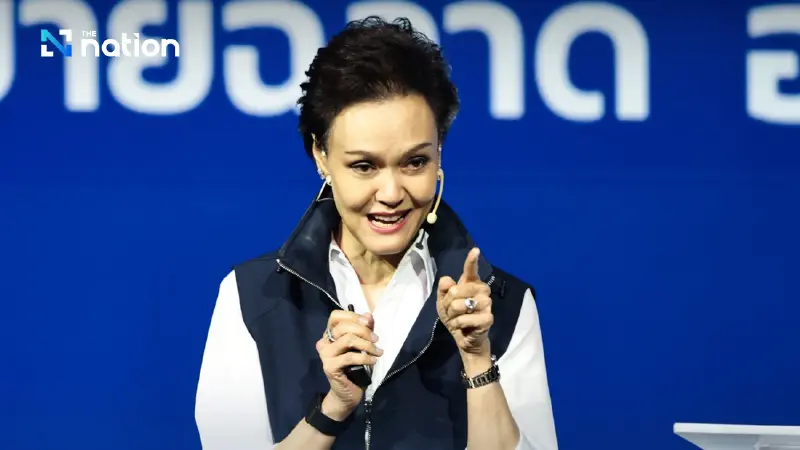


Suphajee Suthumpun said Thailand should move beyond simple exports by embedding itself in partners’ supply chains, while raising farm incomes and helping SMEs and higher-value services drive growth.
- The Bhumjaithai Party has launched its "Trade Plus–Thailand Plus" platform, a strategy to upgrade Thailand's economy by integrating the country more deeply into global supply chains.
- The policy aims to position Thailand as a valuable and neutral trading partner to attract business from multiple countries amid geopolitical pressures, rather than leaning towards one side.
- A key tactic is to move beyond simple exports by having Thai products processed or re-exported by partner nations, strengthening Thailand's role in international supply chains.
- The platform includes targeted support for farmers through countertrade and premium branding, and for SMEs by helping them transition to online and asset-light models like franchising.
Suphajee Suthumpun, a member of the Bhumjaithai Party’s trade and economic team, on Wednesday (December 24) launched what she called the party’s “Trade Plus–Thailand Plus” platform, pitching it as a strategy to upgrade Thailand’s economy by embedding the country deeper in global supply chains while supporting farmers, SMEs and targeted industries.
Speaking at a party policy briefing ahead of the election campaign, Suphajee said Thailand must balance its positioning amid intensifying geopolitical pressures and a more fragmented global order.
She argued that the country should avoid leaning too far towards any one side and instead raise its value as a trading partner so that multiple countries would want to do business with Thailand.
She pointed to what she described as structural imbalances, saying agriculture contributed about 6% of GDP over the first nine months of the year despite employing around 30% of the workforce, while industry’s share stood at roughly 25% but was declining.

Services, she said, accounted for about 66% and should shift towards higher-value segments such as medical services, the creative economy and content industries.
On agriculture, Suphajee said government efforts had helped lift rice prices, with white paddy at about 8,000 baht per tonne and jasmine rice at about 17,000 baht per tonne.
She claimed the gains were achieved without additional budget spending, citing an integrated push to expand market access and move products into higher-value channels.
Suphajee said Thailand should look beyond exporting goods for a partner’s domestic use and instead plan for Thai products to be processed or re-exported onwards to third markets, creating multiple export endpoints and strengthening Thailand’s role in partners’ supply chains.
She said trade should be built on mutual benefits, not one-sided gains.
On US tariffs, she said Washington applied different rates to different countries and claimed Thailand faced a 19% rate, lower than some economies such as China, India and Canada.
Thailand, she said, should identify gaps created by higher tariffs on competitors and move to fill them.

She also outlined measures to raise farm incomes and value, including promoting countertrade deals using agricultural products in large procurement contracts, encouraging production aligned with market demand, and developing geographical indication (GI) branding for premium rice varieties.
She said more than 200 communities had been supported in just over two months through targeted help such as equipment, packaging and market access, and argued that extending the programme could reach thousands more communities and other crops such as cassava.
For SMEs, she said support should focus on helping businesses transition from offline to online, build skills and adopt “asset-light” expansion models, including franchising.
Suphajee said the policy agenda would require faster approvals, improved ease of doing business and stronger transparency, arguing that speed must be matched by fairness and accountability.
She said the party’s broader “10 plus” package, covering areas such as security, foreign affairs, disaster response, scam suppression, AI, ageing society policy and education, was aimed at restoring confidence, naming Bhumjaithai leader Anutin Charnvirakul as the figure she said would lead that effort.
