
EC Reports Smooth Advance Voting Nationwide Amid High Alert for Vote-Buying


Over 2.2 million citizens registered for advance voting today as authorities maintained order while strictly monitoring financial activities to prevent electoral fraud.
- The Election Commission (EC) reported that the advance voting process, with over 2.2 million registered participants nationwide, has been generally smooth and orderly, despite some polling stations experiencing overcrowding and heavy traffic.
- The EC is on high alert for vote-buying, working with police and intelligence units to prevent illegal activities, with a particular focus on 42 provinces identified as having intense competition.
- Preventative measures include monitoring suspicious financial activities, such as large cash withdrawals, in collaboration with the Bank of Thailand to identify potential links to candidates.
- While intelligence has detected "movements" related to potential vote-buying, the EC stated that most current complaints pertain to social media campaigning, and a viral allegation of vote-buying was investigated and proven false.
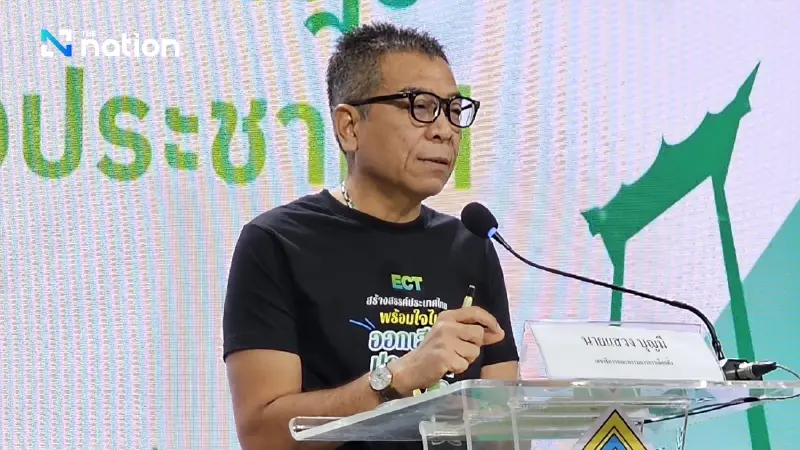
At the Office of the Election Commission (EC), Sawaeng Boonmee, Secretary-General of the Election Commission, held a press conference regarding the "Overview of the opening of central polling stations for Members of the House of Representatives (MPs) outside of constituencies and within constituencies nationwide." High-level EC executives also attended the briefing.
Sawaeng stated that Monday (February 1) is the day for advance voting both outside and within constituencies.
The number of polling units and registered voters is as follows: 1. Registered for advance voting within the constituency: 8,610 people; 2. Registered for advance voting outside the constituency: 2,206,138 people; and 3. Registered persons with disabilities/infirmities and the elderly: 1,666 people.
The polling units consist of 521 locations within constituencies, 524 locations outside constituencies, and 22 locations for persons with disabilities/infirmities and the elderly.
The overall situation since the opening of polling units at 8am for the public to cast their votes has been orderly.
In each of the constituencies across all 77 provinces, a large number of citizens have registered.


The Bangkapi district recorded the highest number of registrants, exceeding 58,000 people.
It is emphasised that since the opening of registration, everything has proceeded in an orderly manner.
However, some polling units have insufficient space relative to the large volume of eligible voters registered for advance voting.
Some areas are experiencing heavy traffic.


The EC has received reports that the Bangkapi district and the Chatuchak district have over 50,000 registrants each, and Chiang Mai also has over 50,000 registrants.
The polling units are continuing to facilitate the public in an orderly fashion.
Meanwhile, regarding the Bang Khen district, Sawaeng revealed that there are 19,000 registered voters, and traffic was heavy before entering the polling unit.
Currently, this has been addressed by notifying the polling unit and the traffic police officers of the Bangkok Metropolitan Administration (BMA) to urgently resolve the traffic issues and facilitate the public’s rapid access to the polling stations.
At the same time, he admitted that there were incidents of disorder in some provinces.
For example, in Chonburi province, a campaign banner for the MP candidate of the People's Party installed in front of a polling unit went missing; the province has since rectified this, and the situation is now resolved.
Overall, the process remains orderly.
Regarding the casting of votes, he urged caution regarding declaring which candidate one voted for, to avoid complaints that could result in the election not proceeding smoothly, Sawaeng said.
Furthermore, Sawaeng gave an interview regarding complaints about vote-buying, stating that the EC is working on two matters.
The first is maintaining a good campaign atmosphere, meaning no use of aggressive language, hate speech, or defamation.
The second is ensuring the election is honest and fair, meaning no vote-buying.
In overseeing this part, there are personnel from the EC itself and personnel from other agencies, such as the Royal Thai Police, which has various operation units, including prevention and suppression units and intelligence units, to apply pressure against the use of money for vote-buying initially.
While movements have been detected via intelligence, they have not reached the stage of committing an offence. We focus on prevention and deterrence measures so that money cannot be used.
The overall picture is currently like this.
As for complaints regarding vote-buying, it is not yet considered a major issue; most complaints currently relate to campaigning on social media.
Additionally, Sawaeng admitted that regarding arrests for vote-buying, the difficult part to prove is the preparation process.
Under the Organic Act on the Election of Members of the House of Representatives 2018 (and its amendments), Section 73, even the preparation to buy votes is illegal.
From his interview yesterday, he intended to convey that we have measures to prevent or pressure against vote-buying.
After discussing the measures, he wished to communicate to offenders that even if they have money, they will not be able to buy votes.
Regarding prevention and suppression measures, all 77 provinces have been categorised, with 42 provinces identified as areas with intense competition.
In some provinces, this applies to every district, while in others, it may be on a district-by-district basis.
It must be admitted that sometimes preparations take place in secret, and if the money has not yet reached the hands of eligible voters, it is difficult to make an arrest.
There must be sufficient evidence to notify the police and request a court warrant. When vote-buying occurs, the evidence is clear, but finding binding evidence for the preparation phase is difficult.
Regarding intelligence, Sawaeng cited the example of the Bank of Thailand sending information to serve as supporting data: whether the person withdrawing money has a relationship with a candidate or political party, is a campaign assistant, is a party member, or is related by kinship or any other way; what the money was withdrawn for; and how the money was used.
This is the intelligence measure we are currently implementing.
Regarding the abnormal withdrawals detected by the Bank of Thailand, Sawaeng stated that investigative officers are currently examining the matter.
Regarding the discovery of two lumps of money, it is known that 6 individuals are involved in total.
However, for all 6 individuals, the connections must be examined to see what the withdrawals were for and if the money has been used yet.
If it fits the pattern, it is clear, but fairness must be given.
Whether the withdrawers will be summoned for questioning depends on how the inquiry officers proceed.
Other details are not yet known.
This matter will be brought to the EC meeting on Monday.
Sawaeng added that each province has suppression units and intelligence operation units that possess lists of vote canvassers.
Assessments of the areas are conducted jointly with several agencies, including Election Inspectors, the police, and the public sector, specifically the Centres for Promoting Democracy.
Regarding the case of the THB7,000 that a merchant posted on social media, where the image was used to allege vote-buying, Sawaeng stated that the EC has taken action.
It was not vote-buying money; an investigation confirmed it was money from the merchant's trading business posted on Instagram.
Someone captured the image from the owner's Instagram and created content alleging vote-buying.
As to who is at fault, EC officers are currently investigating; there are 3 individuals involved in this matter.
