
Oil crunch hits Chiang Mai’s red songthaews: fewer tourists, higher costs squeeze drivers
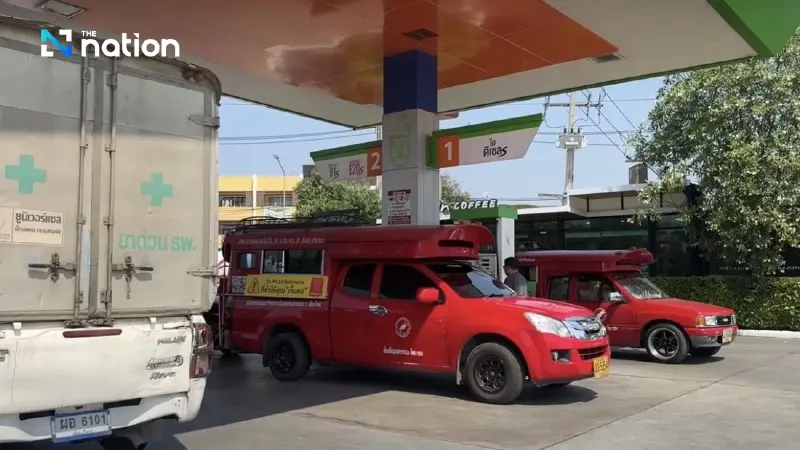


Chiang Mai’s iconic red songthaew operators say fuel shortages and higher pump prices are tightening margins as tourist numbers fall. A cooperative leader warns diesel stocks are running low and calls on the government to address fuel and rising living costs.
After the government announced fuel price adjustments this morning (March 18, 2026)—with diesel up 50 satang per litre, gasohol 95 and 91 up 1 baht, and E20 down 79 satang—the impact has spread widely. Not only is fuel in short supply, prices have also risen, hitting Chiang Mai’s red four-wheeled songthaews, the city’s signature public transport, particularly hard.

Boonniam Boontha, president of the Nakhon Lanna Transport Cooperative, said operators are now being affected by a reduced fuel quota, with depots limiting purchase orders. Although the cooperative has its own petrol station, where members previously refuelled without limits, fuel supplies at the station are now running low. In the past, the station also served non-members, but as stocks shrink it has had to cap non-member purchases at 500 baht per fill-up, while cooperative members can still refuel as normal.
Beyond shortages, today’s price rise has increased the burden on red songthaew drivers. With fuel now more expensive, drivers are carrying higher costs at the same time as their main customers—foreign tourists—have declined sharply. Boonniam said the prolonged Middle East conflict and airspace closures have made it difficult for tourists to travel, cutting drivers’ income significantly.

The Nakhon Lanna Transport Cooperative has more than 2,000 vehicles in total, including red songthaews, taxis and vans, with around 50% running on petrol. Boonniam said everyone is affected because passenger numbers are down, while members still face daily expenses. Many drivers are struggling—buying fuel but finding no passengers. Some have given up and stopped operating altogether. Others have shifted from cruising around the city to parking near tourist sites and “hoping for luck”: on a good day they find tourists; on a bad day they earn nothing.
Boonniam said the cooperative wants to urge the government to help address rising fuel prices and the increasing prices of consumer goods. “Fuel costs are already causing severe hardship, and price increases in everyday goods only pile on more pressure,” he said.
He added that diesel stock at the cooperative station is continuing to fall, while Bangchak’s oil depot in Lampang can no longer supply fuel as usual. Previously, tankers could refill daily; now vehicles must travel to Lampang and queue overnight, with no certainty that fuel will be available. If supplies decline further, the cooperative may need to adjust its policy from limiting non-members to 500 baht per fill-up to restricting refuelling to members only, in order to prioritise those who rely on fuel for their livelihood.

A red songthaew driver said that after the price rise and shortages, the main impact is a lack of customers and the difficulty of finding diesel. Drivers are travelling only a few kilometres a day for fear of running out, as diesel is now hard to obtain. Continuing to operate as before would raise expenses further. The driver said he spends about 400 baht a day on fuel and earns 600-700 baht a day from passengers, leaving roughly 200 baht after fuel costs. “We have to adapt. If we don’t go out and work, we have no money for household expenses,” he said.
