
Abhisit says no coalition signal, Democrats ready for any role
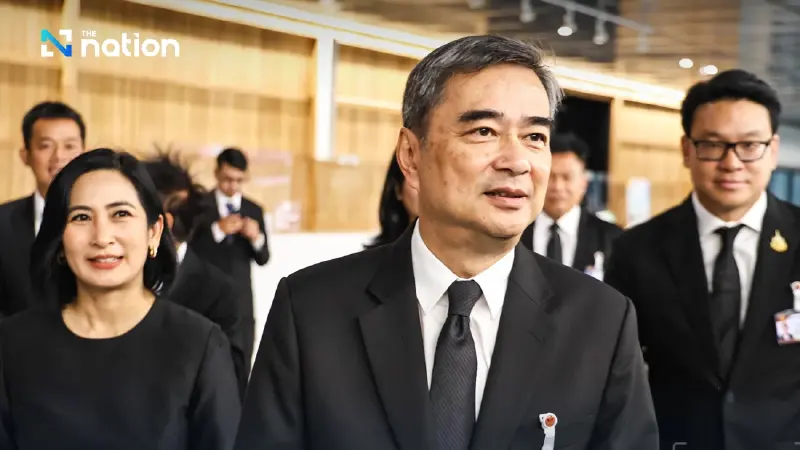


Democrat Party leader says the party has already prepared its legislative agenda and can work either in government or in opposition, depending on the final political outcome.
At Parliament, Abhisit Vejjajiva, a party-list MP and leader of the Democrat Party, led Democrat MPs in reporting to the Office of the Secretary-General of the House of Representatives.
Party executives and MPs who arrived together included Korn Chatikavanij, Karndee Leopairote, Sakoltee Phattiyakul, Sathit Wongnongtoey, Radklao Suwankiri, a party-list MP, Juree Numkaew, a Songkhla MP, Saksit Khaothong, a Songkhla MP, and Kritich Pakichan, a Trang MP.
In addition, Chaichana Detdecho, a party-list MP and deputy leader of the Democrat Party overseeing the South, also joined the group.
He had already reported to Parliament on March 5, 2026, and took the delegation on a tour of the Parliament building, as this marked the first time Abhisit had returned to work in Parliament.
Reporters said that while touring the building, Abhisit greeted school and university students who had come on study visits before posing for photographs with them in a relaxed manner.
Chuan Leekpai, a party-list MP, arrived later to report at 10.45am because he had another engagement.
After reporting, Abhisit admitted that last year he had not imagined he would return to Parliament again in such an atmosphere, but said that today he was determined to work to the fullest because parliamentary work was what he had done for almost his entire life and was the kind of political work he liked most.

Abhisit also said there had so far been no signal inviting the Democrat Party to join the government.
He said that, from what he had heard Prime Minister Anutin Charnvirakul say, the party would still have to wait for the various processes to be completed first.
However, the Democrat Party had already prepared itself for legislative work, regardless of whether it would ultimately serve as the opposition or as part of the government.
Its key mission was to push forward various laws, especially those it had promised to the public during the election campaign.
He also said that the various processes should move forward swiftly, because the global situation and the domestic situation at present meant that the formation of a government, the policy statement and the assumption of full state administration should happen as soon as possible.
Although the caretaker government could still perform its duties, a fully empowered government would help build greater public confidence, especially at a time when the country had to deal with both external and internal challenges, including the economy, energy, consumer prices and agricultural goods.
A fully empowered government, he said, would be better placed to ease problems and strengthen confidence.

Regarding Thailand’s position under the caretaker government at this time, Abhisit said that, in terms of foreign affairs, he saw no problem because what the prime minister, as well as the foreign minister, had stated was appropriate, and the Democrat Party supported that position.
He said he did not want to see conflict and wanted all sides to find a way back to the peace process.
He also did not want Thailand, the region or other countries to be drawn into a widening conflict, because that would not benefit anyone.
However, Abhisit said that what needed to be done urgently now was to create clarity so that the public could feel reassured, especially on energy and the economic response.
Although a new government had not yet been formed, there were still three or four key ministers who could continue working and were in a position to help give society confidence.
Asked about the Democrat Party’s stance in not yet declaring itself fully as the opposition, Abhisit said this was a matter of political etiquette and had not reached the point where the party would have to reject the idea outright.
He said the Bhumjaithai Party already knew that, if the Democrat Party were to join the government, it would have to adhere to what it had said to the public, including the conditions the party had previously announced.
As for petitions seeking scrutiny of the election process, Abhisit said he wanted to see the government-formation process move forward so that the country’s problems could be addressed, but at the same time, he accepted that the election management of the Election Commission had involved many problems that needed to be cleared up so that similar issues would not arise in future.
He said both matters should proceed in parallel through the proper process.
Regarding reports that Sophon Saram, a party-list MP from the Bhumjaithai Party, might be nominated for the post of Speaker of the House of Representatives, Abhisit said that, as a matter of political etiquette, it was for the party forming the government to decide, and once a name was proposed to the meeting, members would then vote.
However, he stressed that if the Democrat Party were to vote in support of Sophon as House Speaker, this would not necessarily be linked to a vote supporting Anutin Charnvirakul as prime minister, because the two were separate matters.
Each vote in Parliament, he said, would first have to go through discussion at the meeting of the party’s MPs.

