
Thailand Unveils 2026 MICE Masterplan for Global Innovation
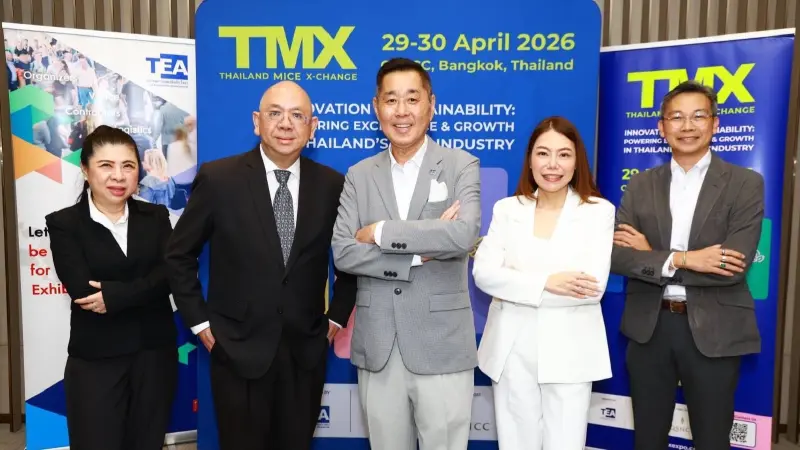


TEA targets over 4,000 global leaders at TMX 2026, positioning Thailand as a premier innovation and sustainability hub to elevate the region's MICE sector.
The Thai Exhibition Association (TEA) has officially launched its strategic roadmap for Thailand’s exhibition and MICE (Meetings, Incentives, Conferences, and Exhibitions) industry for 2026–2027. Focused heavily on innovation and sustainability, the masterplan aims to cement Thailand's status as a future-ready, premier global event destination.
Riding on the strong momentum of previous successful editions, TEA is gearing up to host the Thailand MICE X-Change 2026 (TMX 2026) this coming April at the Queen Sirikit National Convention Center (QSNCC).

Driving Economic Growth Through Face-to-Face Engagement
TMX has rapidly evolved into a critical growth engine for Thailand's MICE sector. Over its past two iterations, the event has drawn over 5,000 participants and facilitated more than 360 business-matching meetings.
"TMX has established itself as a key exhibition and conference platform driving greater adoption of MICE among corporate organizations," said Mr. Loy Joon How, President of TEA. "We aim to enhance the global competitiveness of Thai entrepreneurs and generate sustainable economic value for the country as a whole."
Strategic partner Dr. Duangdej Yuaikwarmdee, Director of the Exhibitions Department at the Thailand Convention & Exhibition Bureau (TCEB), emphasized the enduring power of physical events. “Exhibitions are not merely booth display spaces; they are among the most powerful marketing tools in the global business arena,” he noted, adding that TMX aspires to be Thailand’s premier One-Stop Service hub for the industry.

TMX 2026: What to Expect
Operating under the theme ‘Innovation and Sustainability: Driving Thailand’s MICE Industry Towards Excellence,’ TMX 2026 is designed to be a comprehensive ecosystem for event professionals. Key highlights include:
Massive Turnout: Expected to attract over 4,000 global industry leaders and participants.
Comprehensive Solutions: Featuring over 100 full-service event solution providers representing the entire value chain—from smart venue logistics and AI-driven marketing agencies to sustainable booth constructors and tech providers.
X-Change Square: A dedicated knowledge-sharing platform featuring over 15 comprehensive sessions led by more than 25 international and domestic industry experts.
Targeted Business Matching: A curated program designed to connect exhibitors with qualified buyers, corporate decision-makers, and international organizers to forge strategic partnerships.
A Commitment to Green Events
Aligning with global ESG (Environmental, Social, and Governance) standards, TMX 2026 will implement rigorous sustainability initiatives aimed at minimizing environmental impact:
Eco-Friendly Transit: Promoting travel via the seamlessly connected MRT and BTS networks to QSNCC.
Plastic Reduction: Providing on-site water refill stations to eliminate single-use plastics.
Digital Integration: Utilizing paperless online registration and promoting digital media over printed collateral to minimize event waste.
Responsible Sourcing: Prioritizing exhibitors and service providers who adhere to Green & Responsible Event principles.
Industry leaders increasingly view these exhibitions not as expenditures, but as critical investments. “We do not regard trade exhibitions as an expense, but as a long-term strategic investment in the future growth and sustainable advancement of our organization,” stated Ms. Navaporn Santiwattana, Deputy Director at King Rice Oil Group.
Event Details at a Glance
Event: Thailand MICE X-Change 2026 (TMX 2026)
Date: 29–30 April 2026
Time: 10:00 AM – 6:00 PM
Location: Ballroom 1–3, Level 1, Queen Sirikit National Convention Center (QSNCC), Bangkok
Sponsors: DSV CONTRACT LOGISTICS LTD., Shanghai New International Expo Centre, Resorts World Sentosa, and RX BITEC (Thailand) Co., Ltd.
Registration: Free visitor registration is available at Eventpass Insight.
More Info: www.tmxexpo.com
