
How one parent built an online school for globally mobile Indian children
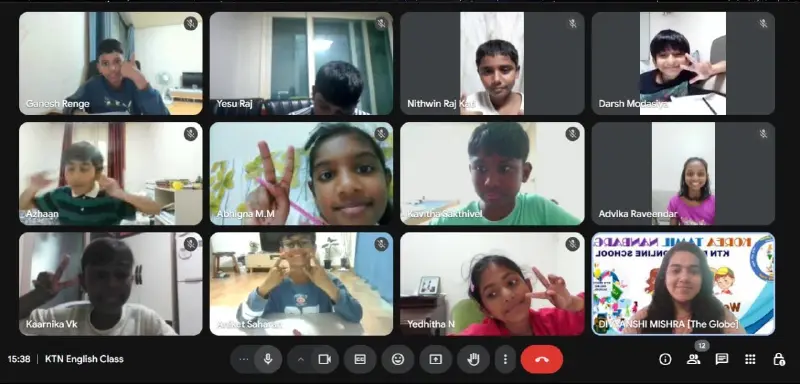


KTN Digital Online School helps Indian children in Korea reintegrate into India's highly competitive education system
When Syed Shanu arrived in South Korea in May 2007 with his family, his children's education was a distant concern: his son was just 6 months old, and his daughter would only be born in 2014.
But as they grew older, the question began to weigh on him, especially as he considered sending them back to India for high school.
How would they cope with India’s intensely competitive system?
Both children attended an international school in Itaewon, Seoul, studying alongside classmates from diverse cultural backgrounds on a globally recognised curriculum.
Yet Shanu, a software engineer himself, knew it would not be enough to prepare them for the rigour of math and science classes in India.
"Many Indian families live on short- or medium-term work contracts, with many of their children attending international schools or Korean public schools.
But when they return home, many often struggle to adjust to India's far more demanding, content-heavy education system," he, 44, told The Korea Herald.
That realisation eventually led to the founding of the Korea Tamil Nanbargal Digital Online School in November 2019.
Established by Shanu and three others, the free online platform aims to help students moving between countries navigate the transition into India’s highly competitive education system.
The KTN Digital School now serves about 150 students, supported by 30 volunteer teachers.
His two children also enrolled before relocating to India in 2022.
“What started as a personal question became something much bigger,” he said. “I realised that if my family was struggling with this transition, then thousands of others were, too.”
A bridge to Indian schools
KTN Digital School is not just an online tutoring service.
It offers a parallel secondary program for students transitioning into India’s education system that goes beyond specific subjects or test preparations.
The online school mirrors standard academic structure: conducting quarterly, half-yearly and annual examinations, issuing report cards, and managing attendance and performance records.
Classes are offered for grades one through six, following the Central Board of Secondary Education curriculum in core subjects including English, math and science, using the same textbooks taught in India.
Shanu highlighted the particular need for academic catch-up support in math and science; returnees often struggle to keep pace with India’s highly exam-oriented, syllabus-driven education system without targeted support.
Classes take place from 5pm to 9pm via Zoom after students and teachers complete their regular daytime schedules.
The academic year runs from February to late November, at the end of which students receive a grade-completion certificate.
While the certificates are not government-authorised, they serve as supplementary academic records when students return to India or transfer to schools elsewhere, helping administrators assess a student’s level and continuity of study.
“International schools provide an excellent environment, but not every family can stay overseas permanently,” said Saraswathi Sivamani, a 40-year-old project completion specialist at an AI technology company in Seoul.
Sivamani joined KTN in December 2019 and currently teaches grade 3 English.
“When children return, they often face a system that assumes a completely different academic background.
But through the program, many of our students have transferred successfully to schools in India and in other countries.”

A hub for the Indian community
KTN Digital School grew by word of mouth.
As parents saw tangible progress in their children’s studies, recommendations spread within the community, accelerating the school’s expansion.
Although the initial focus was on Indian children living in South Korea, demand soon expanded to Indian children living in other countries, such as Malaysia, Taiwan and Singapore, who would face the same challenge of reintegrating into India’s education system upon their return.
The online school is also not tied to any corporate or individual sponsorships.
It relies on volunteers for everything from teaching and administrative work to Shanu’s role in overseeing the school and coordinating teacher and parent communities, he said.
Most of its teachers have strong academic backgrounds, including doctoral degrees and research experience, and some previously worked as professional teachers in India, Shanu continued.
Many are working professionals in Korea, or their spouses.
Some continue teaching online even after returning to India.
“We call our teachers the ‘main pillars’ of our school and are deeply grateful for their dedication to the Indian community in Korea,” he said.
Sivamani added, “This is not employment. It is service.”
Teachers contribute because they feel a strong sense of belonging and responsibility toward the community.
Last year, the school introduced a major change: offline examinations.
For the first time in its history, students gathered in four regions, Seoul, Daejeon, Daegu and Ulsan, to sit the same exams at the same time in physical exam halls.
The offline exam was conducted at venues that were available for free.
“Online exams do not feel like real exams,” Sivamani explained.
“Students are at home. Papers have to be shared in advance. You cannot truly measure their ability in the same way. Also, we wanted them to experience what an Indian classroom and an Indian examination environment feel like.”
Looking ahead, Shanu plans to expand KTN Digital School’s curriculum through grade 8, which he described as a critical stage for students preparing to return to India and adjust to its academic demands.
Beyond academics, it also aims to serve as a cultural anchor for globally mobile Indian children.
It offers classes in regional Indian languages, helping students stay connected to their roots while building a confident, multilingual identity across generations and borders.
“We offer classes in Indian history, general knowledge and Indian classical dance,” said Shanu. These programs allow children studying in Korean or international schools to learn about Indian culture and traditions alongside their academic subjects. We believe it is equally important for them to understand their cultural background and heritage.”
The Korea Herald
