
China trims GDP target to 4.5%-5%, first downgrade in 3 years amid weak domestic market
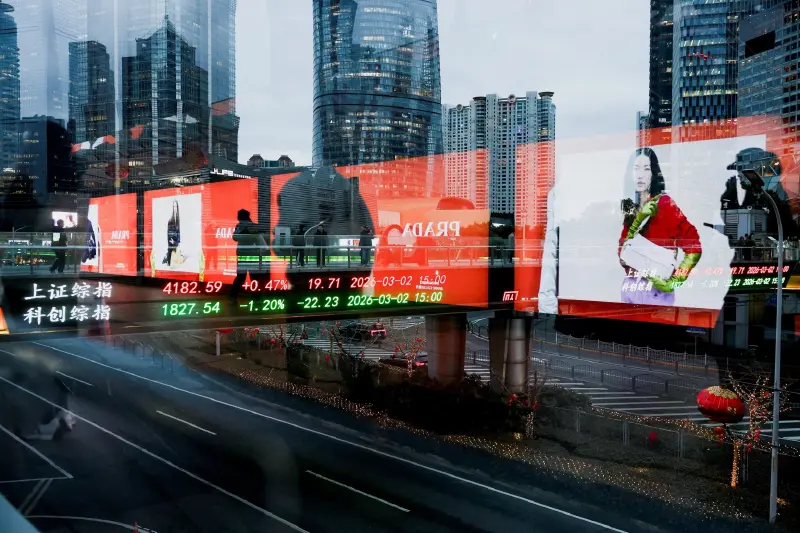


China lowered its economic growth target to a range of 4.5 to 5 per cent for 2026, marking the first reduction in the headline target in three years.
This was delivered in an annual government work report by Premier Li Qiang at the opening of the National People’s Congress (NPC) on March 5. The downward adjustment signalled a recognition of longer-term structural headwinds even as leaders pledge to steady the world’s second-largest economy.
In his report, Mr Li acknowledged the external and domestic challenges that China faced but struck a confident note on the outlook for the world’s second-largest economy.
“The impact of changes in the external environment is deepening,” he said, while at home, the task of transitioning from old to new growth drivers was “formidable”.
“While these difficulties are not to be ignored, we still have every reason to be firmly confident,” he said. “Having been tested by storms and met tough challenges, we are more determined than ever to forge ahead.”
The reduced national gross domestic product (GDP) target was largely in line with economists’ expectations.
Analysts said the lowered target range would allow policymakers greater flexibility amid demographic headwinds, uneven consumption and geopolitical uncertainty, including rising tensions in the Middle East following the recent US-Israeli strike on Iran.
Of the 31 provinces, 21 have lowered their growth targets compared with 2025.
While China has achieved GDP growth of 5 per cent or more over the past three years, many observers had projected a slowdown in 2026, as a prolonged property slump and weak labour sentiments have dragged down its economy.
The World Bank forecasts China’s economic growth to moderate to 4.4 per cent in 2026, down from 4.9 per cent in 2025. The International Monetary Fund projected 4.5 per cent for 2026.
China’s 5 per cent growth in 2025 was largely achieved through a record US$1.2 trillion (S$1.52 trillion) trade surplus while domestic consumption lagged.
Exports have been a bright spot in China’s economy, helping to offset weak domestic demand. But economists have long warned that relying on external demand and industrial overcapacity is not sustainable, particularly amid rising trade frictions.
China’s tolerance for slightly slower economic growth in 2026 could pave the way for greater efforts to curb its industrial overcapacity and rebalance its export-reliant economy.
China will have a fiscal deficit of around 4 per cent of its GDP, maintaining this at 2025’s level and the highest in years. It has set the deficit at 5.89 trillion yuan (S$1.07 trillion).
The country’s inflation ceiling is kept at around 2 per cent, similar to 2025. China has been battling persistent deflationary pressures, with consumer prices largely flat last year.
Additionally, China is aiming to create more than 12 million new urban jobs and to keep its unemployment rate at about 5.5 per cent, goals that mirror 2024 and 2025. The country is projected to have a record 12.7 million college graduates in 2026, state media reported.
Economist Justin Yifu Lin told The Straits Times that the downward adjustment of China’s growth target was “realistic” in view of the current international situation.
Fiscal policy would be a very important means of spurring domestic demand in a relatively weak economic situation, the professor at Peking University and a member of the Chinese People’s Political Consultative Conference (CPPCC) also said.
Some 5,000 delegates are gathering in Beijing this week for China’s annual parliamentary sessions, known as the Two Sessions or Lianghui. Lawmakers will discuss and approve a major policy blueprint – the 15th Five-Year Plan – that outlines China’s priorities over the next half-decade.
The Straits Times
