
Iranian media flaunt ‘underground missile city’ arsenal
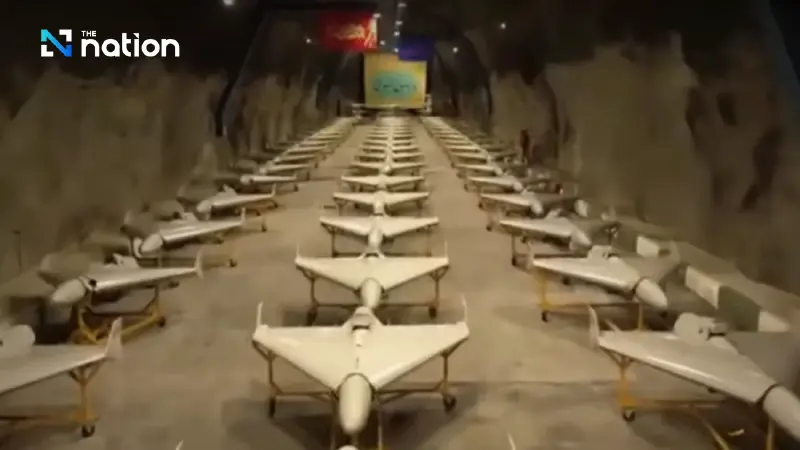


Fars News Agency releases footage of an ‘underground missile city’ as analysts warn Gulf air defences may run short amid costly drone interceptions
Iranian media have released images of a “deadly vault” inside an underground “missile city” used to store drones and loitering rockets, a massive arsenal used to attack and cause damage across the Middle East.
On March 5, 2026, Iran’s Fars News Agency released images of a large underground missile city — a huge weapons store filled with loitering drones and missiles — as Iran continues to inflict damage across the Middle East.
The footage comes amid growing concern that Gulf countries, which Iran is attacking heavily in the current conflict, could face shortages of counter-drone weapons during this Iran war.
US-backed Gulf countries have been rapidly using up their national defence weapons amid Iran’s missile and drone attacks, which have been stockpiled in bunkers of the Islamic Revolutionary Guard Corps (IRGC).
The tunnels extend seemingly without end. Above the vast quantity of weapons, there is a large image of Ayatollah Ali Khamenei, Iran’s former supreme leader, aged 86, who was killed in a joint US–Israeli attack on Saturday (February 28, 2026).
The ceiling is decorated with national flags. Below are transport trucks carrying launch systems for Shahed loitering drones, which have production costs of only tens of thousands of dollars and do not take long to manufacture. Russia has also used them in its war with Ukraine. On Wednesday (March 4, 2026), Israel acknowledged that Iran still has significant capacity to fire missiles at its enemies, amid growing concerns that counter-drone technology is “too expensive” to use in long-term military operations.
The ceiling is decorated with national flags. Below are transport trucks carrying launch systems for Shahed loitering drones, which have production costs of only tens of thousands of dollars and do not take long to manufacture.
Russia has also used them in its war with Ukraine.
On Wednesday (March 4, 2026), Israel acknowledged that Iran still has significant capacity to fire missiles at its enemies, amid growing concerns that counter-drone technology is “too expensive” to use in long-term military operations.
For example, US-made Patriot missiles may have production costs of more than US$5 million, while the “THAAD” missile defence system may cost US$13 million.
Both figures do not include export-related costs. By contrast, a single killing drone may cost just US$20,000 — meaning Iran’s attacks can be sustained far more easily.
Iran has used drones to attack targets at US bases in Gulf countries, forcing defenders to spend millions of dollars to intercept those attacks.
The United Arab Emirates intercepted 92% of the 541 missiles fired at it, but at a cost exceeding US$700 million.
Assessments suggest it can cost as much as US$4 million in high-priced drone interceptors to shoot down a single drone.
By contrast, Iran spent only US$10 million for a drone swarm aimed at the UAE, launching more than 2,500 drones per day, overwhelming air-defence systems.
This is described as a strategy designed to defeat those expensive defence systems.
Although most missiles were shot down, some still slipped through, including drone attacks that caused damage to the US consulate in Dubai.
Analysts say that at the current rate, equipment could run out within four days because interceptors are being used at an unprecedented pace.
Since the start of operations, the UAE has been attacked by around 200 ballistic missiles, eight cruise missiles and 689 drones.
Even if all missiles were intercepted, 44 drones were still able to strike successfully.
Bahrain, Kuwait and Qatar have also faced heavy attacks as well.


