
Trump urges Takaichi to contribute to free navigation in Hormuz
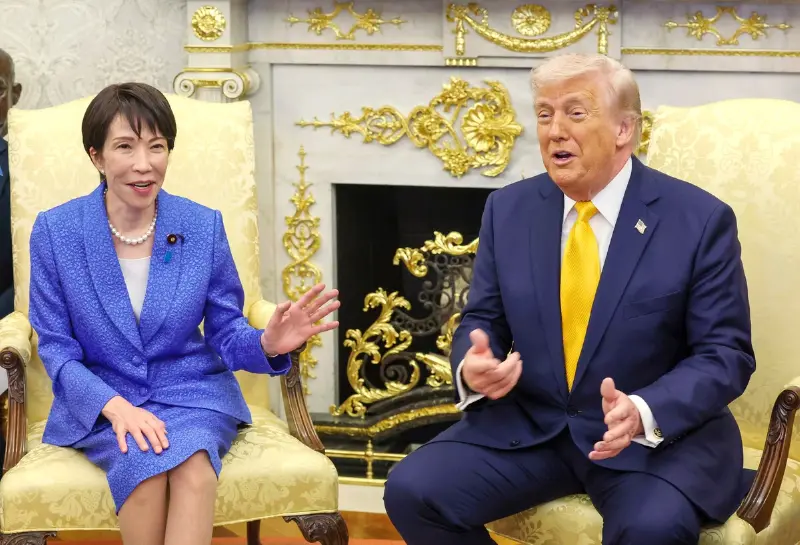


US President Donald Trump on Thursday (March 19) urged Japanese Prime Minister Sanae Takaichi to help ensure freedom of navigation in the Strait of Hormuz, which Iran has effectively closed.
In response to Trump's request made during their meeting in the White House, Takaichi condemned Iran's actions in the region and called for an early de-escalation of the situation.
Also at the summit, the two leaders agreed on a second batch of Japanese investments and loans in the United States under a bilateral tariff deal, including the construction of small nuclear power plants.
The meeting lasted about an hour and a half, including the time that had been secured for a working lunch, which was cancelled for longer summit discussions at Trump's request.
Takaichi visited the United States for the first time since she took office in October last year and had an in-person meeting with Trump for the second time.
Speaking to Trump, Takaichi said, "Only Donald can bring peace and prosperity to the world."
She expressed her strong support for him.
Takaichi also accused Iran of attacking neighbouring countries and described its nuclear development as intolerable.
Trump said that, unlike NATO, Japan is "really stepping up to the plate," but he added, "I expect Japan to step up (further)."
The two leaders confirmed they will continue communicating closely to realise peace and stability in the Middle East.
Ahead of the meeting, Trump called Japan by name to ask for a dispatch of a Self-Defence Forces ship to the Strait of Hormuz.
Speaking to reporters, Takaichi acknowledged there was a "sensitive" exchange with Trump, but she said: "There are things we can do and things we cannot do within the bounds of law. I explained it in detail."
She did not say clearly whether she was asked to dispatch an SDF ship.
Takaichi and Trump agreed to raise their countries' alliance to an even higher level in the areas of security, economy and economic security.
They also confirmed the policy of boosting the wide-ranging bilateral security cooperation further, including a fourfold increase in production of the Standard Missile-3 Block 2A, a new-type interceptor jointly developed by Japan and the United States.
Trump did not specifically request an increase in Japan's defence spending.
The total amount of Japanese investments and loans in the United States planned under the bilateral tariff deal is 550 billion dollars.
The second batch will be worth up to 73 billion dollars, mainly focusing on the construction of small nuclear reactors and natural gas-fired power generation facilities.
At the summit, the two leaders confirmed cooperation to expand US energy production.
Takaichi expressed a desire to realise a joint project to stockpile oil procured from the United States.
Their governments adopted three documents, including one on cooperation on important minerals and the development of rare earths in waters around Minamitorishima, a Japanese remote island in the Pacific.
They confirmed they will promote the "free and open Indo-Pacific" concept further, apparently with China in mind.
They also agreed to cooperate even more closely to deal with China and North Korea.
Trump said he will praise Tokyo in his planned meeting with Chinese President Xi Jinping, although he recognises a slightly tense relationship between the two Asian countries.
He expressed his full support for the immediate resolution of the issue of Japanese citizens kidnapped by North Korea.

[Copyright The Jiji Press, Ltd.]
