
Building a sustainable marine ecosystem as the foundation of Papua's local economy


As an archipelago surrounded by vast oceans, Southeast Asia boasts abundant marine resources. The sea has shaped the region's culinary culture, making seafood an inseparable part of daily life.
However, a 2023 report by BRIN (the Indonesian National Research and Innovation Agency) titled 'Sustainable Marine Fisheries Resource Management' revealed that Southeast Asia experienced a reduction in fish production of up to 7.5 million tons per year, resulting in economic losses of approximately USD 22.5 billion.
This decline is attributed to climate change, chemical and plastic pollution, and ecosystem degradation, particularly of coral reefs and mangroves, which affect fish production.
In Thailand, efforts have been made to preserve sustainable crab populations through seasonal bans on harvesting egg-carrying crabs, as well as initiatives to protect crab populations during critical breeding periods.
For example, fishers in Phum Riang, Surat Thani province, have established crab banks where egg-carrying female crabs are nurtured until their eggs hatch. The hatchlings are then released back into the wild, helping to boost crab populations.

Processing Crabs Sustainably
Across the sea in West Papua, Indonesia, the impact of declining marine resources is evident, especially concerning crabs.
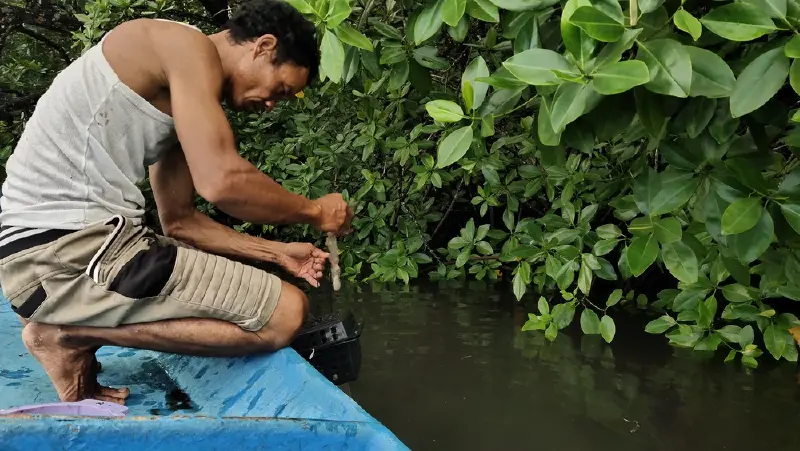
Overfishing of crabs in the area has led to a decline in the natural crab population, threatening the livelihoods of fishers and the well-being of the community, including Adino, a member of the Togar Puan crab farming group in Patimburak Village.
As crab fishers, Adino and his 10 group members must contend with various challenges, from climate change threatening mangrove habitats to the task of finding feed for the crabs they cultivate.
"We realise this change is important for the sustainability of the marine ecosystem. That's what motivates us, how the community can continue to utilise crabs without depleting their population," Adino added.

In 2020, Kaleka, a national non-profit research organisation that works with farmers, fishers, and forest-dependent communities, collaborated with the Togar Puan to address the declining crab population.
The initial approach was not successful due to the size of the container and the difficulty in acquiring it. In 2024, Kaleka resumed crab cultivation.
This time, containers are made using materials readily available in Patimburak Village, such as bamboo. The size of the containers can be adjusted to the cultivator's preference. If the community wants to make or add cultivation containers, they can do so themselves, allowing anyone to participate in crab cultivation activities.
"This time, we are trying a new approach to crab cultivation with the restorative aquaculture method – a practice where aquaculture activities are carried out simultaneously with efforts to maintain crab stock in nature. Each crab is placed in a separate container around the house of the Togar Puan fisher group leader, making it easier for the community to monitor growth. If a female crab has produced eggs, that female crab will be released back into the mangroves to ensure the sustainability of the crab stock," said Venticia Hukom, Kaleka Research Director.
In addition to measuring crab weight, length, and width, Kaleka also helps fishers measure ammonia levels in the water. This is done to monitor changes in ammonia levels to ensure they remain at a safe level for crabs, preventing mortality.
"This is done so that fishers understand the importance of maintaining water quality for the survival of cultivated crabs. Furthermore, by returning female crabs that have produced eggs, the community also learns how to maintain the crab stock in nature. Through this activity, it is hoped that the community will understand the importance of sustainable crab cultivation," Venticia explained.
Venticia added that Kaleka also helped the fisher group develop a unique 8 x 8-meter crab cultivation cage. This cage combines crab cultivation with mangrove plants to protect it from sunlight, with a capacity of up to 100 crabs. The aim is to create a habitat that mimics natural conditions, allowing crabs to grow as naturally as possible.
Promoting Marine Ecosystem Conservation for Papua's Economy
Adino also emphasised the need for regulations governing market demand, specifically for female crabs. Adino believes that conserving female crabs can maintain natural crab stock. This way, crab cultivation can remain a viable livelihood that contributes to increasing the local economy's income.
"There needs to be public awareness on how female crabs should not be entirely harvested, but allowed to lay eggs and reproduce. If preserved in large cages, it could even become an ecotourism attraction for Patimburak Village. Visitors could come and learn about the crab life cycle and crab cultivation," Adino stated.
The collaboration between the Togar Puan Fisher Group, Kaleka, and the local government demonstrates that marine resource preservation can be a solution to improve community welfare.
With a restorative economic approach, we can empower fishers to manage marine resources sustainably, ensuring the ecosystem is preserved and the economic conditions of coastal communities continue to improve.

