
Women forest guardians: Empowering our food security


Our global food situation is primarily impacted by unpredictable climate change, geopolitical conflicts, and disruptions in supply chains that have led to sharp increases in food prices. In 2023, nearly 282 million people across 59 countries faced acute food insecurity, underscoring the urgent need for more resilient and sustainable food systems.
In Thailand, for example, the combined losses from drought and flooding were expected to reach THB55.8 billion in 2024, impacting agricultural productivity and threatening food security.
Additionally, Thailand ranks 9th on the Global Climate Risk Index, indicating its high exposure to climate-related disasters.
This heightened vulnerability underscores the urgent need for enhanced food security measures, particularly in rural areas and among indigenous people, who are at the forefront of addressing food challenges.
Indigenous women, often tasked with household management and food provision, play a critical role in safeguarding food resources and applying traditional knowledge to adapt to climate impacts. Their efforts are vital in strengthening agricultural resilience across the country and Southeast Asia.
Women’s Role in Environmental Challenges and Food Security
Across Southeast Asia, including Indonesia, indigenous women are playing a vital yet often overlooked role in food security. In remote communities, they are not only responsible for managing households but also for ensuring their families have access to food.
From preserving local food knowledge to adapting agricultural practices in the face of climate change, these women are at the forefront of community resilience.

One of those women is Maria Fatima Bunga, known affectionately as Mama Fatima, who lived in East Nusa Tenggara, Indonesia.
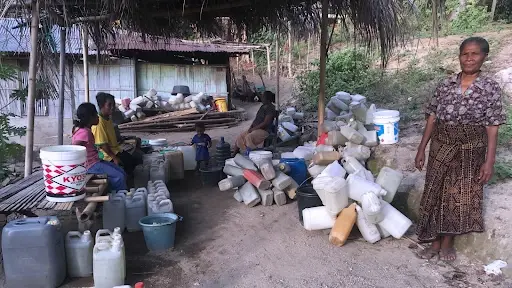
Every day for years, Fatima has risen at 4am, carried multiple jerrycans, and walked half a kilometre on rocky paths to reach the Ae Wuka spring. Long queues often mean she has to wait until nightfall before she can return with water.
Meanwhile, in the Mentawai Islands, Fernanda, a housewife from the Mentawai tribe, faces the challenge of degraded customary forests. Land once abundant with trees and productive plants has now become brush and barren land with little economic value.
Support from Communities
The crisis faced by indigenous women like Fatima and Fernanda is also supported by various organisations, helping them tackle these challenges.
Wahana Tani Mandiri (WTM) and Yayasan Citra Mandiri Mentawai (YCMM) are members of Aliansi Kolibri, a coalition aimed at combating deforestation and promoting sustainability in Indonesia's agricultural sector.
WTM identifies land degradation and the use of chemical fertilisers as the main causes of the reduced water retention capacity of the soil.
To address this, WTM has been assisting the community in land restoration programs around the Ae Wuka spring.

“Planting trees not only restores the environment, but it also restores our lives. Water is our hope, and these trees are also our hope for the fruits they will bear in the future,” Fatima said.
YCMM supports Fernanda’s Uma Samalelet community through various initiatives, including mapping customary land areas, providing plant seedlings, and training in planting techniques and pest management. With YCMM’s help, Fernanda's community now has a legally recognised customary forest management scheme.
“With YCMM’s support, we can remain independent while protecting nature, which is the source of our life and rights,” Fernanda said.
Impact and Hope for the Future
The restoration programs by WTM and YCMM have brought tangible changes to the indigenous people affected by the food and environmental crises. With land now green and productive again, the community is beginning to see improvements in agricultural yields and ecological quality.
In Korobhera Village, the regrowth of vegetation has enhanced the soil's water retention capacity and improved water access for the residents. The community has started adopting regenerative agriculture to preserve soil fertility.
The return of vegetation has also helped restore the ecosystem, attracting wildlife that had disappeared and revitalising the small forests around the Ae Wuka spring. The land restoration and more stable water flows have given new hope for future generations.
Meanwhile, in Madobag Village, the trees that have been planted offer new hope for the community to secure a more sustainable livelihood.
With YCMM’s support, the indigenous rights of the Mentawai people have been strengthened, allowing them to continue managing their forests as part of their identity and their long-term survival.
“For this, we need long-term solutions, such as better water storage systems, more environmentally friendly farming methods, and access to high-quality seeds.
If this restoration is expanded, more families will feel its benefits. We want our village to be more resilient in facing changing seasons, with water sources still available, and crop yields sufficient to meet our daily needs,” concluded Fatima.
