
Anutin charts path to a sustainable economy, navigating global volatility
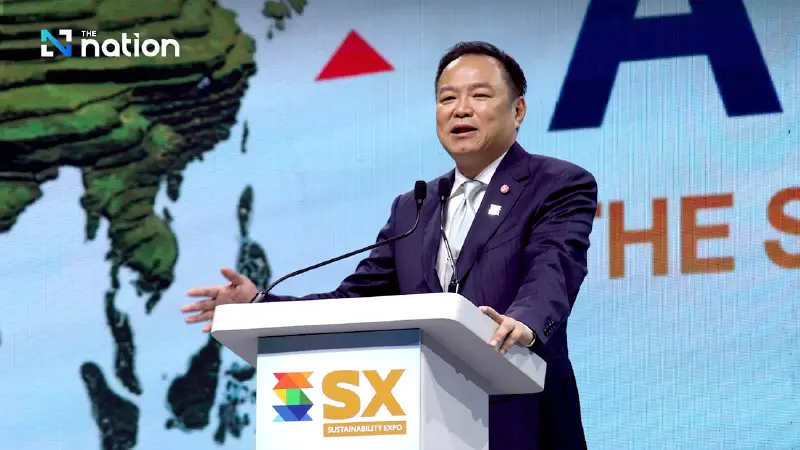


Prime Minister Anutin Charnvirakul stated that “sustainability” is Thailand’s lifeline, not just an option. He emphasised the need to accelerate the foundation of the economy, trade, industry, and healthcare to address the challenges of global volatility and an ageing society.
- Prime Minister Anutin frames sustainability as a crucial "lifeline" for Thailand's long-term economic survival and growth amid global volatility, requiring continuous policies that outlast government changes.
- The strategy focuses on three key dimensions: economic stability through clean energy, environmental sustainability via community solar projects, and social wellbeing by creating a self-sustaining healthcare model for an ageing population.
- To boost trade and investment, the plan aims to attract genuine foreign investment to establish Thailand as a regional hub, leveraging the nation's cultural and political stability as key assets.
- Anutin emphasizes that sustainability is not just about "Green" environmental policies, but a broader approach to creating new economic opportunities, increasing product value, and improving the quality of life for all citizens.
Krungthep Turakij partners with Sustainability Expo 2025 (SX 2025), the largest sustainability event in ASEAN, to host the seminar "A Call for Adaptation: Sustainability in Trade & Industry" on Friday (October 3).
The seminar featured a special address by Prime Minister Anutin Charnvirakul, who spoke on the topic "Elevating Industry, Trade, and Investment towards Sustainability."
Prime Minister emphasised that sustainability is not just a passing trend but a "lifeline" for Thailand amidst a world grappling with economic volatility, trade competition, and escalating geopolitical pressures.
He explained that sustainability has become the new global standard. While many people may still struggle to fully understand the meaning of the Sustainable Development Goals (SDGs), Thailand cannot afford to ignore them. However, focusing only on short-term quick wins cannot address structural issues. Therefore, the government must lay the groundwork for long-term solutions to ensure that policies are not abandoned when governments change. “If sustainability lacks continuity, its purpose will be lost.”


For development to proceed effectively, it must address three key dimensions:
- Economic Stability: Thailand must navigate trade wars, trade barriers, and competition in production technology. This has led businesses to adopt clean energy solutions and reduce carbon footprints.
- Sustainable Environment: The government plans to promote "Community Solar" projects, linking electricity generation at the village level. This would allow surplus energy to be sold back, creating income for communities and supporting a new grassroots economic model.
- Quality of Life and Social Wellbeing: As Thailand faces a fully ageing society, with life expectancy rising to an average of 90 years, the government must prioritise health budgeting.
“With the increasing life expectancy of Thai people, we must ensure a sustainable healthcare system. The government will need to invest heavily, both from public funds and through private sector cooperation,” the Prime Minister said.
To address this, the government has proposed a model where public hospitals can generate additional revenue through premium services for those who can afford them. The profits would then support patients covered by the 30-baht scheme and social security, ensuring the sustainability of the healthcare system while improving service quality for vulnerable groups.

In terms of trade and investment, the Prime Minister emphasised that Thailand should be a regional hub, but not merely a “transit point” for investments. The country must create incentives to attract genuine foreign investment, which will create jobs, generate income, and increase the value of the economy.
However, Thailand’s strengths lie in its rich cultural heritage, religious diversity, and political stability—assets that act as "social capital" and inspire confidence in foreign investors. Yet, the government must ensure that these factors do not allow vested interests to dictate the direction of the economy, as this could stifle competition, leading to stagnation and lost opportunities in the long term.
Anutin further stated that sustainability should not be viewed solely as an environmental issue or simply “Green” policies. It is about creating new opportunities in trade and investment, expanding markets, increasing product value, and improving the quality of life for citizens across all dimensions.
“Sustainability is not just a policy; it is the future of the country. If we succeed, Thailand will not just survive, but will thrive, growing steadily and with pride,” he concluded.

