
‘Cloudbursts and rising seas’: Thailand must invest now to avert economic collapse
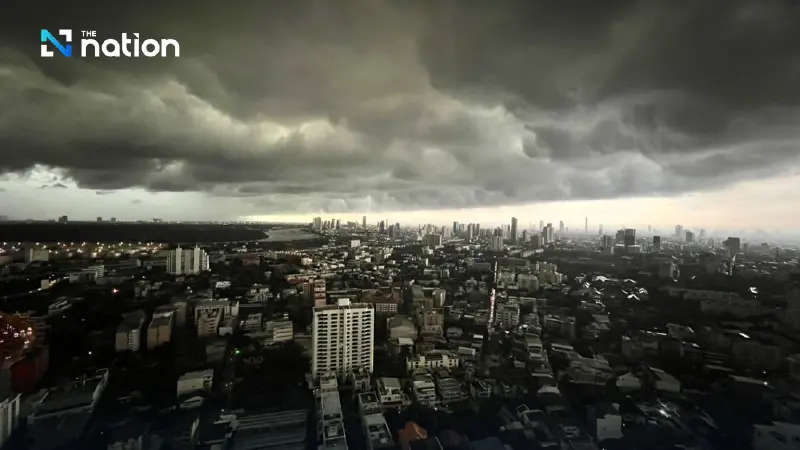


Thailand is confronting a new era of extreme disasters, from violent cloudbursts to rising seawater, that today’s ageing infrastructure can no longer withstand. Experts are urging immediate investment in large-scale strategic projects to prevent future economic losses of an unprecedented scale.
- Thailand faces a severe economic threat from a new climate reality of intense, localized "cloudbursts" and rising sea levels, which existing systems cannot manage.
- The country's flood preparedness is critically undermined by outdated, undersized drainage infrastructure and a national water masterplan that lacks legal authority, allowing urban development to obstruct floodways.
- Experts urge immediate, proactive investment in large-scale strategic projects, such as offshore water retention pods, to protect against both flooding and sea-level rise.
- Key recommendations include elevating the water masterplan to an enforceable law and upgrading all infrastructure to handle rainfall volumes far greater than past standards.
Chawalit Chantararat, a water-resources engineer and board member of TEAM Consulting Engineering and Management PCL (TEAM Group), one of Thailand’s leading water-management experts, has warned of critical gaps in the country’s flood-response system.
He pointed to the absence of a legally enforceable national water masterplan and outdated infrastructure that can no longer withstand today’s extreme weather.
He urged the government to make urgent, proactive investments in large-scale strategic projects, such as the proposed “monkey-cheek water retention pods in the sea”—to prevent future economic losses that could reach “tens of billions of baht.”
Thailand’s ‘new era’ of disasters breaking past limits
Chawalit noted that Thailand is now facing a permanently altered climate pattern, with a clear turning point emerging from 2021 onwards. The old assumption that disasters come and go quickly, he said, is no longer valid.
Shift to high-intensity rainfall
Recent years have seen a major shift towards high-intensity rainfall, commonly known as cloudbursts, causing unprecedented pressure on urban drainage systems.
• Localised, extreme downpours:
Instead of rainfall spreading over large areas, storms now unleash massive volumes of water over small, concentrated zones. For example, Phuket recorded 350 mm of rainfall in just eight hours, while Chiang Mai’s San Pa Tong district saw 300 mm in a short period. These volumes far exceed the design capacity of most urban drainage systems.
• Longer disaster duration:
Beyond intensity, the duration of extreme events has also increased significantly. The recent floods in the lower South, Phatthalung, Songkhla, Yala and Pattani, saw continuous heavy rainfall for 5–7 days, unlike past storms that typically subsided after about three days. The accumulation of rainfall over longer periods has led to catastrophic damage that is difficult to quantify.
Case study: a complex and severe flood crisis in the South
The recent flooding in southern Thailand was driven by the convergence of three major climatic factors, which intensified the monsoon far beyond normal levels:
Cold air mass from China:
A surge of cold air pushed southward, forcing the monsoon trough to shift downward and settle over the lower South.
Influence of a nearby low-pressure system:
A low-pressure cell forming near Kota Bharu, Malaysia, strengthened the monsoon winds and prevented them from moving out of the area.
La Niña phenomenon:
La Niña amplified the northeast monsoon, pulling vast amounts of moisture from the Gulf of Thailand. This resulted in extreme rainfall of 200–400 mm per day in multiple provinces.
Assessing Thailand’s preparedness: persistent weaknesses exposed
Despite efforts to improve water management, Thailand still faces systemic weaknesses that limit its ability to cope with increasingly severe disasters.
Policy problem: a water masterplan without legal authority
The Office of the National Water Resources (ONWR) was created to integrate water-related agencies—a step in the right direction. However, its key instrument, the national “water masterplan,” lacks legal enforceability and does not carry the same authority as urban zoning laws.
Impact on urban development
In practice, construction permits and city planning continue to follow urban zoning rather than water zoning. As a result:
- Water flow zones and natural retention areas (monkey cheeks) are frequently ignored.
- Developments often encroach on designated floodways, including zones originally outlined under guidance from His Majesty King Rama IX.
- Urban expansion increasingly obstructs natural drainage, reducing the landscape’s ability to absorb or redirect floodwaters.
Outdated infrastructure and chronic “bottlenecks”
Thailand’s existing drainage infrastructure was designed for weather patterns of the past and can no longer cope with today’s high-intensity rainfall. Undersized culverts beneath roads and railway lines have become major bottlenecks, preventing water from flowing through fast enough and causing severe flooding.
Urgent need to expand capacity
Surveys have identified 52 locations along the Southern Railway Line where water-passage structures must be expanded. At several points, the number of culverts must be increased from four to six or even eight, depending on local hydrological conditions.
Major drainage canals also require immediate intervention. In Hat Yai, the Khlong R.1 canal, one of the city’s primary drainage arteries, needs urgent sediment dredging at its downstream section to restore flow capacity into Songkhla Lake.
Strategic proposals: proactive investment for long-term survival
Addressing long-term threats, especially sea level rise, will require bold strategic decisions and a 25-year vision.
Adapting to a projected 75-cm rise in sea level
What no longer works: raising barriers along 3,000 km of coastline
The old idea of continuously raising floodwalls along the Chao Phraya River and the coastline—stretching more than 3,000 kilometres—has been rejected. Studies show it would take over 22 years to complete and cause severe ecological damage to coastal ecosystems.
A new strategic proposal: “monkey-cheek retention pods at river mouths”
TEAM Group proposes building large offshore water-retention pods near river mouths. These would function both as:
- giant monkey-cheek reservoirs to temporarily store floodwater, and
- sea-level surge barriers protecting inland areas from rising tides.
The concept is assessed to have significantly lower environmental impact and offers a far more effective solution than trying to fight rising waters solely on land.
Consequences of inaction: saltwater intrusion threatens Thailand’s agricultural economy
Without decisive and timely intervention, saltwater intrusion will penetrate deeper inland, inflicting severe damage on high-value agricultural zones and major economic corridors. Several river basins are projected to face escalating impacts:
- Chao Phraya River – the boundary between Ayutthaya and Ang Thong is at high risk, with vast agricultural and economic zones facing large-scale losses.
- Tha Chin River (Suphan Buri) – saltwater intrusion could devastate key crops such as pomelo, coconuts and other high-value produce.
- Bang Pakong River (Bang Khla to Prachin Buri) – threats to freshwater ecosystems and extensive farming areas.
- Mae Klong River (Ban Pong, Ratchaburi) – impacts expected even with support from the Tha Muang Dam.
Policy recommendations for long-term sustainability
Thailand is confronting challenges that can no longer be managed with traditional reactive measures. A shift toward urgent, proactive action is essential.
Economic rationale
Investing in preparedness offers far greater economic value than absorbing repeated losses. The tens of billions of baht in damages from just one flood event in Hat Yai could have funded long-term infrastructure upgrades capable of preventing future crises.
Lessons from the Netherlands
Even one of the world’s most experienced water-management nations needed 22 years to complete its large-scale flood protection systems. Thailand must therefore make strategic decisions now and begin construction immediately to meet the challenges expected over the next 25 years.
Five policy actions Thailand must take now
Elevate the national “water masterplan” into enforceable law
The master plan must be given legal authority equal to urban zoning laws to halt developments that obstruct natural water flow.
Strict enforcement of existing zoning laws
Local authorities must ensure that natural retention areas and designated floodways are protected from encroachment.
Urgent allocation of funds to upgrade infrastructure
Establish a systematic national plan for dredging, expansion and maintenance of weak drainage structures across the country.
Commit to large-scale strategic projects
Thailand must select and initiate major long-term solutions—such as offshore monkey-cheek water-retention pods—without delay.
Design future infrastructure for extreme rainfall
All new construction must be engineered at larger capacities, prepared to handle rainfall volumes at least twice the old design standard, reflecting today’s high-intensity, long-duration storms.
Julawan Koedyam
