
Peace from the White House
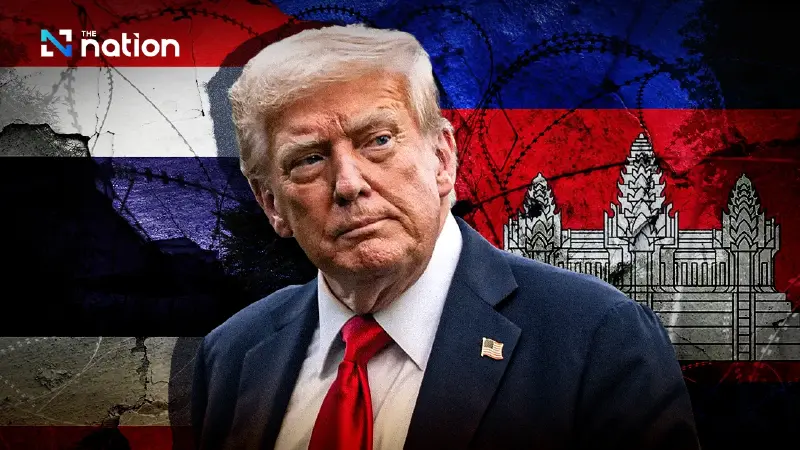


US President Trump's offer to mediate Thailand-Cambodia peace sparks debate on military power and multilateral efforts in resolving the long-standing conflict.
- US President Donald Trump has offered to preside over a peace signing to resolve the conflict between Thailand and Cambodia.
- The US intervention is credited with pushing for a ceasefire and shifting the conflict from a bilateral to a multilateral issue with geopolitical implications.
- It is suggested that a potential motivation for the President's offer is to gain political legitimacy and pursue the Nobel Peace Prize.
It must be acknowledged that US President Donald Trump has once again generated excitement in resolving the Thailand-Cambodia conflict by offering to preside over the peace signing between the two countries under the ASEAN Chairmanship of Prime Minister Anwar Ibrahim of Malaysia.
Although the details of Trump's offer remain unclear, this article attempts to highlight some observations regarding his proposal.
- The author has long stated that the resolution of the Thailand-Cambodia conflict has gradually shifted from bilateral to multilateral efforts. However, Thai leaders, both political and military, still seem adamant that the problem must be solved bilaterally, or through “two-party negotiations” only.
- The recent push for a ceasefire and the agreement in Malaysia can be credited to the intervention of US leadership, not a “success” of Thai pressure on Cambodia to accept a ceasefire.
- It is worth questioning whether a ceasefire negotiation would have been possible without US pressure, and whether Malaysia could truly exert enough influence on both countries.
- Falling into the “illusion of success” has led Thai leaders and the public to fail to see the increasing multilateral pressure on the issue.
- This illusion also fosters a “myth of power,” with the belief that Thailand can continually pressure Cambodia using its “military power” due to its significantly superior military strength, leading to the assumption that Thailand will always win. This has led us to forget the lessons from the use of force during the governments of Field Marshal Sarit Thanarat and Abhisit Vejjajiva, where such actions ended up at the International Court of Justice in 1962 and 2013, respectively.
- Thai leaders must understand that international conflicts never exist in a vacuum. Military force is merely one of Thailand's “strategic tools,” and the use of such tools does not guarantee that Thailand will be the “decisive winner.” Using force without understanding the international context can easily result in a “political defeat.”
- It is common for conflicts with neighbouring countries to fuel the rise of nationalism, which is often intertwined with imperialism, where society values the military over politicians. In particular, the “Uncle's audio clip” has poured high-quality fuel into the “nationalism fire,” and today, the “far-right” movement is becoming the dominant force in addressing the Thailand-Cambodia issue.
- The rise of the “far-right” movement, operating under the banner of “nationalism + imperialism,” combined with the “myth of power,” creates the belief that Thailand can quickly and decisively resolve the dispute. However, it is evident that since the conflict began in late July, the issue remains “stagnant” with no real resolution in sight.
- The conflict is increasingly showing signs of becoming a “protracted war,” with growing military tension along the border, making it unlikely that the issue will be resolved bilaterally, as Thai leaders had hoped. Analysts believe that a new conflict could emerge with relative ease.
- The ongoing situation, compounded by rising nationalism and media-driven narratives, has diverted the focus of both the government and society towards “smaller-scale issues” such as the disputes in Ban Nong Chan and Ban Nong Ya Kaew. However, this narrow focus fails to acknowledge that the problem is an “international issue,” with the real battle taking place on the global stage, as seen in Cambodia’s leadership policy which focuses on international platforms.
- The prolonged nature of the dispute could open the door for “external factors” to step in as mediators. The international community might view this conflict as a threat to regional stability and may feel compelled to intervene to bring about a resolution.
- Trump’s offer to mediate introduces a “geopolitical dynamic,” with major global powers competing for influence. As a result, the Thailand-Cambodia dispute has become a multilateral issue and a part of the broader “global political game.”
- Thai government and society must realise that the complexity of this issue has escalated, potentially extending well beyond the scope of MoUs 43 and 44 (it may be time for the Prime Minister to reconsider the idea of a referendum).
- The Thai government must not overlook whether it has accepted the “Trump Tariff of 19%.” There is a need for transparency on this matter, as Thai leaders cannot afford to ignore this issue.
- The Thai government should consider the “endgame” of the conflict, or what is referred to in strategic terms as the “exit strategy.” As the government, the Prime Minister must be prepared to answer what Thailand’s exit strategy in this matter is (which may be far more significant than the reports from the National Defence College that the Prime Minister is familiar with).

The final note
I admit that I greatly misjudged the situation. I believed that a change in government in Bangkok would be a key factor in facilitating negotiations to resolve the dispute. However, the issue has instead evolved into a "protracted war," a condition that all strategists are taught will "erode" larger states more than smaller ones.
Furthermore, when the disputing state shows no signs of stepping back from this prolonged conflict, such a situation could easily become a “legitimacy” for the president to “rack up points” in the pursuit of the "Nobel Peace Prize"!
