
Auto sector expected to stay put


Play
Unlike electronics industry, complex manufacturing infrastructure hard to shift
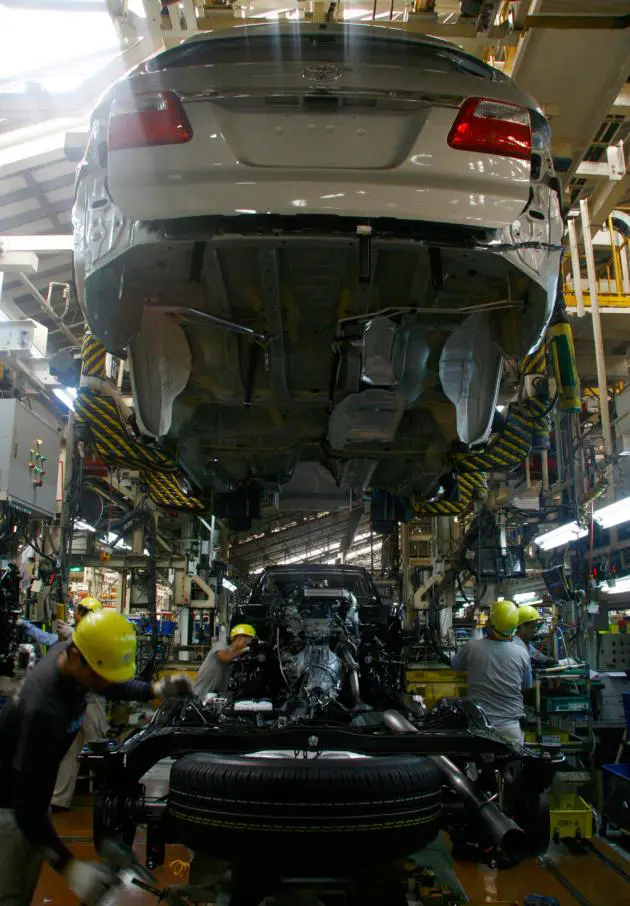
Unlike the electronics industry, manufacturers in the automotive industry are expected to remain in Thailand and invest substantially in high-technology production for much of the next decade, industrialists say.
The severe flooding that began in October inundated seven industrial estates that are the manufacturing bases of the automotive and electronics industries. There is concern that manufacturers in both industries may move their production out of Thailand if the country does not have a concrete plan for water management.
However, an auto-industry source said that business was different from the electronics industry. The supply chain in the automotive industry is longer and more complicated. When carmakers and auto-parts manufacturers have settled in a country, the production set-up throughout the industry becomes rigid. Hence it is not easy to move it to other destinations.
“Competitiveness is the main concern for carmakers. Thailand has skilled labour and a well-developed infrastructure for this industry. So I don’t think the automotive industry can be moved easily from Thailand.”
The source said there would be huge investment in such high technology as continuously variable transmissions. Moreover, the government’s policy to promote eco-car production will attract investment in producing parts for this type of vehicle in Thailand
“Certainly, there will be investments from the automotive industry over the next five years. The automotive industry will be prosperous in Thailand for at least 10 years.”
The source added that skilled labour was the strength of Thailand. Wages are not as great a concern as in the electronics industry, as they are not a key operating cost in auto production. High quality is the main criterion, and Thailand is qualified in this area. While more investment in Indonesia is predictable, mainly due to the huge demand for vehicles in that big country, the main production will remain in Thailand.
The source said auto production in Thailand was expected to reach 2 million units in 2012, boosted by the introduction next year of eco-cars from Mitsubishi and Suzuki. Full-scale production is forecast to resume normally in March, only three months after the floods forced its slowdown. That is faster than the recovery after the Japanese tsunami last March affected the Thai industry. On that occasion, the Kingdom’s automotive industry did not resume normal production until September, six months after the tsunami.
“In September 2011, the Thai automotive industry achieved a monthly production record of 174,000 units. Then the number dropped drastically in October. We expect production to increase gradually starting from January and hit a new monthly record of 180,000 units in March,” the source said.
Thailand in 2012 is expected to reach auto-production capacity of 2.7 million units, and the number will rise to 3 million by 2014. The industry employs 525,000 workers. In developed countries, the automobile penetration rate is one vehicle per two people. The rate in Thailand is one vehicle per six people. So auto sales in Thailand can grow to 2 million units per year until it reaches saturation point, the source added.
Swift resumption
Suparat Sirisuwannangura, president of the Automotive Industry Club under the Federation of Thai Industries, said large auto-parts makers would be able to resume normal production quickly, but small and medium-sized enterprises are forecast to take six months before they can restart normal production.
He said the launch of new eco-cars from two manufacturers – Suzuki and Mitsubishi – would help boost auto production in 2012 to 2 million units. Hence the proportion of city cars will be more than 30 per cent of total auto production.
DBS Vickers Securities forecast in its research that auto production in 2012 would grow by 30-35 per cent to 1.9 million units. The full recovery of the Thai automotive industry is likely to take place late in the second quarter.
