
UD Town a focal point for Udon Thani


Play
Premium shopping mall has become a showcase for the changing Isaan lifestyle
Three years ago, the 25 rai (4 hectares) of land around the train station in the sleepy northeastern city of Udon Thani was empty, and people maintained their traditional way of life.
The landscape today is completely different. New construction nearby mirrors the explo-
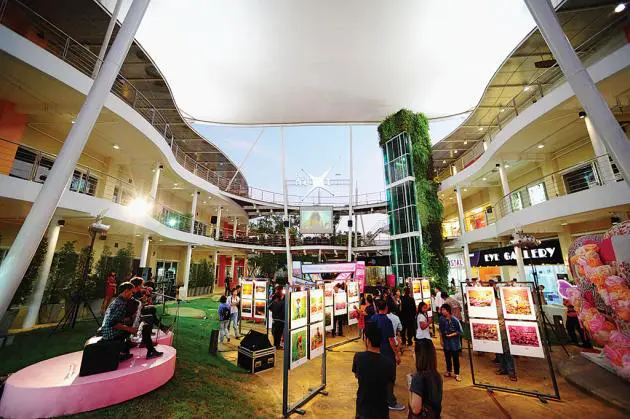
sion in economic prosperity. However, nothing compares to UD Town. The premium-lifestyle community shopping centre, costing Bt1 billion, flung its doors open in 2009.
It has become a focal point for local people to meet, entertain and relax. Some companies have used it as a trial market for new products before expanding across the Northeast.
“The reception from the peo-ple is beyond my expectations
right now,” Tanakorn Weera-chatyanukul, president and chief executive officer of Udon Plaza Co, said yesterday.
The Udon Thani native, 45, has a dream. He wants to promote the province as one of the landmarks of Isaan with a flurry of development projects. Today, he is setting his target high.
“There is a lot of business potential here, so why not become a shopping destination?’’ he asked.
In fact the province’s economy has grown fast because it is a trading and transport hub in the region. Overseas remittances reach Bt8 billion to Bt9 billion annually.
In terms of lifestyle, locals are now more modern. They like to eat out and have strong purchasing power. In terms of geography, Udon Thani connects to Khon Kaen, Nong Bua Lamphu, Loei, Nong Khai, Sakon Nakhon and Nakhon Phanom, as well as Laos.
“I want to bring progress to my home town. In Bangkok, if I worked there, I would be a small ant. Here I’m an ant too, but the king of ants,’’ he said.
The former key person for Total Access Communication (DTAC) in the Northeast region built UD Town without any retail experience or connections in this field. That gave him a headache after construction was completed. He had to learn how to persuade branded products and services to come to his centre. At the time, nobody believed in its potential. Some said, “Our brands are not suitable for the Isaan area.”
However, he went ahead with his plan. Some brand owners, especially Tan Passakornnatee,
the previous owner of Oishi, gave him a chance. Time itself proved his success. Today, there is a long line of recognised brands including McDonald’s, Oishi Ramen, B2S, Super Sport, and Tesco Lotus. A KFC will open in the near future. Oishi Express and Melt Me chose here as their launch pad in Isaan, and iStudio uses it for a prototype outlet for expansion in the region.
At the grand opening, some brands broke their own sales records. During its first year, passenger-car brands liked to show off their innovations here too. More than 90 stores are used as flagships, while more than 300 small shops are mainly operated by local entrepreneurs.
This year, Tanakorn expects to draw more than 30,000 patrons a day, up from 15,000-20,000 in 2011. Last year, 70 per cent were local residents, and 30 per cent from other areas, including neighbouring provinces, Laos and Bangkok. Traffic is expected to increase to 10,000 vehicles from more than 9,000 last year.
Last year, frequency of visits was three or four times per week. Average spending was Bt500-Bt1,000. Revenue increased 30 per cent to Bt150 million, of which 87 per cent was from tenant rental income and 13 per cent from organising activities and other sources.
This year, its revenue is expected to grow 15-20 per cent.
Tanakorn seems to be working even harder because of the entry of Central Department Store. The firm has allocated Bt40 million for marketing and Bt50 million to modernise the landscaping. Communication campaigns will be highlighted both in the local area and outside to promote its brand. Fashion brands will be added to become a new magnet.
The firm plans to build a business centre to serve demand for office rentals. A hotel project will take more time to study.
UD Town today is described as a model upcountry mall. Investors from locations around the country such as Phuket, Maha Sarakham and Hat Yai have come to visit and approach him to do business with him. So far, he has said ‘‘no’’. The reason is that he wants to keep its size small in order to control everything as he wants it to be.
He attributes his success to the “three C’s” – concept, content that includes brands and activities, and care, which includes customers and tenants. Staff often see him inspecting all the details, even toilets, by himself. And he goes around to talk to vendors and ask them about their business.
When asked how much tension he felt with the arrival of Central, he said he was somewhat ‘‘scared”.
“However, it makes me more active and keen to survive. The more we feel paranoid, the harder we work.”
