
Dawei to be modern link to 131-year-old Chennai port
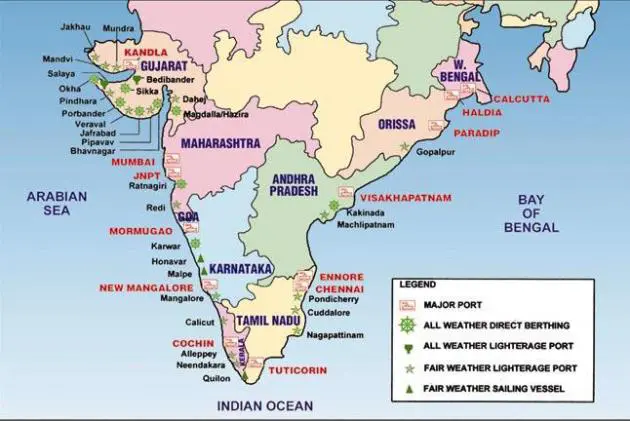


Myanmar's Dawei deep seaport, to be built by Italian-Thai Development, has plenty of choices for connecting with India as its aim to link Thailand via the Andaman Sea with the far edge of the Bay of Bengal comes true.
India has a very long coastline, totalling 7,517 kilometres and shared by nine states. The country has 12 major and 187 minor ports on its east, south and west coasts.
The shortest and most direct route from Dawei is to Tamil Nadu’s Coromandel Coast, where many ports have existed for a long time.
The oldest one is Chennai Port, which can be dated back to 1639 when a fishing village could be found on the sandy coast. This area began to function as a port in 1861 and was first operated as a commercial port in 1881.
The maritime history of 131 years for this port, formerly known as Madras Port, is long enough. It is the third-oldest of India’s 12 major ports. It is also one of largest Indian ports, second only to Mumbai. It is the largest one on the east coast of India.
There are seven major ports on India’s east coast. Tamil Nadu state alone has three: Chennai, Ennore and Tuticorin. The state has another 22 small ports along its coast and the authorities plan to approve construction of four more.

The state-run Chennai Port handled 55.71 million tonnes of cargo in 2011-12, according to chief engineer R Srinivasa Nannan. As Chennai is the home of the Indian automobile industry, the port was the top car-handling facility in the country with 2.5 million units in 2011-12, compared with 2.3 million units a year earlier, he said. Hyundai topped the list of cars being handled for export through Chennai Port.
The port stopped handling dirty mineral items such as coal recently for environmental reasons. It later focused on other mineral items such as dolomite, nitrogen fertiliser and limestone to compensate for coal and iron ore.
Being one of the largest and oldest ports has advantages and disadvantages. It is now surrounded by communities and access to the port is not easy. Truck traffic congestion near the port is very common although the port also has rail connectivity. The authorities plan to build more transport links.
Besides the traffic problems, bureaucratic red tape for customs clearance is one of the weak points for this port. It takes at least seven days to unload and clear goods.
Tamil Nadu and Chennai might not be very famous for tourism but Chennai Port Trust, the authority that runs the port, plans to turn part of it into a major destination for cruise tourism, Nannan said. A lot of world-class cruise vessels have already visited the port, he said.
Ports in India are highly competitive. Privately run smaller ports also have the ability to compete with major ones like Chennai. The giant construction firm Larsen & Toubro Group has just completed the US$400-million (Bt12.6-billion) port of Kattupalli and will open it for operation this month.
With modern equipment, the new port has an initial annual capacity of 1.2 million TEUs (twenty-foot-equivalent units). The most competitive point compared with Chennai Port is less congestion, as container movement is away from the city.
A customs clearance facility is located in Kattupalli Port. It will operate 24 hours a day and seven days a week, said chief operating officer G Gandhirajan. If all documents are ready, clearance of goods from the port could be complete within one day, he said. “We are also offering the same prices as Chennai Port,” he said.
Kattupalli Port also offered shipyard facilities for repairs and shipbuilding, he said, noting that this was the first and |still the only shipyard on India’s east coast. The facility in Chennai could build even submarines for military purposes, he said.
The company has experience in building and running many ports in India including Kakinada Deep Water Port in Andhra Pradesh and Dhamra Port in Orissa.
Both the state-run and private ports in Chennai said they were ready to connect shipments with any ports on the opposite side of the Bay of Bengal.
l This is the second of a three-part series to explore the visions and possibilities on Chennai-Dawei connectivity to link India with Thailand via Myanmar and other Southeast Asian nations. The first was published on August 3.
