
Hand-Sketch vs Sketchup: tools for helping designers
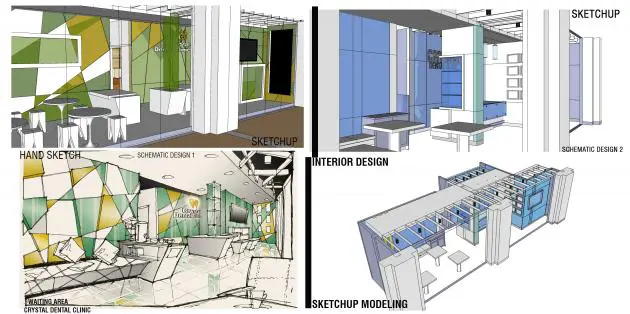


Why do architects sketch? Some do manual sketching, while others opt for digital. There are, indeed, many sketching programs, including SketchUp. But why SketchUp? Why digital sketching? Is manual sketching too unpractical, too clumsy or too hard to learn
In the architectural design process there are three stages – schematic, development and documentation.
Prior to the digital revolution, architects spent the preliminary part of the design process using pen or pencil to sketch on paper, translating design concepts from the designer’s mind into 2D or 3D images that could be easily understood by the architect himself or by others. Physical or mock-up models also helped.
With computer technology, architects began to develop designs and create construction documents, but the schematic design process was not really computerised.
By the 1960s, however, computer-aided design (CAD) began to take shape as a new line of research that was quickly applied to the architectural practice. By the 1970s, CAD programs began to be commercially produced and sold.
In the 1980s, while personal computers began to develop, Autodesk Co was established, with made-for-PC programs such as AutoCAD Release 1 coming to the market.
Design, both architectural and engineering, began to be computer-aided. However, the early generations of CAD programs remained largely drafting tools on PCs, as they were developed by engineers and researchers who were not designers themselves. They did not have much understanding of the minds and working process of architects. Architects needed not only an aid for architectural drafting, but also for architectural design.
In 1999, a group of researchers, both architects and software developers, began to search for an alternative program that catered better to architects’ needs than CAD. A company called @last Software was established and designers’ hand-sketching and design processes were studied to develop a sketching/designing program. In August 2000, SketchUp was born.
With full understanding of architects’ needs and work methodology, SketchUp is an easy-to-use program that works on quick 2D sketches that can be projected into 3D form very quickly. The award-winning program caught on and now is widely used.
In 2006 it was sold to Google, which turned it into what we now know as Google SketchUp. It is now very easy to design, create forms and exchange information about these forms over the Internet. With free use for the basic-level program, Google SketchUp is commonly used by not just architects and designers.
As it was based on AutoCAD, SketchUp’s interface is fairly similar, with the same set of basic functions, command icons, and form-creating, manipulating and rendering commands. These commands are not complex, with just enough options to generate various forms, with many styles of effects. Those already familiar with AutoCAD can easily learn to use SketchUp.
The success of SketchUp is based on four factors – the user’s skill and experience, user-friendliness, simplicity, especially of the interface, and accessibility in terms of the program and the exchange of data.
The program can be helpful in three parts of the design process – schematic sketch design, mass study and presentation for alternative design.
SketchUp is suitable for projects that are not too complicated, with minimal details, especially interior design projects, as they often are not as complicated as large-scale building projects.
SketchUp’s main limitations are the inability to keep up with extreme complexity, realistic rendering and construction drawing, which still lag behind other CAD programs.
A recent development is the emergence of Building Information Modelling (BIM) software, which can generate 3D forms that are embedded with a whole lot of data such as building components and material data. BIM can assist a lot in the architectural design business, from preliminary design to documentation, so many offices have turned to using BIM programs such as Autodesk Revit and ArchiCAD.
Every program has its strengths and weaknesses, while human needs are also limitless. New software must be constantly developed to cope with users’ new needs, but no one wants to spend much time learning how to use the new, complicated applications.
An easy program with universal functions has an edge over its competitors. Even though technology can help one’s life become easier, sometimes hand-sketching is useful as a means to communicate with a client, with no need for a computer, or any other electronic means.
In the end we should understand that a computer is just a tool that helps in designing. Good designs do not solely depend on good design tools, but good design tools can increase the opportunity to create and present good designs. These new tools and technologies are simply a part of the future design’s changes.
