
Airbus' launches plan to help airlines go 'green'
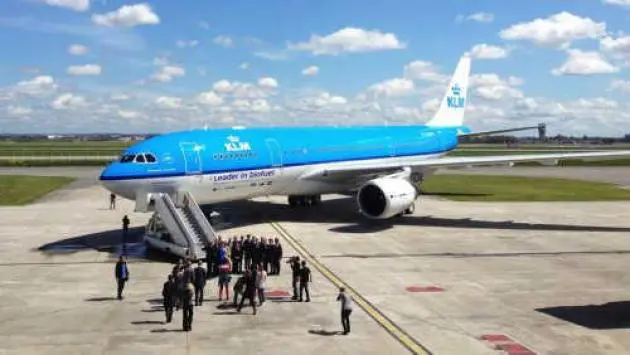


Airbus has launched the "Sustainable Aviation Engagement Programme", a long-term partnership programme, set up to help airlines reduce their environmental footprint through a tailored offering of services and expertise.
Based on four pillars (aircraft technology, aircraft operations, Air Traffic Management and sustainable aviation fuels), the programme enables airlines to minimise their environmental impact by harnessing the full potential of Airbus’ latest generation, fuel efficient aircraft to minimise fuel burn and noise in their operations. Airbus will accompany each airline throughout the deployment of the programme.
The Sustainable Aviation Eng-agement Programme is currently in a phase of developing pilot projects, during which Airbus will work closely with Cathay Pacific, British Airways and KLM Royal Dutch Airlines. The feedback and learning from these three pilot projects will be taken on board before the programme is extended to operators worldwide from 2016.
"We are very pleased to see the Sustainable Aviation Engagement programme taking shape with world leading airlines as British Airways, Cathay Pacific and KLM", said Jean-Luc Taupiac, Airbus’ head of environment."
By working closely with our customers and building long-term partnerships, we offer them tailored solutions and expertise to meet their environmental objectives. The benefits unfolded with the ‘Perfect Flight’, a winning combination of using latest aircraft technology, best aircraft operations, optimised Air Traffic Management and sustainable aviation fuels, which really unlocks the full potential to minimise the environmental footprint."
"We really welcome the opportunity to work closely with Airbus to demonstrate the change in environmental performance of the next generation of aircraft delivering significantly lower noise and carbon emissions," said Jonathon Counsell, British Airways’ head of environment.
"As a leading airline that has set ambitious targets to address its environmental impact and integrate sustainability into all aspects of its business, Cathay Pacific seeks to work with strategic partners that understand the significance of the challenges posed by future growth.
"Our engagement with Airbus is a key opportunity to work together to draw upon the potential that advanced aerospace technology offers in this regard, including reducing greenhouse gas emissions and noise. This will enable us to drive future improvements within our business and contribute to reducing the industry’s overall environmental footprint," said Dr Mark Watson, head of environmental affairs at Cathay Pacific.
KLM is the leader in the development of a market for sustainable biofuel. In 2014, KLM launched a series of biofuel flights to Aruba and Bonaire that lasted six months, operating an A330-200.
"We worked intensively with Airbus during the entire project, to research the engine performance during the biofuel flights. Airbus’ sustainable aviation engagement program is a logical next step in this cooperation, enabling us to expand our relationship to other areas than biofuel," said Eileen van den Tweel, innovation manager at KLM.
Together with Air France, KLM has been ranked the most sustainable airline in the Dow Jones Sustain-ability Index for 10 consecutive years, and our ambition is to keep this leading position. Cooperation with Airbus and other partners in our supply chain is very important.
Airbus works constantly to mitigate its environmental impact and reduce not only CO2 emissions, but other emissions linked to climate change and air quality, as well as noise, through its innovative technologies and cross-industry partnerships. New technologies are constantly in development and Airbus invests around 2 billion euros (Bt73.6 billion) annually in R&D to develop incremental innovations that will further enhance the efficiency and competitiveness of all our aircraft.
The Perfect Flight is a commercial flight combining all best practices currently available: operating fuel-efficient aircraft, using sustainable
fuels and implementing a truly streamlined Air Traffic Management system alongside optimised ground and flight operations.
In June 2012, Airbus and Air Canada performed North America’s first "Perfect Flight" over international borders, cutting CO2 emissions by more than 40 per cent compared to a regular flight.
The commercial flight on an Airbus A319 aircraft from Toronto, Canada to Mexico City combined the use of a modern aircraft, powered by sustainable jet fuels (a 50/50 blend of biofuel made of used cooking oil), guided by streamlined Air Traffic Management procedures and facilitated through best practice operations (single-engine taxiing, light weight cabin equipment).
In October, 2011, Airbus and Air-France completed the first Perfect Flight. The flight from Toulouse to Paris using an Airbus A321 demonstrated the cutting in half of CO2 emitted compared to a regular flight.
Airbus is convinced that scaling-up Perfect Flights today can significantly contribute to shrink the environmental footprint of an aircraft’s flight operations to a minimum.
