
Hongsa promises responsible management of environment
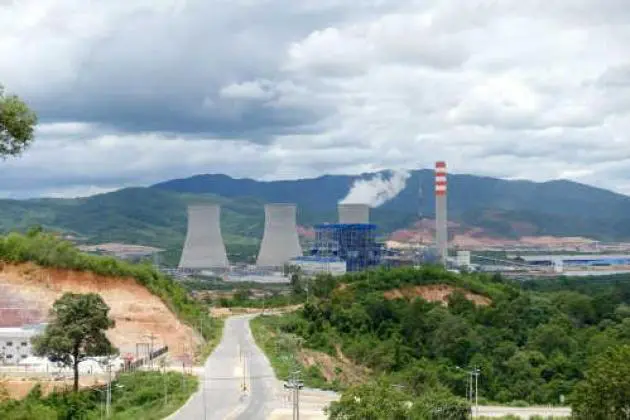


Following the commencement of operations at the 1,878-megawatt Hongsa Mine Mouth Power Project in Muang Ngeune district in Xayaboury province, the firm intention of Hongsa Power Co Ltd (HPC) is to manage the environment and community around the Lao projec
"We are dedicated to conducting our business in a responsible manner to protect life, minimise loss, conserve the environment and contribute to community initiatives," said Rum Herabat, chairman of HPC, which is a joint venture between Thailand’s Banpu Power and Ratchaburi Electricity Generating Holding and the Lao stakeholder, Lao Holding State Enterprise.
Under this policy and the company’s concession agreement, the resettled community’s home plots, each measuring 450 square metres, have been promoted to involve both on-farm and off-farm activities as a short-term income source.
The concept features include a common area, at the ground level of the house, to be used for a handicraft working area or shop; a green, garden area – in front of or at the side of the house – to be used for planting shrubs or as a kitchen-herb garden, catfish pond, mushroom-culture shelter, or plant nursery; and a livestock area, in the backyard, with a focus on cleanliness and odour and noise abatement.
The company, meanwhile, is also supporting farmers to generate income by setting up a programme to help build new careers for them, he said.
In terms of on-farm activities, these include vegetable-gardening, pig-fattening, chicken-raising, fish-farming, and mushroom-growing.
Off-farm activities include cotton-spinning; the production of floating lanterns, brooms and bricks; and the operation of small businesses within the resettled village – for example, repair shops, beauty salons, groceries and food shops.
On an approximate 1,200-hectare area, the host community’s slash-and-burn farmland – located 18 kilometres to the east of Hongsa town in a valley and on a rough hillside between two routes, Hongsa-Xayaboury and Hongsa-Luang Pabang – has been developed as more stable farmland, benefiting from the construction of new road access and a pipeline irrigation system.
In 2012, a 202-hectare area of the farmland was prepared for para-rubber plantation and intercropping.
Despite the difficulties of such preparation caused by the addition of extra housing for the resettled villagers and uneven land, efforts are being made to promote para-rubber plantation in the remaining
area, in order to accomplish the committed target of 150 per cent of baseline income in the seventh year of plantation, the company’s chairman explained.
Meanwhile, HPC has also developed the livestock area by improving three sites for the raising of common farm animals: the Phou Fah-Ban Thaen Khaen zone, occupying about 500 hectares close to the resettlement site; the Kiew Ngeow-Phou Mak Jon zone, covering 800 hectares, 20km from the resettlement site on the Na Poung-Chompet road; and the Phou Leng-Ban Nong Luang zone, with a size of 500 hectares, also located 20km from the resettlement site, on the ADB road to Xayaboury.
As part of the Income Restoration Programme, a demonstration highland farm was proposed, consisting of three strategic areas: a highland agricultural demonstration zone, an agro-forestry zone, and an ecological and agricultural tourism-attraction site.
Due to its location as a buffer zone for watershed-area protection, a 30-hectare area located at the edge of the farmland along the Hongsa/Na Poung-Luang Prabang route was chosen for development as the learning centre under the programme, encompassing a number of diverse demonstration plots for highland cropping, accommodation, learning facilities, and so on.
Whether or not the objectives of the centre should be extended at the national level is a challenge, as this would require the involvement of external resources, Rum said, adding that further discussion was therefore needed on this issue.
Meanwhile, at the power plant itself, HPC employs around 400 Laotians out of a total staff of some 700. "We believe this project is a model for how to do business that is friendly to the environment and the community, and that is sustainable in the long term," he said.
HPC was formed in 2009 by Banpu Power and Ratchaburi Electricity Generating Holding, which each hold a 40-per-cent stake, and Lao Holding State Enterprise, which has 20 per cent, to develop and operate a 1,878MW lignite mine-mouth power plant with a total investment of US$3.71 billion (Bt133.5 billion).
The consortium has been granted a 25-year operating concession, which runs until 2040.
