
Co-working space that seeks to inspire ‘wolf-like professionals’


Play
MOST CO-WORKING spaces have their eyes fixed on tech start-ups, but the newly opened Wolf seeks to mainly inspire non-tech professionals who are in pursuit of soft skills.
That focus is related to the experience of the space owner, 48-year-old Wisit Chiapiyaskul, who for more than 20 years worked for an international advertising agency, before retiring early from the firm two years ago.
“I had three options then – renting out this place, turning it into a hostel or building a co-working space. The last option was the most appealing. Non-tech people also want to start their own businesses and, through co-working spaces, they can build up networks and learn new ideas. I myself can learn new things,” he said.
Wisit is thankful for his years in the ad industry, which allowed him to learn about several businesses. However, when he wanted to switch careers, this experience encouraged him to choose something that opens up a new world.
Wolf is designed to appeal to wolf-like people: Those who cherish freedom but love their kind and want to live in a big group. For survival, they are fearless and creative.
To Wisit, co-working spaces offer a new and dynamic pattern, and the spaces are also supporting the emergence of new businesses.
The timing is right thanks to the government’s support, which could raise the number of co-working spaces and co-working cafes in Bangkok and other major cities around the country to above 50 this year.
He has also made use of his experience in spreading news about his business. Wolf will be part of Mahidol University students’ “Thailand co-working space collections” project, while requests for interviews keep flowing in.
But Wolf – requiring an investment of Bt10 million, mostly on renovation of the five-storey shophouse – requires new skills to ensure that the business thrives.
Wisit has no plan to grow Wolf by expanding franchises, but to expand it with his own strengths.
While other spaces provide services to tech start-ups which are common resources, Wolf is designed to be the place for those keen on creativity and communication. Start-ups, digital nomads and freelancers working in this area are all welcome to this space.
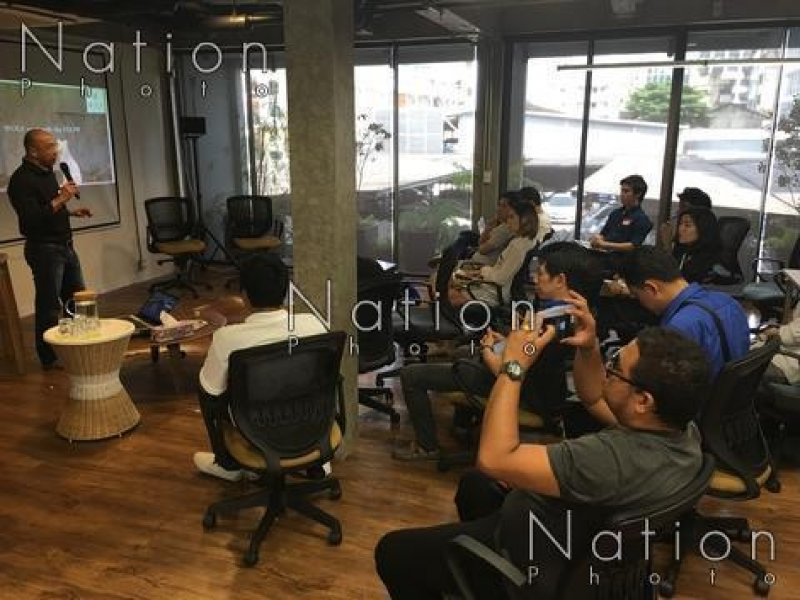
The place, able to accommodate single users or seminars for up to 60 attendees, is designed to make use of natural light, to fit a wolf’s nature. To reflect the creativity, murals appear on its walls.
Meanwhile, a corner is turned into a small library where clients can have coffee and read or relax in cushioned chairs.
There is shared space on every floor, to encourage communication among strangers.
Usually stationed at the office, Wisit from time to time also reaches out to other co-working spaces and joins others’ sessions.
But Wolf is not meant to be just a co-working space. It is also part of a jigsaw in turning Surasak and nearby neighbourhoods like Bang Rak and Charoen Nakorn on the Thon Buri side of the Chao Phraya into attraction points for foreign and local digital nomads, which will boost inbound traffic to the area.
“Work is not everything in one’s life. People should also enjoy the workplace’s surroundings. If this happens, the idea could be replicated by co-working spaces in other zones. This will ensure the sustainability of our business,” Wisit said.
He is now in talks with Poolsub, a co-working space on the Thon Buri side of the river. A map has been just finished, listing attractions – including temples and restaurants – that the two business’ clients can enjoy while working at the spaces.
In the next stage, he plans to build up a network with local and overseas co-working spaces.
At CU Asia, a gathering of co-working spaces, he met a counterpart from Serbia who showed interest in forging a joint marketing plan. As allies, clients of these two spaces could be offered a joint package, whereby they could buy a 10-usage time ticket, for example, but could work anywhere.
Wisit admitted such an alliance could materialise when the district networking concept became clearer. Then, the district can be connected with overseas districts and create an alliance. “Co-working space is like other businesses that are run by revenue. But my goal is turning this business into a part of bigger and sustainable schemes,” he explained.
