
Grower tastes success after mushroom farm revamp
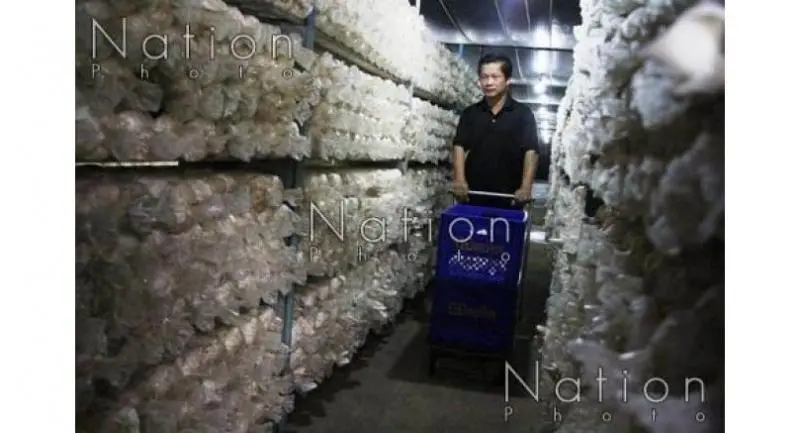


MUSHROOM grower Pornchai Janimit, after almost 35 years in the business, decided on a complete overhaul of his production system in 2016 that has led to an increase of up to 50 per cent in production capacity and sales growth.
Pornchai, now 52, spent an investment budget of Bt3.5 million that year to establish a closed-end mushroom farm on a two-rai property in his home province of Nakhon Pathom.
“I spend my family savings of Bt500,000 to start out growing mushroom in an open-end farming system in 1983 when I saw it as a way to generate income daily from mushrooms, as they can be put out for sale every day,” he said “The business was generating income for me at an average of Bt300 a day in 1983. Some days, we made sales of Bt2,000 a day. But that all depended on the prevailing market prices and the volume of produce that we grew.”
Mushroom prices over the past 30 years ago have averaged between Bt8 and Bt20 per kilogram. His farm had been typically producing between 30 and 100 kilograms a day on a 1-rai holding.
Then, Pornchai hit on the idea of constructing six closed-end building for a higher-yielding system of growing mushrooms, backed by the Bt3.5 million investment.
The new production system was set up on the 2-rai holding at his home in Nakhon Pathom province, enabled by borrowings from the Bank for Agriculture and Agricultural Cooperatives and a guaranteed loan by the Thai Credit Guarantee Corporation (TCG).
The closed-end method for mushroom growing succeeded in boosting production capacity by up to 50 per cent from a level that had been up to 100 kilograms a day. The improvements saw total sales jump from an average of Bt2,000 a day to Bt5,400. On some days, sales hit Bt27,500. Net profit can often amount to 30 per cent of the daily sales value, Pornchai said.
He said that as part of the business costs, producing the mushroom culture comes to Bt5 per culture.
“One culture can produce an average of 500 grams of mushroom for five months. This means one culture can generate sales of mushroom between Bt15 and Bt25 per culture for its lifetime
“This is the key to our success in the business, as we can make high net profits by producing the mushroom culture by ourselves.
“If farmers cannot produce the mushroom culture by themselves, they have to buy it at Bt7 per culture. This is a higher cost than we have in operating the business,” he said.
Buoyed by the success from the switch in methods that boosted production capacity, Pronchai said that he is working with Nakhon Pathom Rajabhat University to process mushrooms to make a bacon-flavoured product from them as well as mushroom balls.
“We will invest up to Bt300,000 to produce both the bacon-style product from the mushrooms and mushroom balls that may be launched in the market by the end of this year. This will help us to double sales growth,” he said.
