
A look at global battery laws: controlling impacts from production to toxic waste
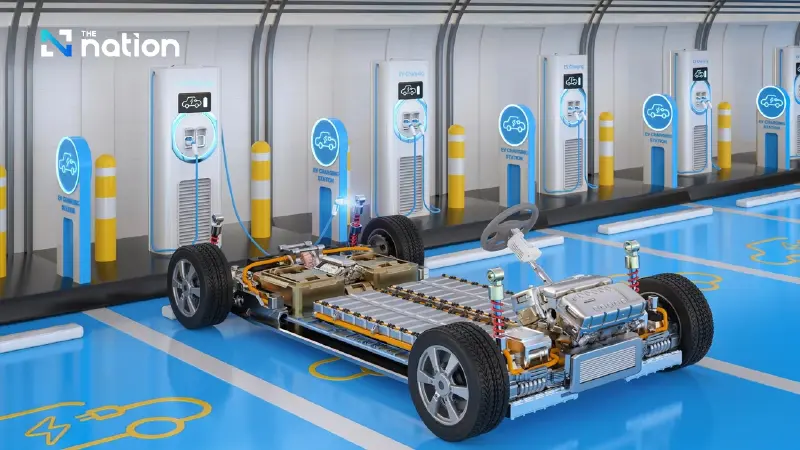


As EV use grows in Thailand, overseas laws show how countries regulate batteries across their full life cycle, from production and tracking to reuse and recycling.
The use of electric vehicles (EVs) in Thailand has grown significantly. In 2010, only 12,349 newly registered electric vehicles were recorded, rising to 232,754 in 2024. EV batteries generally reach the end of their useful life within about 8-10 years. Research by the Thailand Development Research Institute (TDRI) indicates that by 2031, accumulated battery waste from electric vehicles could reach around 38,050 tonnes, rising to 168,590 tonnes by 2035.

Nattaphorn Buayam, a policy researcher on the bio, circular and green economy at the Thailand Development Research Institute (TDRI), said that although electric vehicles are widely seen as a key solution for a low-carbon world, the battery — the core component of an EV — remains a major unresolved challenge.
EV batteries are classified by the United Nations as Class 9 dangerous goods, meaning they carry risks of ignition and hazards during transport or storage. The transition to clean energy does not end with use, but must also cover the “end point” of these technologies.
At present, Thailand does not have specific legislation directly governing batteries for electric vehicles or energy storage systems (ESS).
A look at overseas laws and measures governing batteries
European Union: a leader in strict and comprehensive regulation
The European Union has a legal framework covering the entire battery life cycle, including:
Battery Regulation (EU) 2023/1542, which came into force in 2024 and expands extended producer responsibility (EPR) to cover producers, importers and manufacturers of equipment containing batteries.
Battery Passport, which requires a digital battery passport system by 2027 to track information on origin, raw materials, capacity and recycling.
Recycling targets, which set minimum recycled material content in new batteries, such as cobalt, lithium and nickel, as well as clear targets for the collection of used batteries.
The EU also has other related laws, such as the WEEE Directive for electronic waste and the ELV Directive for end-of-life vehicles, to promote designs that are easy to dismantle and support the reuse of batteries in “second-life” applications.
China: a comprehensive tracking and management system
China is a major battery producer and has a management system focused on traceability, producer responsibility and recycling standards.
It enforces the EPR principle, requiring carmakers to take primary responsibility for battery recycling. It also has specific industry standards, such as GB/T 44132-2024 for managing recycling processes.
China also operates a national traceability platform to track battery information from production to recycling. Batteries are assigned identification codes, with 24-digit codes for new batteries and 19-digit codes for reused batteries.
The country supports the reuse of degraded EV batteries in other applications, known as cascade use, before materials are extracted through recycling. When EV batteries reach the end of their vehicle life, they are collected and sorted. If they still have sufficient performance, they are passed on to echelon utilisation companies to be processed for reuse.
For example, used batteries from electric vehicles may be repurposed as stationary energy storage systems (ESS) or used in electrical devices requiring lower power capacity. This approach forms part of the circular economy principle, helping extend the useful life of resources, reduce waste and reduce demand for new raw materials from mining.

South Korea: resource circulation laws
South Korea’s EEEV Act enforces resource circulation from electrical and electronic equipment and vehicles, requiring producers to take responsibility for setting up funds and recycling systems.
The Eco-Assurance System (ECOAS) provides a comprehensive electronic waste management system, covering everything from product design to recycling.
Waste resource collection centres are operated by the Korea Environment Corporation (KECO), which is tasked with collecting and recycling waste resources in cooperation with the private sector.
Japan: advance recycling fees
Japan has laws promoting the efficient use of resources, as well as legislation on the recycling of small electronic waste.
Under its recycling fee system, buyers of electric vehicles must pay a recycling fee in advance when purchasing the vehicle.
A group of seven Japanese companies is also developing a Battery Passport and plans to launch it by 2027 to improve transparency of information throughout the supply chain.
Singapore: resource sustainability law
Singapore’s Resource Sustainability Act (RSA) 2019 designates EV batteries as products for which producers and importers must bear waste management costs through the Producer Responsibility Scheme (PRS).
It also requires that at least 50-70% of EV battery materials by weight be recycled.
United States: a decentralised system
At the federal level, the United States uses the Resource Conservation and Recovery Act (RCRA) to regulate batteries as hazardous waste, along with the Battery Act of 1996, which covers rechargeable batteries and batteries containing mercury.
At the state level, several states, including California, New York and Oregon, have introduced their own EPR laws. These require battery take-back measures and prohibit rechargeable batteries from being disposed of with general waste.
Overall, the most common mechanism used overseas is extended producer responsibility (EPR), which requires producers to take responsibility for the waste generated by their own products.
This is combined with tracking technologies such as the Battery Passport to build a sustainable circular economy, reduce the burden on the public sector in managing hazardous waste and promote an end-to-end management system from upstream production to downstream disposal.
